Wire-Laser Metal 3D Printer - DED -
What is Additive Manufacturing?
Definition, Types and Processes, Technologies

Wire-Laser Metal 3D Printer - DED -
Mitsubishi Electric
*DED : Directed Energy Deposition
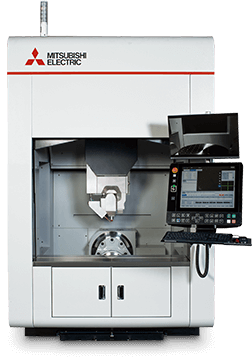
This page provides an overview of representative technologies used in metal 3D printing, also known as additive manufacturing, with images and videos. It also includes examples of builds produced using Mitsubishi Electric's wire-laser metal 3D printer using the DED process.
Contact us | Wire-Laser Metal 3D Printer - DED - | Mitsubishi Electric*Mitsubishi Electric's wire-laser metal 3D printers are currently sold in Japan and the United States.
1. What Is Additive Manufacturing?
A metal 3D printer is a machine that creates a desired three-dimensional shape by melting or sintering metal materials such as stainless steel and titanium with a Laser, Electron beam, Arc, or Plasma and building them up layer by layer. While there are also “resin 3D printers” that produce objects from plastics and other resin materials, metal materials require much more energy than resin and are more difficult to build stably due to greater thermal effects and other challenges. Recent technological advances in metal 3D printers have led to remarkable improvements in build accuracy and speed, and they are beginning to spread across a wide range of manufacturing industries. Industries like automotive, aerospace, power generation, and medical, are realizing new manufacturing methods and forms of production that were previously difficult to achieve. Metal 3D printers are also referred to as additive manufacturing or 3D printing.
2. Types and Characteristics of Additive Manufacturing
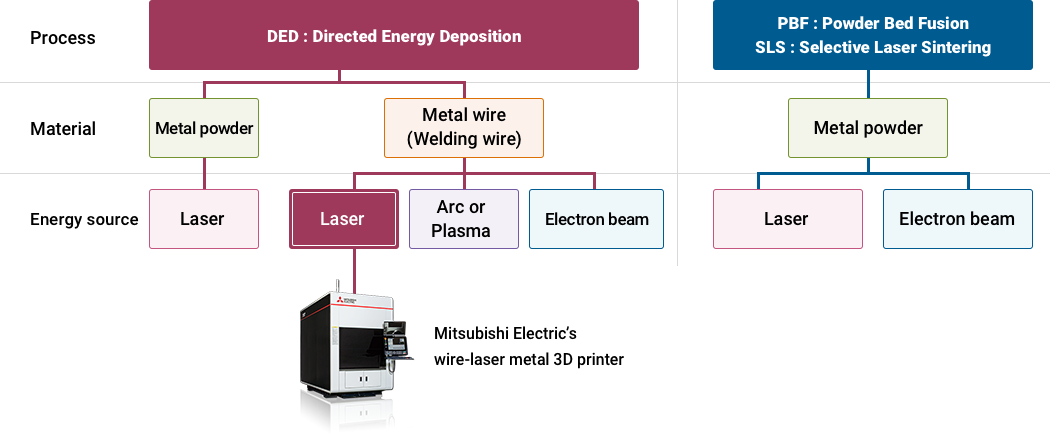
Representative processes used in metal 3D printing include DED (Directed Energy Deposition), PBF (Powder Bed Fusion), MEX (Material Extrusion), and BJT (Binder Jetting). This section introduces DED and PBF. The materials used for building can be broadly classified into metal powders and welding wire, while heat sources used for melting or sintering include Laser, Electron beam, Arc, or Plasma.
- *PBF may also be referred to as SLS (Selective Laser Sintering).
What is Directed Energy Deposition (DED) 3D Printing?
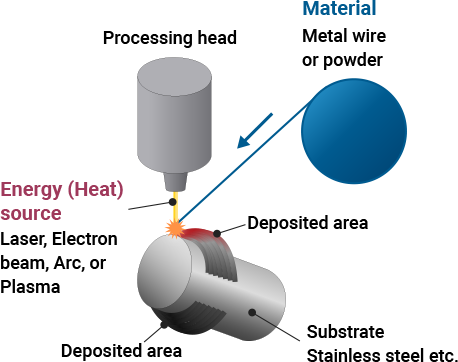
Directed Energy Deposition (DED) is a metal additive manufacturing process where an energy source—usually a Laser, Electron beam, Arc, or Plasma —is directed toward a substrate, melting wire or powder feedstock and building up material layer-by-layer to create new parts or repair existing ones.
Advantages
- 1.Fast build speed, ideal for large-scale parts
- 2.As an additive process applied to an existing part, it also enables repair by build-up and joining dissimilar metals
Disadvantages
- 1.Not well suited for producing complex geometries
- 2.Post-processing, such as machining and heat treatment, is required after building
*Mitsubishi Electric's wire-laser metal 3D printers are currently sold in Japan and the United States.
Please note that this product falls under the items listed in Japan's Export Trade Control Order, Appended Table 1, and the Foreign Exchange Order.
When exporting or providing the main unit, dedicated parts, or the machining control program for this product, approval from Japan's Ministry of Economy, Trade and Industry (METI) is required.
Accordingly, if you wish to use this product outside Japan, please be aware that it may take additional time for us to respond to inquiries.
Comparison of DED Processes by Build Material and Energy Source
DED processes are broadly categorized by whether they use welding wire or metal powder as the build material, and whether they use a Laser, Electron beam, Arc, or Plasma as the heat source. The main characteristics of each process are shown below.
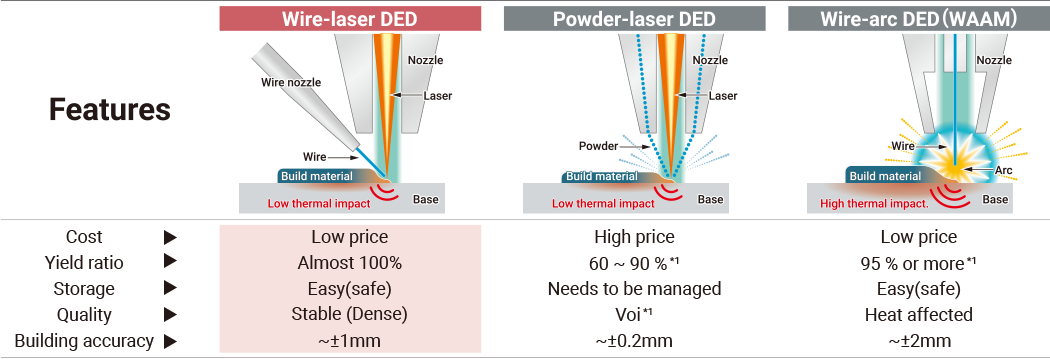
- *1 : “Build utilization rate” indicates the proportion of supplied material that is actually incorporated into the finished build. Depending on the process, this rate may decrease if some of the material is dispersed or lost during fabrication.
PBF (Powder Bed Fusion)
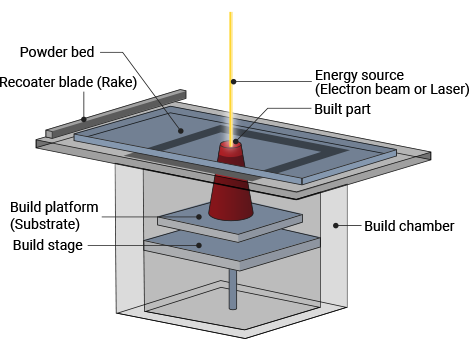
PBF is a process in which metal powder is spread in layers, the target area is exposed to heat energy such as an electron beam or laser to melt and solidify the metal, and the part is built up layer by layer through repeated powder spreading and fusion. It is the most common process used in metal 3D printing.
Advantages
- 1.Complex geometries can be built
*including complex internal structures such as lattice structures
Disadvantages
- 1.Cost effectiveness is difficult to achieve unless the part design is revised specifically for metal 3D printing (DfAM)
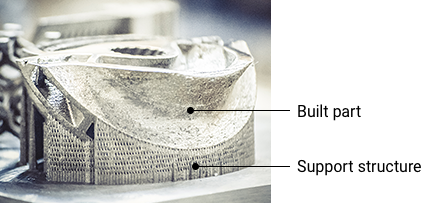
*DfAM: Design for Additive Manufacturing - 2.Support structures are required to prevent the built part from collapsing
Comparison between the DED and PBF processes
The DED and PBF processes have the following characteristics. The appropriate process should be selected based on the application and purpose.
| DED process | PBF process | ||
|---|---|---|---|
|
Build
perform ance |
Build size |
Ideal for large parts >Best for small to medium parts |
|
| Build speed |
Shorter build times >Longer build times |
||
| Density |
High density can be achieved >Pores may be more likely to form |
||
| Dimensional accuracy / geometry |
Less suited to highly complex geometries <Well suited to highly complex geometries |
||
|
Controll
ability |
Material cost |
Lower >Higher |
|
| Safety |
Easier to handle >Requires caution due to |
||
| Handling / management |
Easier to manage >Requires control of powder humidity |
||
|
Scope
of application |
Best-fit application |
Ideal for near-net-shape builds <Ideal for complex part fabrication |
|
| Replacement of existing technologies |
Can serve as an alternative to welding >Generally limited to additive |
||
| Dissimilar metal joining |
Relatively easy >Requires specialized equipment |
||
*Mitsubishi Electric's wire-laser metal 3D printers are currently sold in Japan and the United States.
Please note that this product falls under the items listed in Japan's Export Trade Control Order, Appended Table 1, and the Foreign Exchange Order. When exporting or providing the main unit, dedicated parts, or the machining control program for this product, approval from Japan's Ministry of Economy, Trade and Industry (METI) is required.
Accordingly, if you wish to use this product outside Japan, please be aware that it may take additional time for us to respond to inquiries.
3. DED process | Features of Mitsubishi Electric Metal 3D Printers
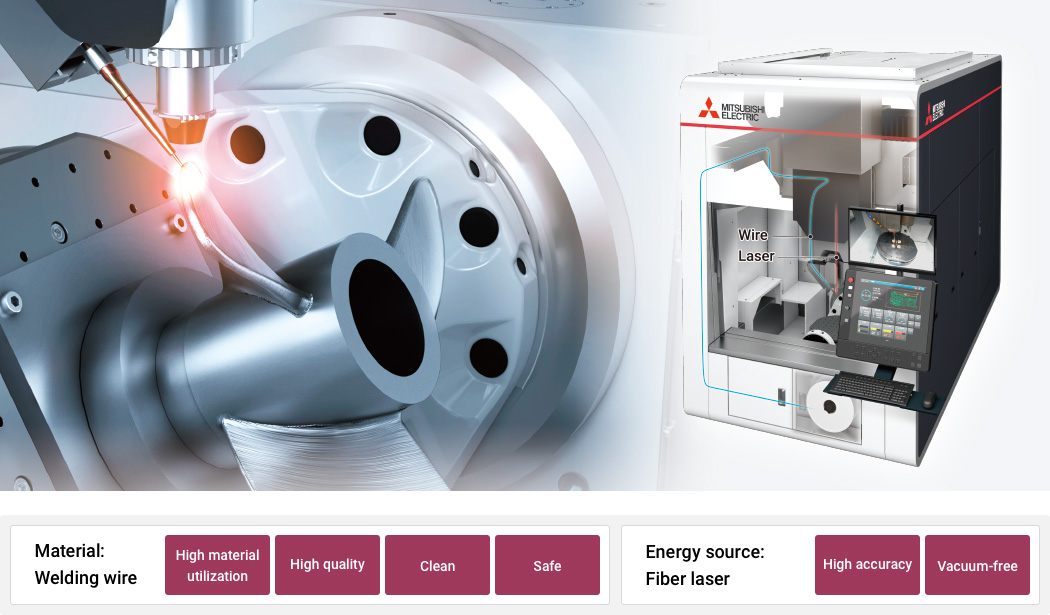
Mitsubishi Electric launched the AZ600 wire-laser metal 3D printer in March 2022. This DED system uses welding wire as the feedstock and a laser (fiber laser) as the heat source.
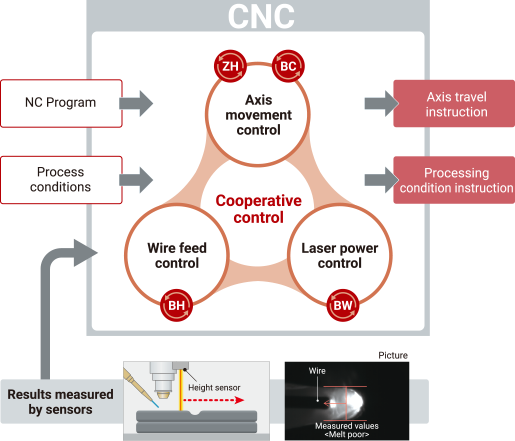
AM process control
Coordinated control that automatically compensates in real time automatically for the axis movement,
wire supply volume, and the laser power based on information from various sensors.
*Mitsubishi Electric's wire-laser metal 3D printers are currently sold in Japan and the United States.
Please note that this product falls under the items listed in Japan's Export Trade Control Order, Appended Table 1, and the Foreign Exchange Order. When exporting or providing the main unit, dedicated parts, or the machining control program for this product, approval from Japan's Ministry of Economy, Trade and Industry (METI) is required.
Accordingly, if you wish to use this product outside Japan, please be aware that it may take additional time for us to respond to inquiries.
4. DED process | Build Examples with Mitsubishi Electric Metal 3D Printers
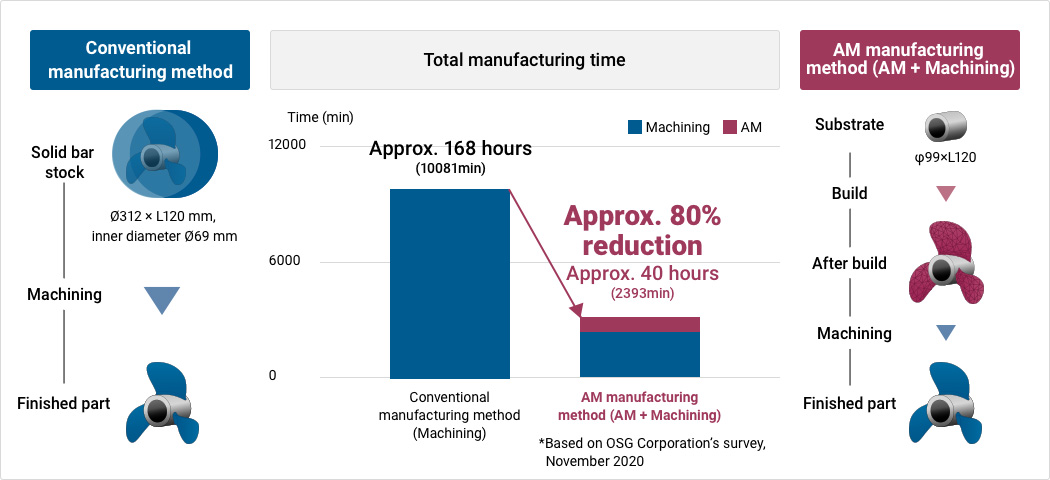
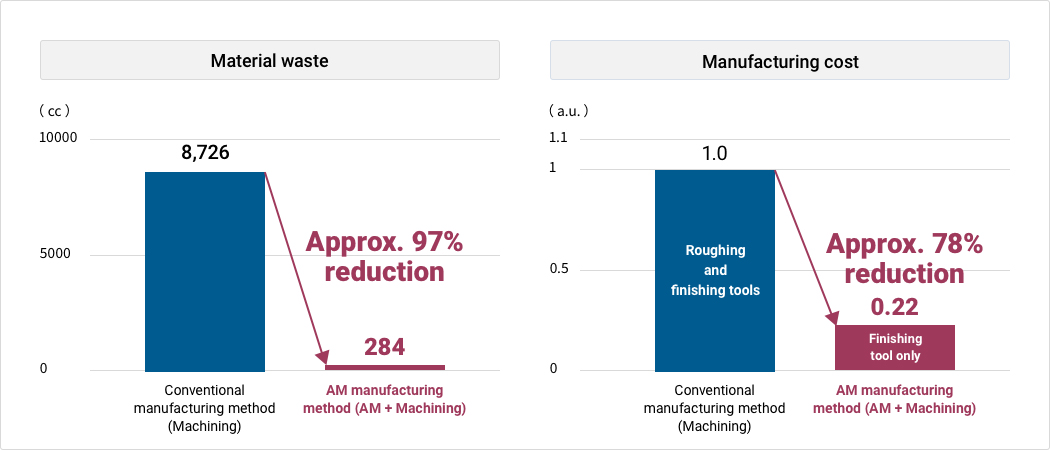
Additive (Near net shape)
Metal 3D printers improve production efficiency by limiting 3D printing to the necessary areas and manufacturing by cutting.
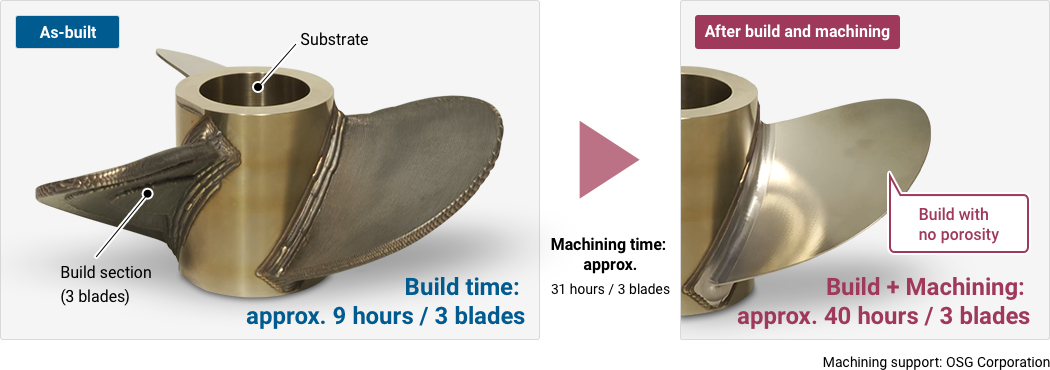
Marine propeller
- Time : 8h 47min.
- Size : Ø300(11.8) × L120(4.7)mm(inch)
- Substrate : Stainless steel(SS) 304
- Wire : Stainless steel(SS) 17-4PH
Repair
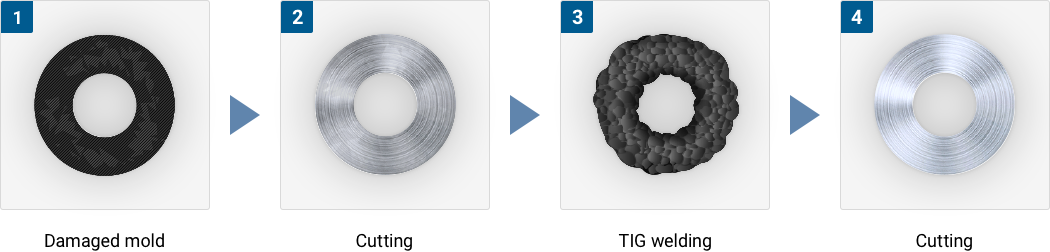
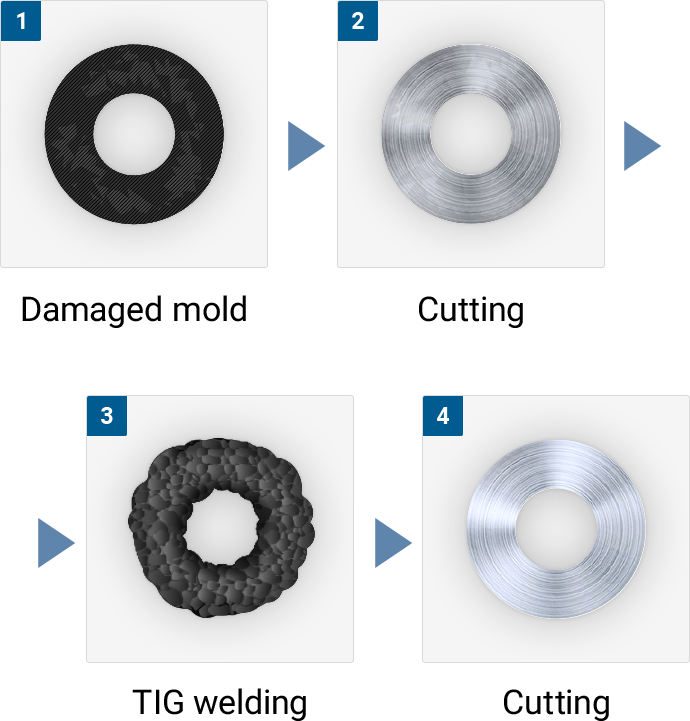
Traditionally, skilled workers repair molds by welding. Metal 3D printers automate the repair process and stabilize quality.
Conventional
AM
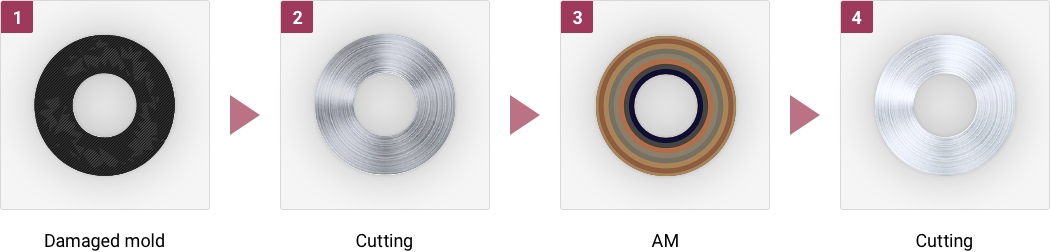
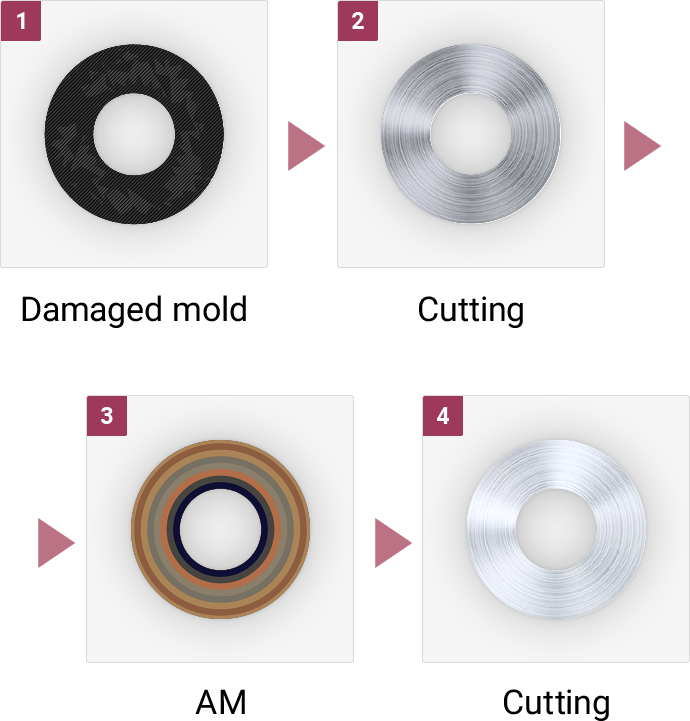
Conventional method → work time reduced by approximately 85% with a metal 3D printer.
(The reduction shown is based on one example and varies depending on the TIG welder and the build requirements.)
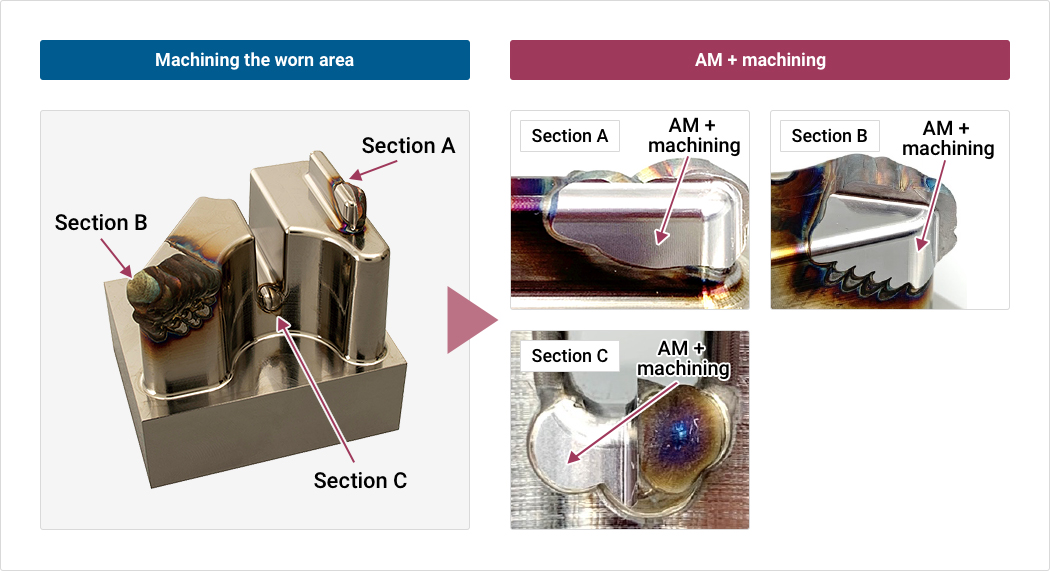
Die casting dies
- Time : 10min.
- Size : W57(2.2) × D50(2.0) × H52(2.0)mm(inch)
- Substrate : H13 Tool steel(TS)
- Wire : DHW™
Welding
Wire laser DED “AZ600” realizes mechanization of the welding process that used to be handled by skilled workers.
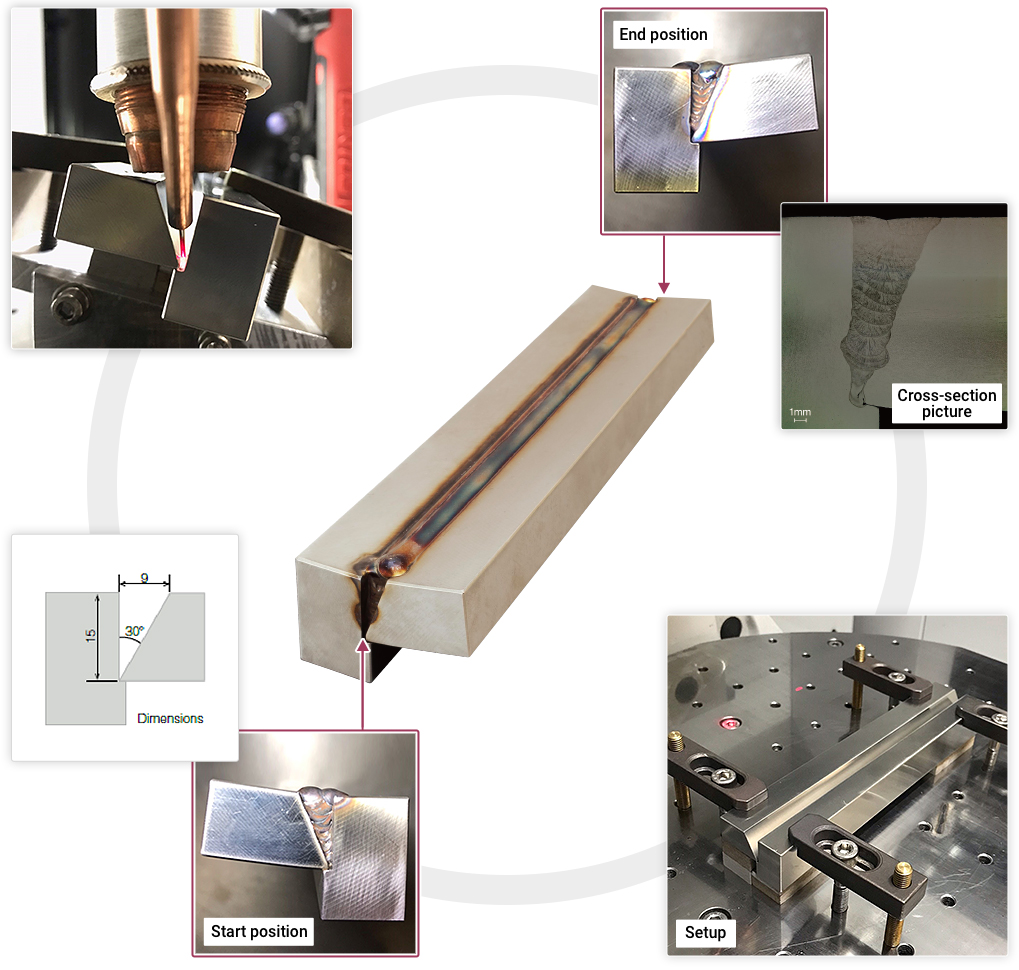
Groove weld
- Time : 10min.
- Size : L200(7.9)mm(inch)
- Substrate : Stainless steel(SS) 304
- Wire : Stainless steel(SS) 308L
Dissimilar Material Deposition (Coating)
Dissimilar metal modeling increases the degree of freedom in product design and creates new added value.
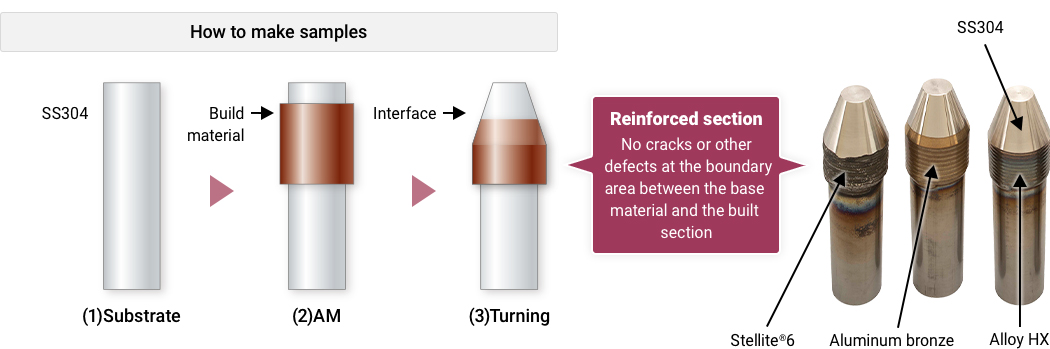
| Stellite®6* | Aluminum bronze | Alloy HX | Alloy 718 | M2 High Speed Steel |
|---|---|---|---|---|
|
|
|
|
|
- *Stellite is a registered trademark of Kennametal Inc.
Wire list
- Iron : Mild Steel, Maraging Steel(18Ni), H13 TS, M2 HSS, DHW™
- Stainless : SS 308L, SS 316L, SS17-4PH, SS 420J2
- Nickel : WASPALOY™, Alloy 718, Alloy 625, Alloy HX
- Copper : Aluminum Bronze, Cupronickel
- Cobalt : Stellite® 6, Stellite® 21
- Titanium : Ti-6Al-4V
- Aluminum : A5000(A5183, A5356) (Additional option: special wire feeder for aluminum alloy, is needed)
- *WASPALOY is a registered trademark of United Technologies Corporation(UTC). Stellite is a registered trademark of Kennametral Inc.
- *Please contact us for materials not listed here.

5. Video Library
Watch our Mitsubishi Electric's Wire-Laser Metal 3D Printer in action. Experience the world of metal AM (Additive Manufacturing).