

World roundup

6th Mitsubishi Electric Cup India: Where Future Engineers Meet Real-World Automation
Published in Augusta 2026 [2 parts]

Part 1: Supporting Sustainable Development and Responsible Engineering
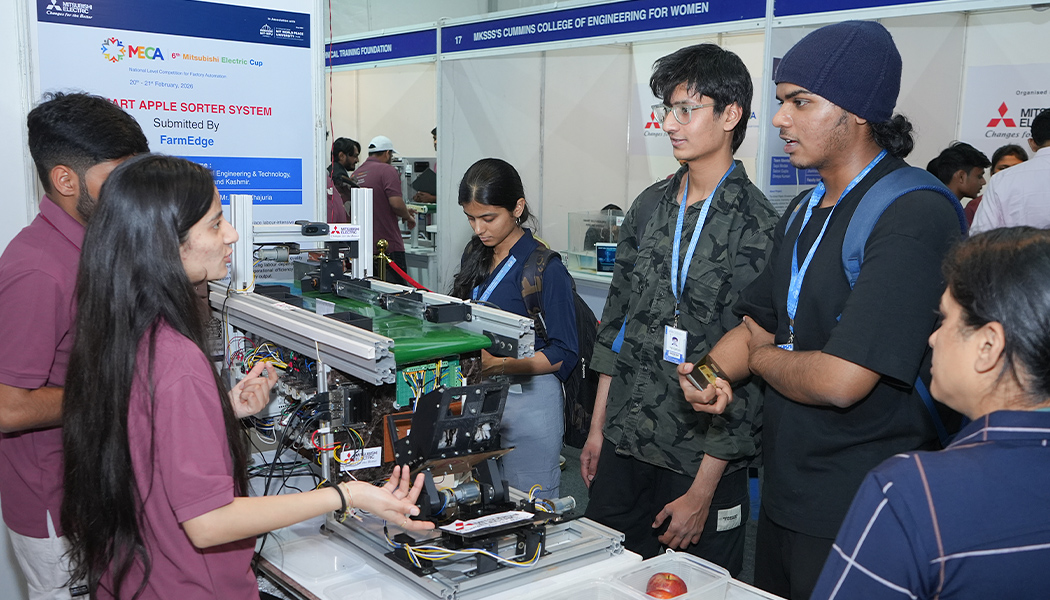
The 6th edition at Pune
Returning after a five-year gap, the 6th ME Cup India, themed ‘Automating the World through Digital Innovation,’ received 288 proposals from 140 institutions spanning 19 states and 2 Union Territories across India. After an initial review, 35 teams were shortlisted to compete in the finals.
“It was a fantastic journey,” said Dr. Ganesh Kakandikar, Dean of Innovation, Start-ups and Collaborations at MIT-WPU and Convener of the 6th ME Cup India, describing the event.
“In July 2025, we received the proposal from Mitsubishi Electric India about hosting the ME Cup India 2026 in association with our university in Pune. The moment I understood the concept and its objectives, I immediately agreed to host it,” he said. “I think this is a very nice platform for students to work with mentors from industry, who are experts and professionals, as well as their teachers, and to come up with their own concepts. Many times, what happens is that students have many bright ideas, but unfortunately their university or institution may not have all the facilities to provide the right tools and equipment to create them into prototypes.”
- Mr. Rohan Gavali, Program Chair and Senior Manager of Factory Automation & Industrial Division, Mitsubishi Electric India, explained that the core vision of the Mitsubishi Electric Cup is to develop engineers who can shape a more advanced and sustainable industrial world by:
- Building students’ creativity, teamwork, and practical engineering skills through hands-on automation projects.
- Bridging classroom theory with real-world engineering, and developing practical skills in design, implementation, and problem-solving.
- Supporting sustainable development and responsible engineering, in line with Mitsubishi Electric’s focus on energy efficiency and improved environmental performance.
For the grand finale, 34 teams presented their projects for final evaluation before a panel of judges drawn from industry and academia.
- The judging panel comprised:
- Mr. Sunil Mehta, Associate Vice President, Mitsubishi Electric India Pvt. Ltd.
- Dr. Arvind AR, DGM-PP, Ashok Leyland
- Mr. Atul Patil, Global Controls Engineering Director, Wipro PARI
- Mr. Rahul Bramhankar, Head of Central Manufacturing Engineering, Mahindra
- Dr. Sanjaykumar Patil, Professor, Department of Instrumentation and Control, COEP Technological University, Pune
- Dr. Pramod Kanjalkar, Senior Academician, Researcher, Innovator, and Mentor, Vishwakarma Institute of Technology
- Mr. Anil Purohit, Technical Consultant and Ex Founder, Leonardo Automation
- FProf. Ravikiran Deshmukh, Professor, BITS Pilani
The inaugural ceremony formally declared the competition open. Mr. Atsushi Takase, Managing Director, Mitsubishi Electric India, congratulated all the teams gathered for the finals. “Globally, Mitsubishi Electric organizes this competition under the MECA banner – MECA Competition. MECA also stands for Mission, Experience, Communication, and Achievement: values that shape this platform for young talent,” he said.
Referring to the company’s core belief that technology should make life better for people and society, Takase added: “Our business direction is strongly focused on automation, digitalization, and sustainability. The future depends on people, especially young engineers, who will shape the future of industry. This is the core vision behind MECA.”
The projects
The Mitsubishi Electric Cup is designed to closely mirror real-world industrial environments, where constraints such as cost, efficiency, safety, scalability, and sustainability must be addressed simultaneously. Participants are required to develop solutions that are not only technically robust but also commercially viable, encouraging an entrepreneurial approach to engineering problem-solving.
Following the inaugural ceremony, the exhibition area saw plenty of engagement from visitors, industry representatives, and MIT-WPU students, who explored a wide range of solutions for industrial automation, agriculture, MSME applications, and public utilities.
- Among the projects showcased were:
- Smart Energy Management System by Team EdgeSmart from Vellore Institute of Technology, integrating conveyor and HVAC operations using PLC-based control, sensors, and VFD-driven optimization
- Intelligent PLC Programming Assistant by Team Nexus AI from Sona College of Technology, a platform converting natural language inputs into structured PLC logic
- Spectra Scan – Automated Gantry System by Team CON-SOL-E 5.0 from Nirma University, designed for automated paint defect detection in automotive manufacturing
- PCB Prototyping Machine by Team SVVV MITSU MINDS from Shri Vaishnav Vidyapeeth Vishwavidyalaya, leveraging CNC systems for rapid PCB fabrication
- AI-driven Smart Agricultural Robot by Team Phoenix from Bannari Amman Institute of Technology, enabling autonomous marigold harvesting and crop monitoring
These represented only a fraction of the innovation on display, with all 34 projects demonstrating strong problem identification, technical depth, and application-oriented design. Additional solutions addressed applications including automated sorting systems, precision irrigation and fertilization, and sustainable waste management through recycling-based innovations.
The evaluation process involved detailed assessments by the jury, who examined each project for technical feasibility, robustness, and commercial viability. Following individual evaluations and collective deliberation, the winners were decided.
- Introduction: Report on the MECA 2026 student competition in India
- Part 2: Strong Capabilities in India Contribute Directly to Global Excellence