

The Inside View

Staying an “Outsider”: Innovation from an “Unconventional Organization” at Nagoya WorksRyuhei Sumisaki
First Published in Japanese in May 2026 [2 parts]
Part 1: “New Combinations” Powered by Curiosity and Assets: The Practical Philosophy of an “Unconventional Organization”
The “Unconventional Organization” Born from Core Businesses
Mitsubishi Electric’s Factory Automation (FA) systems business, which is led by Nagoya Works, is one of the company’s core businesses. From programmable controllers and servo motors to industrial robots, its products support manufacturing operations worldwide and have maintained a competitive advantage going back many years. However, markets mature and eventually reach a turning point. When improvements to existing products are no longer enough to sustain growth, the question becomes how to create the next core business.
Nagoya Works celebrated its 100th anniversary in 2024, but that milestone, triggered a sense of alarm: “If we continue on this path, can we last another 100 years.” This prompted a momentum for change. Riding that wave, the Open Innovation Department (Nagoya OI), which is responsible for creating new businesses in the FA field, was established as a department in April 2024. As of November 2025, when this interview was conducted, the department had about 30 employees. It is comprised of a business planning group that comes up with new ideas in the “zero to one” phase, and two business development groups (the generative AI team and the mobility platform team) that are responsible for scaling steps from “one to ten”. It also collaborates with development centers in North America and Europe, forming an organization of about 60 people including both domestic and international operations.
The department has no existing products, and is not forced to meet sales targets. Instead its mission is to create value the world has yet to see and to plant the seeds of businesses that will become the next pillars of the company.
In the past, the standard business approach of Mitsubishi Electric was to bring fully finished products to market. This approach reflects a corporate culture that prioritizes dependability, but it can sometimes make it difficult to embrace new challenges.
In contrast, Nagoya OI follows the mantra: “sell it before you make it.” Workers share ideas internally, even before the ideas are fully formed, gathering collaborators and co-creating with partners to nurture the seeds of new businesses.
By consciously taking a non-traditional approach and intentionally remaining an unconventional “outsider organization,” the department seeks to act as a stimulating force within the company.
The manager leading this “unconventional organization” is Ryuhei Sumisaki, who took on this role in 2024. Sumisaki himself has taken an unusual career path. He began in R&D for embedded systems and software infrastructure. This led to managing social infrastructure projects, launching the Boston office, expanding the solution businesses into the Chinese market, and serving as the senior director of the North American Development Center. His work has spanned a wide range, from R&D to the forefront of solutions sales.
For an organization that fits no preset mold, an unconventional leader is a good fit.
Innovation Isn’t Born from Needs: Creating Value from “New Combinations”
Sumisaki’s view of innovation was shaped by his experience leading new business creation as the senior director of the North American Development Center. As he pursued co-creation with regional startups and partner companies, he arrived at a certain realization: Innovation is not about creating something from scratch. Value is produced by recombining existing elements in new ways. This idea is based on the “new combinations” theory by Joseph Schumpeter, an Austrian economist and pioneer of innovation theory. Nagoya OI defines innovation as these “new combinations.”
How do “new combinations” come about? Sumisaki sees many corporations as “static, balanced, and rational” organizations. While stability is often a strength, it can make it difficult to generate change or serendipity (fortuitous accidents) to happen. In fact, it is the “unconventional organizations,” the ones that are “dynamic, decentralized, and irrational,” that spark unexpected chemical reactions. Sumisaki’s belief is that for large corporations to spawn innovation, they need an “outsider” or “outside element” that disrupts the existing equilibrium.
The concept of “new combinations” is also evident in the department’s methods for business development. A traditional approach to new business development begins with identifying customer needs: What concerns do customers have? What challenges are they facing? The textbook approach is to listen carefully to the issues and then propose solutions to address them.
Sumisaki, however, avoids using the word “needs.” When customers are asked “What problems are you having?” the answers are often issues that have already surfaced. There is a quote often attributed to Henry Ford, the American entrepreneur and founder of the Ford Motor Company: “If I had asked people what they wanted, they would have said faster horses.” Starting with only the needs that customers can clearly articulate tends to keep a business on its existing trajectory. Moreover, addressing issues that have already surfaced is where the company’s existing business departments excel, drawing on years of experience and a proven track record. It is because of this strength that Nagoya OI is freed up to explore new areas. So, what should Nagoya OI focus on? According to Sumisaki, it’s “areas that are not even recognized as needs” — the areas customers themselves have not yet noticed, and do not even think “I wish something like this existed.”
For this reason, Sumisaki prefers to use the word “assets” instead of “needs.” By recombining the assets held by customers, partner companies, and Mitsubishi Electric —technology, data, workplace know-how, networks, and the like —it becomes possible to create value that no one had ever imagined. These are also examples of “new combinations.” Once these seeds of value are defined, how can they be nurtured? Many companies have new business departments that can cover the “zero to one” phase but lack the platforms to carry ideas further, leading promising initiatives to vanish into thin air. Sumisaki has sensed this challenge since his days as the senior director of the North American Development Center. For this reason, Nagoya OI handles the entire process, starting from discovery to business development. Customers use early-stage products, which are continuously refined until the customers say they would be willing to pay for them. Sumisaki believes the department’s true purpose lies in this “one to ten” process of turning promising ideas into viable businesses.
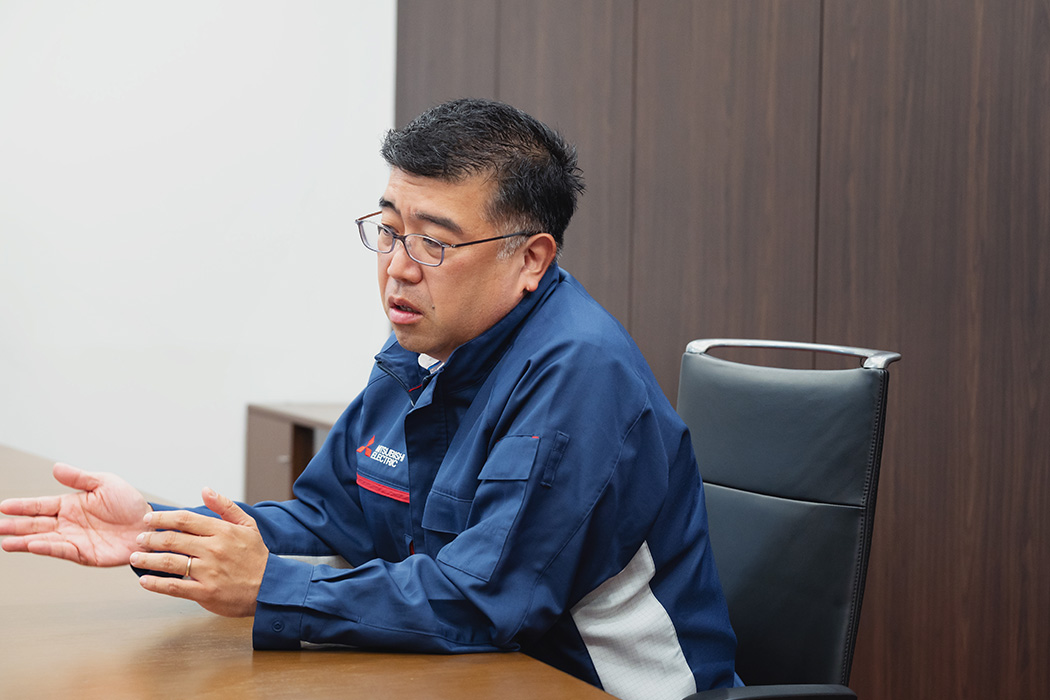
“We don’t just stop at the ‘zero to one’ phase. We also take care of steps ‘one to ten.’ We want to check how it fits into the product market before passing it on to the business department.”
Making “Interest” the top Priority: A Major Shift in Organizational Policy
An organization that can create “new combinations” and nurture them through stages “one to ten”: How is Sumisaki working to create that? When Sumisaki first assumed his position, he felt both genuine surprise and a certain sense of dissatisfaction with the department’s results to date. At the time, Nagoya OI was pursuing innovation in a methodical way, and it had already achieved more than had been apparent from the outside. Even so, Sumisaki could not shake the feeling that something was missing. “We should be able to create a much bigger wave,” he recalls. The key, he says, lies in what he calls “what’s interesting.”
By “interest”, Sumisaki refers to things that are engaging and catchy. This stems from his belief that “the most important thing in new business development is whether you can attract collaborators.” No matter how strong an idea may be, it will not move forward unless others become involved. That includes support from internal colleagues, understanding from management, empathy from customers, and collaboration with partner companies. Every project begins with a feeling, “I want to work with these people” or “I want to be part of this.” Without that element of appeal, people will not be drawn in. And without people, a business cannot take shape. For this reason, before evaluating feasibility, Sumisaki first asks, “Is it something interesting?”
Because of this, he chose to move away from the previously-established “efficient process that enabled anyone to pursue innovation.” Instead, he encouraged team members to prioritize “your own unique approach that only you can achieve,” and adopted a policy that maximized individual freedom. From the start of his tenure, Sumisaki made it clear “we will change the approach.” He regularly revises policies in response to the constantly changing environment and aligns the team on the new direction each time. It can be challenging to keep up, but Sumisaki calls that an “upward spiral.”
“Even if we return to an earlier policy, the vantage point is different the second time around. You cannot climb a mountain in a straight line—you circle around, but you steadily gain altitude.”
In his first year after taking his new role, Sumisaki intentionally steered the department toward “freedom.” Now he is preparing to move into the next stage: from freedom back to methodology. But this is not a return to the old way of doing things; by pointing out the patterns of success uncovered through trial and error, he is turning them into something that anyone can follow. The second rotation of the upward spiral is about to begin.
Maximizing the “Value” from Growth: A Philosophy for Nurturing People
Another area in which Sumisaki places importance is the development of talent. Simply telling people to produce results does not always work, but when you develop people, results naturally follow. This is a lesson Sumisaki learned during his time as senior director of the Development Center in North America. An organization’s success can only be the sum of the growth of its individuals.
When evaluating individual growth, Sumisaki emphasizes what he calls “differential value” (the amount of change). Rather than focusing solely on the absolute value of what a person has currently achieved, he looks at the rate of their change, meaning how far someone has come and their potential for further growth. For both individuals and organizations, growth follows an S-curve. Entering a new area of growth can lead to a rapid rise at first, but after a period of acceleration, there inevitably comes a plateau. The movement from that point determines the next stage of growth.
For this reason, Sumisaki often tells his team members this: “When your growth begins to slow, take a step into a new area.” The goal is to maximize employees’ “differential value” in order to pursue the greatest possible development during the limited time they spend with Nagoya OI. The composition of the department’s members is another key factor. Nagoya OI brings together designers of various products along with people from a wide range of backgrounds, including researchers and production engineers. It is not meant to be a homogeneous or evenly balanced group of individuals. The organization is driven by personnel with standout strengths that may not always fit within existing evaluation frameworks. These diverse and unconventional personalities are essential for continuously generating “new combinations.”
So how can an organization built on individual sensibilities and freedoms keep delivering results? One answer lies in what Sumisaki calls his “Manager’s Diary.” Each day, he openly shares his actions and thoughts on the department’s internal chat app: whom he met and where, what they talked about, and what he took away. He also shares with the whole team the types of information that only a department head would learn, such as comments from senior management, industry trends, and feedback from various sites. “It keeps me from having to repeat the same thing to every team member thirty times,” says Sumisaki with a laugh. To help the team understand why he made a certain decision when he did, or what made him think a certain way, Sumisaki has the team imagine for themselves the context of his thinking so that they develop a shared sense of how he, as their manager, would approach decisions.
When making such decisions, Sumisaki places greater weight on intuition than on logic. He processes comments from senior management, industry trends, and feedback from the field to determine when “the time is right.” Such intuition, he believes, can only be cultivated through experience. That is why he shares his observations so that his team will develop a similar sensibility. By visualizing the inner mind of the leader, the goal is to raise the overall level of decision-making across the organization. Sumisaki knows that he will not be a leader forever. The top-down leadership phase is limited to an organizations early stages; once it reaches a certain maturity, responsibility is handed to the next generation. For this reason, he has been aiming from the start to create an organization that can go on without him.
Products&Solutions
