

The Inside View

Staying an “Outsider”: Innovation from an “Unconventional Organization” at Nagoya WorksRyuhei Sumisaki
First Published in Japanese in May 2026 [2 parts]
Part 2: “Disruptors” Spread Positive Stimuli: Co-creation for Faster Chain Reactions
Don’t Set a Goal; Act on Your Curiosity
Sumisaki is careful not to define goals too precisely. In his view, setting objectives early can limit the diversity of innovation. Instead, he prefers to keep all possibilities open. Rather than establishing goals and setting detailed plans in advance, his approach is to take action first. He believes the action reveals what is important.
A case in point is the Fun Factory. This initiative was aimed at improving worker engagement by providing feedback that incorporates game-like elements at the manufacturing site. What makes the project especially interesting is how it began with an extremely simple idea: “Wouldn’t it be interesting to combine gamification — the application of game elements and feedback mechanisms into non-game areas such as manufacturing — with factory automation?” This led to a collaboration with startups, pilot trials at their own factory, media attention and a showcase at CEATEC, one of Japan’s largest digital innovation exhibitions.
Looking back, the Fun Factory initiative aligned closely with broader trends in the manufacturing industry. For example, the World Economic Forum (WEF) identified “talent” (meaning workforce development) as one of the five key areas the sector should focus on going forward. Sumisaki himself has also noticed a shift in priorities through his talks with executives at various companies. The higher one moves in management, the more aware one becomes of people-related issues, such as personnel retention, engagement, and employee well-being. What began as an initiative driven by “that looks interesting” expertly addressed an area that had not previously received sufficient attention in the factory automation industry.
It’s the result not of a planned strategy, but a sense of curiosity, with its significance becoming clear in hindsight. Sumisaki compares it to a constellation.
“First, you have to create a number of shining stars with the potential to become first-magnitude stars. Drawing the lines that connect them into a constellation can come later.”
In other words, you can’t make a constellation without stars.
A similar success story can be seen in the generative AI business. A conversation with a customer sparked the idea of automatically generating ladder programs, the control programs used at manufacturing sites. By prioritizing action rather than spending time on planning, the concept quickly took shape as one of the most advanced initiatives within the company. This led to its demonstration at IIFES, a major international industry exhibition for automation and measurement technologies.
While the department may not set concrete goals, that doesn’t mean there is no vision for the organization. Plans are being considered to launch a third business development group, following the existing initiatives in generative AI and mobility platforms. Once a group is on track, it “graduates” from the organization and moves toward commercialization. The space that opens up is used to cultivate new seeds of ideas. Sumisaki believes the continuous cycle of renewal is the ideal form for an organization.
The Chain of Innovation and Roles of Co-creation Partners
Fun Factory and the generative AI project are both the products of co-creation with startups and customers. So why did they choose to partner with Mitsubishi Electric?
First, Mitsubishi Electric has touchpoints with customer manufacturing sites around the world. Also, it brings extensive technology and expertise developed over many years. Furthermore, through collaboration with corporate venture capital (CVC), it has a system for accessing external resources. By combining these assets, it can generate value at a scale that would be difficult for a startups to achieve alone.
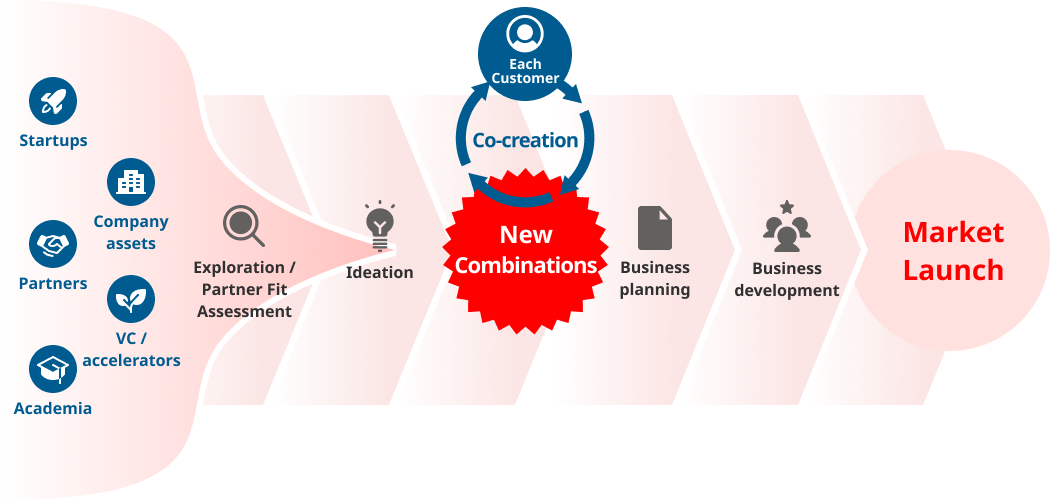
Through all this co-creation, Sumisaki has developed a stronger sense of the “chain of innovation.” Joseph Schumpeter, who proposed the theory of “new combinations,” divided innovation into five categories: Source of supply (raw materials), product, process, business model (market), and organization. Sumisaki initially thought about creating a huge explosion through innovation, but he says he has started to rethink that. Rather than a single big explosion, he realized that a series of small explosions could better lead to a new business. For example, one co-creation project with a startup yielded an initial technological innovation in materials. From there, a new process was born, and new manufacturing equipment was needed to handle it. Mitsubishi Electric developed the equipment, which in turn is leading to the emergence of a new business model.
“From materials to processes, from processes to products, and then to business models. Only when different types of innovation form a chain like this can a business take shape.”
Sumisaki believes this chain is essential. To create this chain of innovation, it’s essential to have partners. So, what does Sumisaki look for in a partner? Surprisingly, his answer is not technical ability. Instead, he places greater importance on a sense of curiosity, motivation, personality, and the ability to grow together. Technology can always be supplemented later, but without a willingness to move in the same direction, co-creation cannot continue.
For Sumisaki, co-creation is more than just “technical collaboration.” It is a “new combination” based on the chemistry between people and organizations, and it is the very process through which new value is created. The essence of a partnership, he believes, is when people share a vision and enjoy the process of trial and error as they move forward together.
As an “Outsider” Spreading Positive Stimulation
Nagoya OI is looking beyond the usual framework of the factory automation industry. Past co-creation examples include non-thermal food processing using pulsed electric field (PEF) technology to sterilize and process foods while preserving flavor, and IoT Green Shade — exhibited at Expo 2025 in Osaka (Kansai, Japan) — which combines urban greening with IoT to mitigate the urban heat island effect. Both of these “new combinations” are in different fields from the existing factory automation business.
The future of manufacturing is not just within factories. With factory automation technologies as a launching point, how far can its reach be extended? Sumisaki believes the role of Nagoya OI is to continue exploring these possibilities without eliminating any options.
Nagoya OI is also seeking to share its experience of such challenges within the company. Department members are transferred to new posts about every two to three years. This might seem as though it would weaken the organization, but Sumisaki says that this, too, is intentional. His hope is that team members will apply the new perspectives and experiences they gain to the existing businesses. By combining new ideas with established practices, they can create something new. This too becomes innovation – a truly “new combination.”
Sumisaki describes Nagoya OI as “a virus of innovation.” Its purpose is to spread positive stimulation throughout the company, driving change by involving people around them. The goal is not to tear down the rigid organization, but to cross departmental boundaries and make the whole company more innovative. In fact, personnel who trained under Sumisaki are already beginning to thrive in other parts of the company. He’s delighted to see this. Mitsubishi Electric has adopted the description of being an Innovative Company. Sumisaki takes that phrase more seriously than anyone else.
“I can’t see the goal yet. But for now, I’m going to take a step towards it. I won’t know what is there until I get there.”
As an “outsider” that keeps sharing positive stimulation, Nagoya OI’s challenge has only just begun.
Reporting and Text: Chiharu Takeshima / Photography: Seitaro Yamada
This column is based on an interview and was researched, written, and edited by the author.
Products&Solutions
