2024.09.02
Adopting Good Ideas to Make Society Better
The Mitsubishi Electric Group has employees around the world, in different cultures and environments. We asked them, "What’s on your mind as you work to make changes for the better?"
In this article we ask Akiko Tatebe, who took part in Mitsubishi Electric’s OJT Global Trainee Program with a placement in Thailand.
Here’s what she said, in her own words, about her year-long placement and her plans for the future.
Contents
Things I noticed working with local colleagues
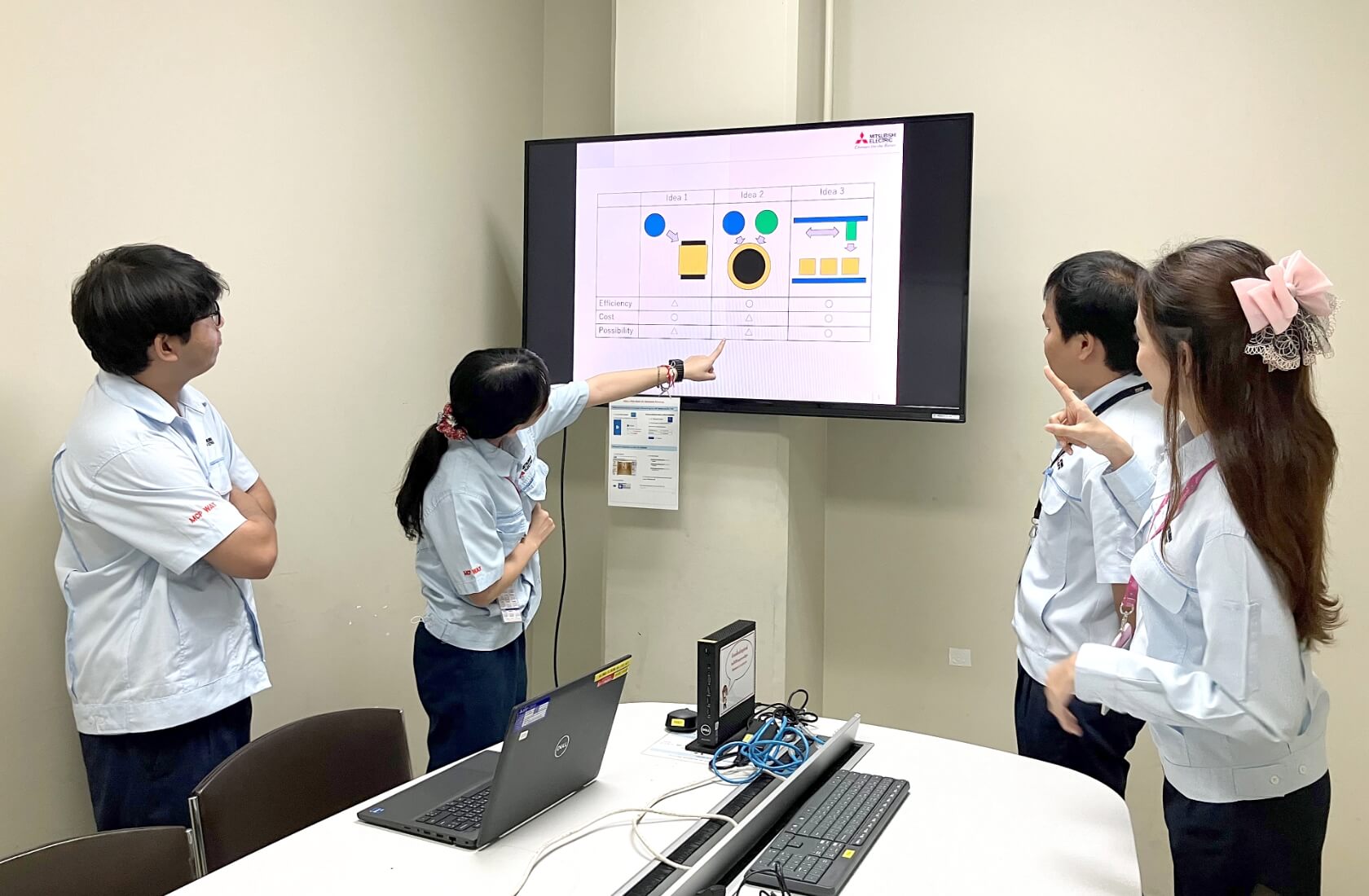 At meetings, lively debate crosses national boundaries
สวัสดีค่ะ (Hello!)
I’m Akiko Tatebe, currently working in the Production Control Department at Mitsubishi Electric Consumer Products (Thailand) Company Limited (MCP) as an On-the-Job Training (OJT) Global Trainee Program placement.
I entered Mitsubishi Electric in 2014, joining the Manufacturing Engineering Section at our Nakatsugawa Works’ Manufacturing Engineering Department, where I developed manufacturing technology for fan motors. In 2021, I transferred to the Mechanical Devices Engineering Section in the Component Production Engineering Center’s Motor & Generator Manufacturing Engineering Department. There I was involved in manufacturing technology and production design for various kinds of motors, including the ones used in air conditioners.
MCP manufactures and ships air conditioners as well as making the motors used in them. I work with local colleagues to improve production productivity at motor-related workplaces, develop new models, and more.
Before my placement at MCP, I had never worked with local colleagues outside Japan, so I found communication very difficult at first. There was the language difference, of course, but even at meetings with interpreters, exchanges didn’t go as I hoped. When I thought about what was causing this, I realized that it was because I was employing high-context communication techniques. I used demonstratives rather than nouns, and unthinkingly left out information because I assumed that it would be understood implicitly. I started paying attention to how I phrased things and meeting in person rather than online wherever possible. This made my interactions gradually smoother. I can feel the progress I have made in this area—today I can share my thoughts to a certain degree even without an interpreter.
Thai colleagues are passionate about work and events
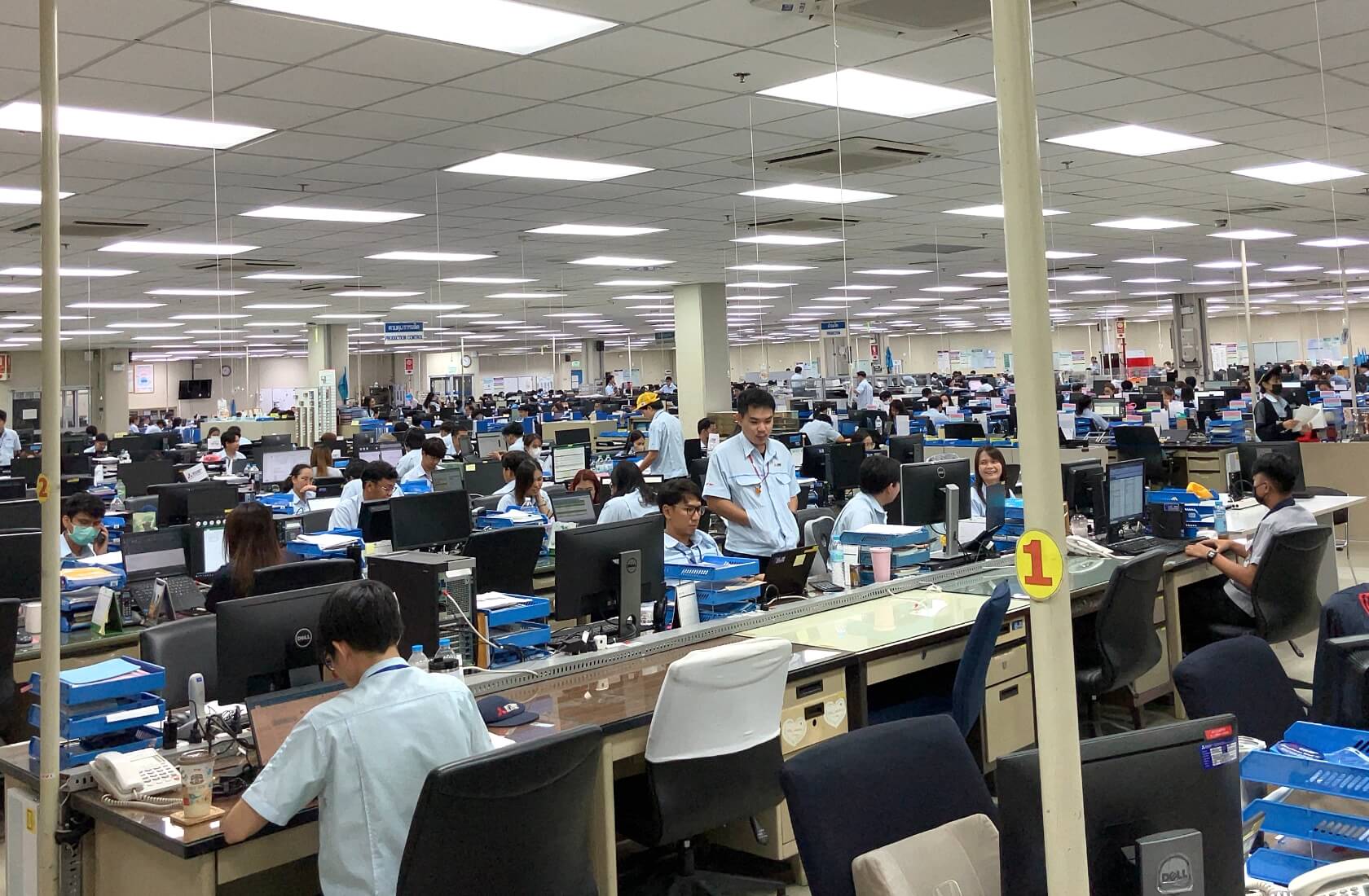 Many colleagues work in the Production Office
MCP is in an industrial park in a place called Chonburi province. It takes an hour to drive there from my residence in the capital Bangkok. As well as the Main Office, MCP has a Production Office inside the manufacturing plant. The Production Office contains the Production Control Department where I work along with the Production Department, Engineering Department, Quality Assurance Department, and several others, with almost 800 colleagues in all. This is Site 1. Site 2 is twenty minutes’ drive from Site 1, and is where motors are manufactured.
The office atmosphere is surprisingly similar a Japanese workplace. Everyone is highly passionate about work. Pardon my impoliteness, but I must admit that before I came to MCP, I had an image of Thai people as rather easy-going. It’s true that this is said to be one of Thailand’s national characteristics, but of course there are individual differences. I came to regret thinking in such general terms.
On the other hand, there is one difference from Japan that surprised me: a passion for events. One event to celebrate the 34th anniversary of MCP’s founding was held at a large, rented venue, with all our colleagues—some 3,000 people—in attendance. As well as food and drink, there were prize drawings and performances by famous musicians, making for a very lavish party. Many of my local colleagues wore costumes and danced to the music, acting very differently from the way they did at work. Also, Thailand is a Buddhist country, but they enjoy Christmas too. A few days before Christmas, a tree goes up in the office and both male and female local colleagues wear Christmas-related accessories like headbands with reindeer antlers. Christmas songs are played during break periods, and this continued even after Christmas was over, in a display of Thai generosity. At the end of the year, we exchanged presents within our section. I like events too, so all this gives me a chance to enjoy various events with my colleagues.
Naturally, I also see my colleagues outside work. We go out drinking and have regular activities like futsal games. I’ve even gone on camping trips with colleagues. It feels like colleagues are closer to each other than they would be in Japan. Staying connected outside work helped make things smoother back in the office.
The "tham bun" spirit is part of the fabric of everyday life
On workdays, I get up before 5 in the morning and spend about an hour driving to work from my residence in Bangkok. Once I arrive, I have fruit for breakfast. Fruit of all kinds is plentiful and inexpensive in Thailand. After working until 5 in the evening I have an online language lesson for an hour, and then I spend about an hour and a half driving home. The drive home takes longer than my morning commute because of the frequent traffic jams in Bangkok at that time of day. On weekends, paydays, or rainy days, the traffic is even worse. It once took me three hours to get home. I order dinner delivered while still on the road so that I can eat as soon as I arrive home. Bangkok has many food delivery options. You can get many kinds of food—not just Thai cuisine but also Japanese, Western-style, Chinese, Italian, and more. Delivery fees are also cheap, so I make frequent use of this option. I strive to stay healthy by getting enough sleep, so I go to bed by 10 o’clock.
On my days off I often travel, visiting the markets and temples at my destinations. The people I meet are always kind, and vendors in the market often throw in a free gift. I am constantly moved by the generosity of Thai people and the high level of hospitality here. The deeply rooted Thai custom called "tham bun" (accumulating merit by doing good deeds) means there are many people who actively seek to give donations and help people. The belief is that those who practice tham bun will eventually receive happiness in return. I think this is a wonderful mindset.
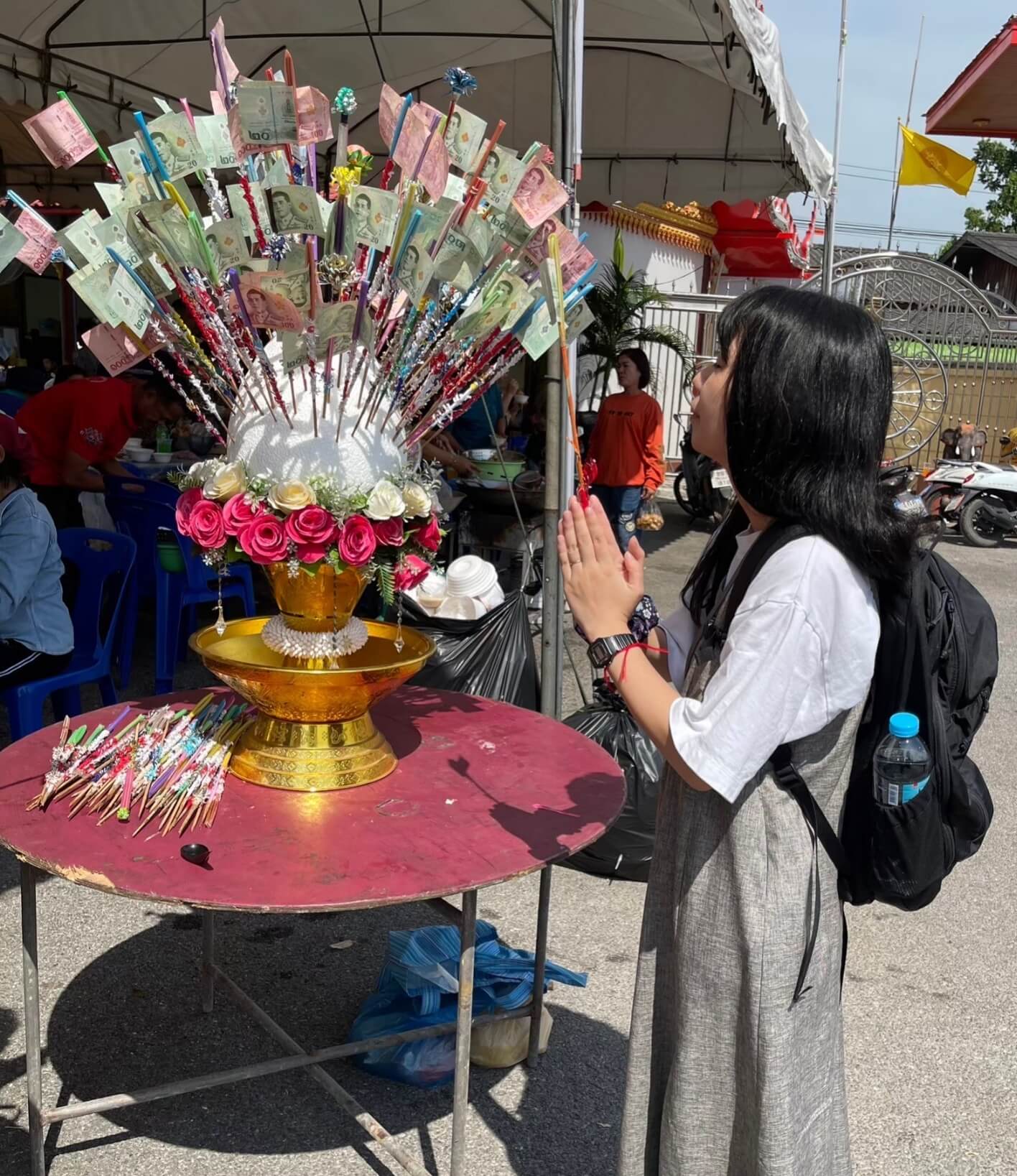 Learning from Thai culture, I also accumulate merit with tham bun
Learning Japan’s good points and Thailand’s good points
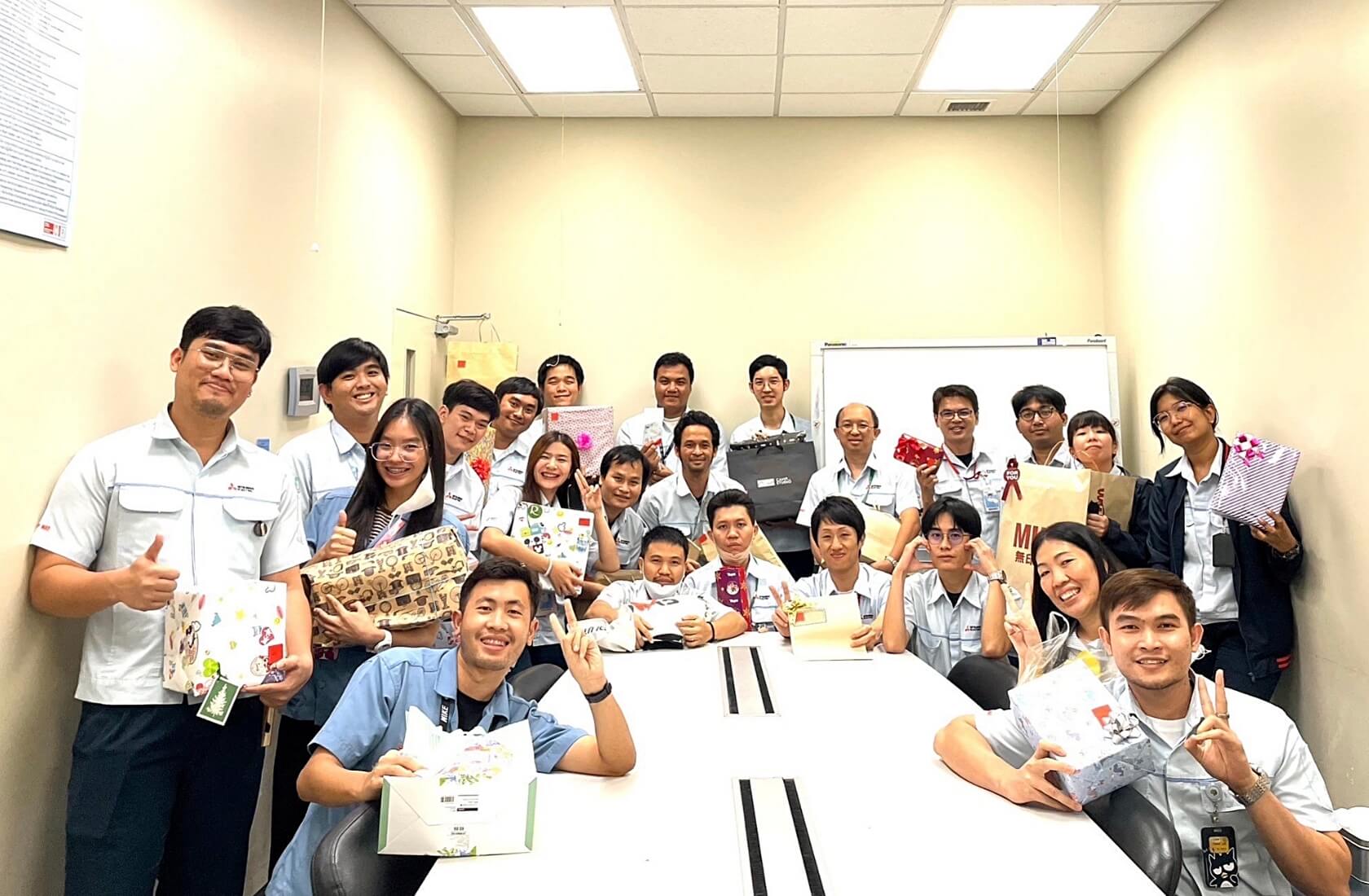 My colleagues (at the end-of-year present exchange)
Living and working in Thailand, I have become captivated by the kindness and generosity of the Thai people. As well as the tham bun spirit I mentioned above, I also like the Thai idea of "mai pen rai," meaning "no worries." Adopting this attitude myself has helped me avoid dwelling on problems myself. At the same time, living in Thailand has also given me a new appreciation for Japan’s many good points. For example, uniformly high-quality goods and services at low prices is one of the wonderful things about Japan. In Thailand, products and services of the same quality level are more expensive. Every day I encounter reminders that what we take for granted in Japan may not be the case overseas.
I have learned many things on this OJT global trainee program placement, but one particularly major example is understanding from personal experience that there are good sides to both my own country and others. Even after this placement, when I work with local colleagues, I will teach them about Japan’s good points, and when I work in Japan I will adopt good ideas I learned overseas. In this way I hope to make the world as a whole a little better through my actions.
Globalization is underway across every field today, and if you’re reading this, there’s a good chance that you’ll work overseas one day as well. You might be taken aback by the differences from Japan at first, but wherever you are posted will surely have its own good qualities. I hope that this article proves useful in some way when you find yourself living and working overseas. Thank you for reading all the way to the end.
PROFILE
Mitsubishi Electric Consumer Products (Thailand) Co., Ltd.
Akiko Tatebe
I am in charge of manufacturing technology for air conditioner fan motors manufactured at MCP.
2014
Joined Nakatsugawa Works, Mitsubishi Electric.
Assigned to Manufacturing Engineering Section, Manufacturing Engineering Department
2021
Assigned to Mechanical Devices Engineering Section, Motor & Generator Manufacturing Engineering Department, Component Production Engineering Center
2023
Assigned to current post