


Environmental Sustainability Vision 2050 (Full text)
The Mitsubishi Electric Group’s new Environmental Sustainability Vision 2050 defines environmental protection as an even greater corporate priority and stipulates increased initiatives toward this end.
Mitsubishi Electric has announced that in response to the worsening of global environmental challenges, the Company has revised its Environmental Sustainability Vision 2050, first introduced in 2019.
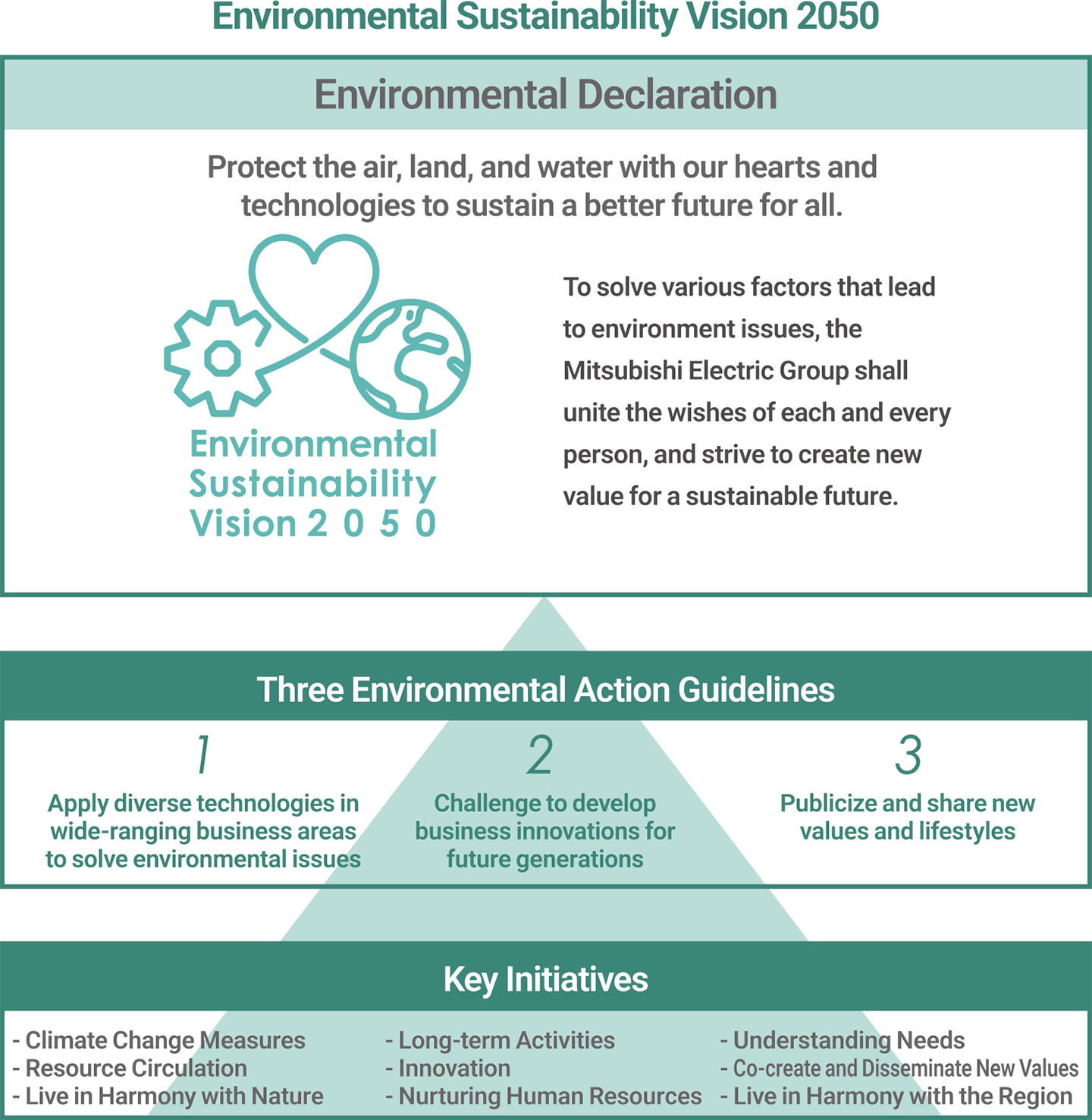
Revision of the Environmental Sustainability Vision 2050
The environmental challenges that businesses face have become increasingly complex on a global scale. These include rising energy demand driven by increased data traffic resulting from the spread of AI, the growing importance of resource circulation due to geopolitical risks, and the loss of natural capital that underpins business activities. In response to these challenges, environmental initiatives expected of companies, such as expanding the use of renewable energy, improving resource efficiency, and advancing biodiversity protection have become even more significant.
In light of these challenges, and to advance sustainability management across the Mitsubishi Electric Group, the Environmental Sustainability Vision 2050 has been reorganized into three focus areas: Carbon Neutrality, Circular Economy, and Nature-Positive.* The change clarifies the Company’s efforts to address environmental challenges. The Vision will continue to guide the Mitsubishi Electric Group’s creation of new value through diverse businesses and the acceleration of initiatives that contribute to a more sustainable global environment.
- Besides reducing environmental damage, also enhancing biodiversity, improving ecosystem health, and supporting the sustainable use of natural resources.
Challenge Areas and Policies for Initiatives
The Mitsubishi Electric Group shall utilize diverse technological assets throughout wide-ranging business areas, and across the entire value chain, to solve various environmental issues, including climate change, resource circulation, and coexisting harmoniously with nature.
Carbon Neutrality: Climate Action
- Promoting and disseminating outstanding energy-saving products, systems, services, and renewable energy businesses, together with our stakeholders, we will contribute to reducing greenhouse gases worldwide.
- Respecting the global shift toward carbon neutrality, we will promote the reduction of greenhouse gases throughout the value chain, from development, design, procurement of raw materials, and production through sales, distribution, use, and disposal. Our present target is to achieve carbon neutrality by 2050.
- Promoting thorough energy efficiency across factories and offices, we will also engage in renewable energy use.
- Observing changes in the global environment, we will provide solutions that contribute to minimizing the risks of natural disasters.
Circular Economy: Resource Circulation
- Reducing the size and weight of products, we will consider the use of recycled materials and the recyclability rate of the products and systems we produce.
- Eliminating resource waste throughout the value chain, we will strive to maximize the effective use of resources.
- We will work to expand the supply of safe, clean water globally, as well as to enforce water treatment that does not pollute oceans and rivers.
- We will promote the effective use of water taking the water environment of each region into consideration.
- We will promote resource circulation businesses globally, such as reuse, repair of products/systems, and waste reduction.
- We will aim to achieve 100% effective use of wastes, such as plastics, generated during manufacturing processes.
Nature-Positive: Live in Harmony with Nature
- Throughout the Group, we will carry out activities to preserve biodiversity in the mountains, rivers, and oceans, and at all business sites, and promote the development of local environments and human resources to be passed to future generations.
- We will work to control, suppress, substitute, and properly dispose of harmful substances that may affect the natural environment.