


Materiality (Important Challenges)
Mitsubishi Electric Group’s Materiality
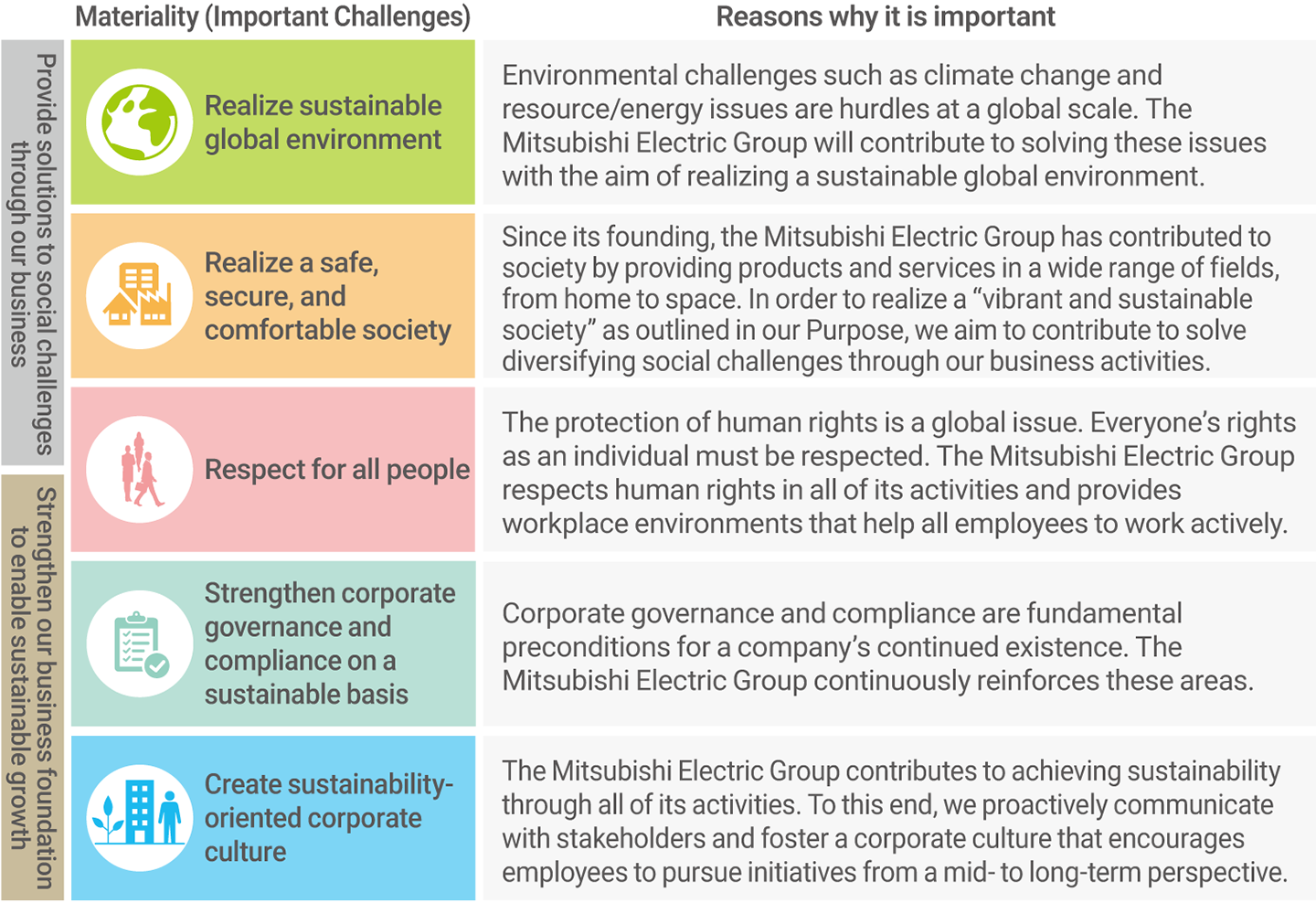
To address sustainability at the management level and to pursue it over the long term, the Mitsubishi Electric Group has identified its materiality items. In fiscal 2026, the Group reviewed these materiality items as shown in the table below, and from fiscal 2027 has been advancing initiatives addressing its new materiality items. The Group is taking a “Trade-On (mutual benefits)” approach to realizing sustainability by implementing materiality initiatives to create business solutions for social challenges while securing its own business growth at the same time. For our materiality initiatives, we set targets and key performance indicators (KPIs) and carry out continuous improvement activities using the PDCA cycle.
| Materiality | Sub-Materiality | Reasons why it is important |
|---|---|---|
| Realize a sustainable global environment | Reduce environmental impact | In the Mitsubishi Electric Group’s business and supply chain, environmental impacts arise from GHG emissions as well as the use of water and other resources. We address such environmental impacts responsibly. |
| Contribute to the environment through business activities | Global environmental issues related to climate change, water resources, and resource circulation are becoming more serious. The Mitsubishi Electric Group contributes to resolving these issues through its products and services that utilize its wide-ranging technologies. | |
| Realize a sustainable society | Contribute to society through business activities | As society changes rapidly, we are surrounded by increasingly diverse and complex challenges. The Mitsubishi Electric Group contributes to improving safety and security in society, productivity, and the well-being of people. |
| Respect for all people | Human rights in the value chain | Human rights are a global issue, and everyone must be respected as an individual. The Mitsubishi Electric Group respects the human rights of everyone involved throughout its global value chain. |
| Human capital empowerment | People are the driving force behind achieving sustainable growth. The Mitsubishi Electric Group creates a workplace environment where employees can work with vitality, encouraging each individual to take on challenges and bringing out the full potential of its broad and talented workforce. | |
| Strengthen corporate governance and compliance on a sustainable basis | Corporate governance | Corporate governance is the fundamental precondition for a company’s continued existence. The Mitsubishi Electric Group has developed and maintains a corporate governance system that enables it to better meet stakeholder expectations and continuously strengthens it. |
| Compliance | Ethics and legal compliance are essential for the stable development of society, and form the foundation for a company’s survival. At the Mitsubishi Electric Group, every employee acts with integrity and a high sense of ethics, and complies with social norms and laws. | |
| Quality | The products and services that underpin people’s daily lives require high levels of safety and reliability. The Mitsubishi Electric Group is committed to continuously strengthening quality management in order to provide peace of mind and satisfaction to society and its customers. | |
| Information security | As data becomes the foundation of society, the threat of cyberattacks is growing. The Mitsubishi Electric Group, as a company handling sensitive information, is committed to strengthening information security. | |
| Promote innovation for sustainability | Create new technologies and value | For achieving sustainability, innovation that contributes to solving social and environmental issues is essential. The Mitsubishi Electric Group creates new possibilities for a better tomorrow, with bold vision and boundless innovation. |
Materiality and SDGs
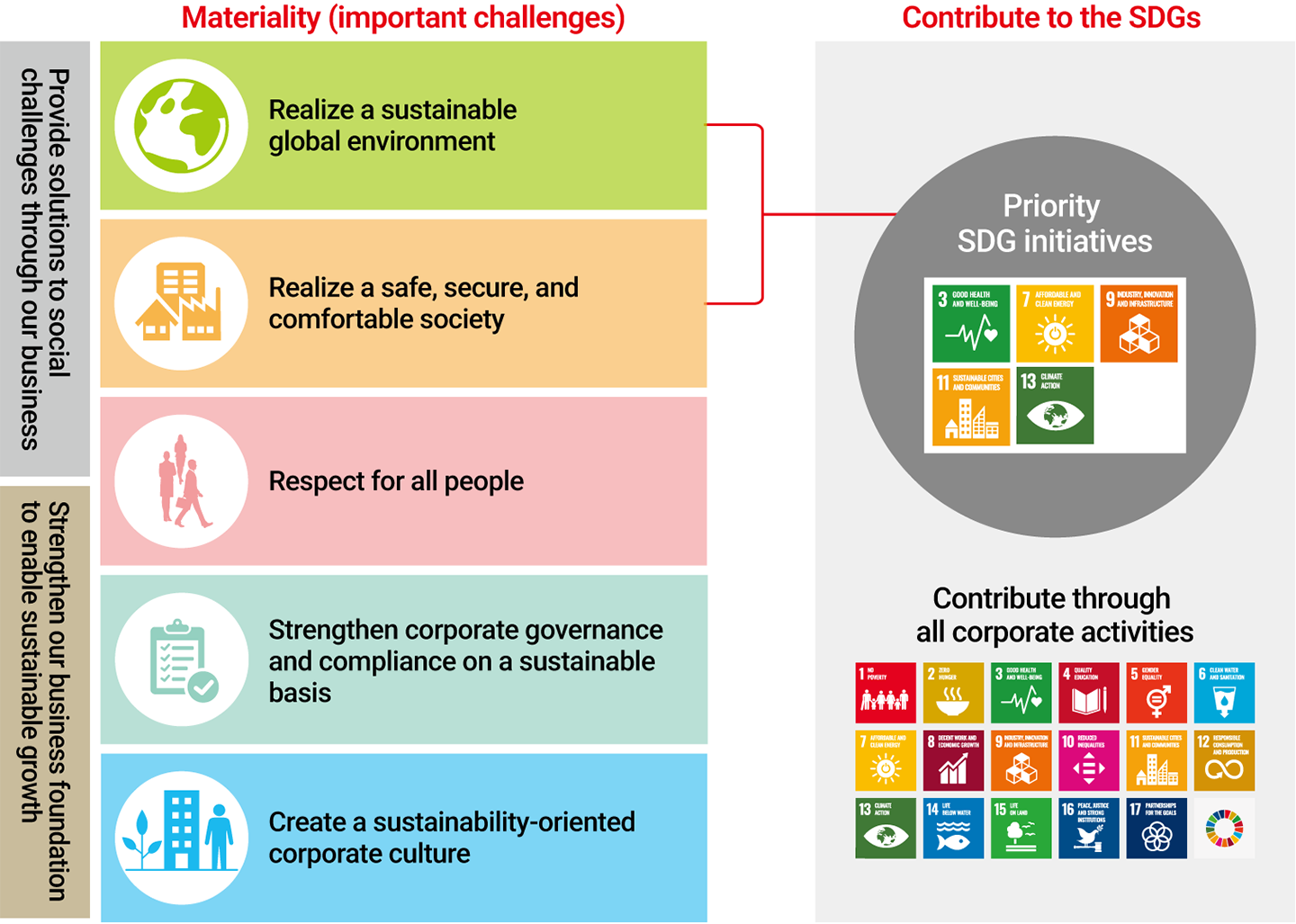
Under its Purpose that “We create new possibilities for a better tomorrow, with bold vision and boundless innovation,” the Group aims to contribute to solving social issues by implementing the five areas of materiality issues. This policy aligns with the objectives of the globally shared SDGs.*
As a comprehensive electrical and electronics manufacturer with a broad portfolio of technologies, products, and services, we recognize our significant potential to contribute to the achievement of all 17 SDGs through our diverse business operations and our ongoing commitment to environmental, social, and governance (ESG) initiatives.
- Sustainable Development Goals
Process of Identification and Review of Materiality
The Mitsubishi Electric Group identifies material issues in accordance with the principle of double materiality, based on the Group’s sustainability-related guidelines. These issues are also reviewed periodically in light of social trends and the business environment.
- 1 Impacts of business activities on society and the environment (Impact), and financial effects on the undertaking arising from society and the environment (Risk, Opportunity)
- 2 Information disclosure rules concerning the environment, society, and governance (ESG) created by the Sustainability Accounting Standards Board (SASB), a nonprofit organization in the U.S.
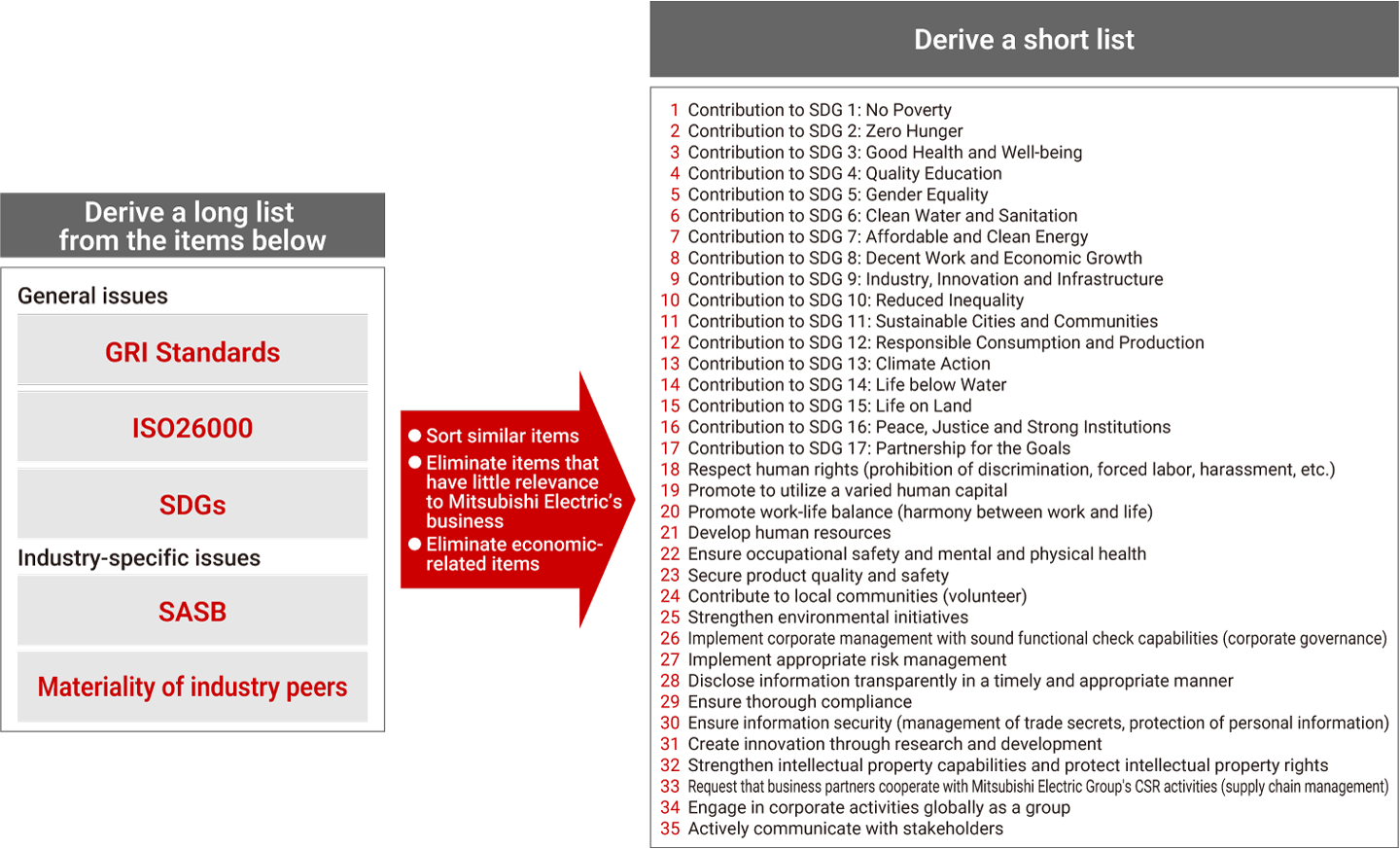
Materiality Identification Process
1. Listing assessment items
In identifying sustainability-related impacts, risks, and opportunities (IROs), we identify the key stakeholders associated with each business and assess the entire value chain. Specifically, we comprehensively identify positive and negative impacts on society and the environment, as well as risks and opportunities that may affect our finances, and organize these into sustainability issues for assessment.
 Sustainability issues to be assessed
2. Identifying impacts, risks, and opportunities (IROs)
For each identified issue, we identified the impacts on society and the environment, as well as the related risks and opportunities. In this way, we are able to systematically organize the impacts of sustainability issues on our business activities and the external environment.
3. Assessing IROs (Including stakeholder engagement)
For each identified issue, we assess on a five-point scale both the significance of impacts and the financial significance of the related risks and opportunities.
The significance of social and environmental impacts is assessed in terms of severity, scope, irremediability, and likelihood. Meanwhile, financial materiality is assessed based on the severity and likelihood of financial impacts arising from the related risks and opportunities.
During the assessment process, we consider external information such as regulatory trends and market conditions, and data on our business activities in addition to opinions gathered from stakeholder dialogue (engagement). Taking all of these factors into consideration, we prioritize issues from the perspectives of both the significance of impacts and the financial significance.
4. Materiality identification
Based on the above assessments, we organize and consolidate the identified sustainability issues, systematically classifying them according to the similarity of their content, the nature of their impacts, and the relationships among the issues.
For each issue, we then identify as materiality those matters deemed important from the perspectives of either the significance of impacts or the financial significance.
We also analyze the impacts of the identified materiality on our business strategy and business model, and reflect these insights in management decision-making.
FY2026 results
After sorting out the sustainability issues to be assessed, we identified five areas as materiality.
A key feature of this review has been the addition of "Promoting innovation for sustainability." This reflects the Mitsubishi Electric Group's commitment to transforming itself into an innovative company that embraces risk and creates value through new ideas.
We have also set new areas as sub-materiality to further clarify the direction our Group aims for.
Incorporation of Expert Opinions
In reviewing our materiality in fiscal 2026, we sought input from external experts and incorporated their perspectives in our new materiality.
Items considered material to our business
We gathered opinions from experts on which impacts, risks, and opportunities (IRO) related to their respective fields of expertise have the greatest environmental, social, and financial significance.
Note: ● indicates items considered material.

Yukari Takamura
Institute for Future Initiatives, The University of Tokyo
Professor
【Areas of Expertise】
International Law
Environmental Law
● Circular Economy ● GHG Emissions Reduction ● Resource Utilization
Plastic use is a matter of major concern to both society and investors in terms of resource utilization and environmental pollution. I believe that R&D and product creation aimed at minimizing plastic use throughout the value chain will become key differentiators. Discussions around reducing the use of virgin materials, together with your company’s long-standing track record in recycling operations, will serve as important selling points.
● Carbon Neutrality
Why not highlight and communicate your company's strengths in energy efficiency improvements and energy conservation initiatives? At a time when energy prices remain high, providing energy-efficient products is a compelling selling point that can contribute to both addressing social issues and reducing the energy expenses for customers.
● Contribution to Water Resource Conservation and Access ● Water Use
Your company's water-saving electric appliances are highly relevant as they contribute to these areas. By reducing water consumption and contributing to water resource and environmental conservation, your company's water-saving appliances create positive environmental and social impacts that contribute to a competitive advantage, especially in water-scarce regions.
Jun Aoki
Representative Director, JunpuManpan Inc.
Outside Director, Chairperson of Compensation Committee, and Member of Nomination Committee of LIXIL Corporation
Outside Director, FIDEA Holdings Co. Ltd.
【Areas of Expertise】
General Personnel Affairs
● Occupational Health and Safety ● Harassment
Occupational health and safety and harassment prevention are fundamental priorities that must be addressed in conducting corporate activities.
● Human Capital Management ● Individual Differences
Employee engagement scores, a key indicator of human capital, improve through a combination of multiple factors. In terms of workplace environment, working alongside diverse talent, including people of different ages and abilities, broadens employees’ perspectives and facilitates the exchange of diverse ideas, which in turn creates value. In particular, an environment where younger employees can participate in discussions from their second or third year promotes cultural transformation, leading to higher engagement scores and improved talent retention. In addition, understanding how the company's products contribute to society through its core business can also improve engagement scores.
Masao Hara
Representative Partner, Attorney, Nakajima Transactional Law Office
【Areas of Expertise】
Compliance
●Quality
The quality incidents that came to light in 2021 gave your company an opportunity to reaffirm its responsibility as a company that provides products and solutions that benefit society. Quality includes both safety and security. By consistently ensuring safety as a fundamental requirement, you give your customers peace of mind, which in turn earns your customers’ trust in the company.
●Compliance
To maintain and improve quality, it is important to recognize again the importance of fulfilling contractual obligations. Each employee's commitment to compliance, such as carefully negotiating with customers after fully understanding and carefully reviewing the contract terms, prevents misconduct.
●Corporate Culture
It is important for employees to understand and take pride in the fact that the company’s products contribute to society. Ultimately, this fosters a corporate culture free from misconduct and drives long-term corporate value.
Chieko Matsuda
Professor, Graduate School of Management, Tokyo Metropolitan University
【Areas of Expertise】
Corporate Strategy
Corporate Governance
●Corporate Strategy
A company’s overarching direction is intrinsically manifested in its corporate philosophy and management strategy. Therefore, it is imperative that a seamless coherence exists between the upcoming revision of the medium-term management strategy and the identified materialities. As a fundamental premise, the Key Performance Indicators (KPIs) established for these materialities must be rigorously aligned with both our overarching business and human capital strategies.
●Corporate Governance
Corporate governance should not be implemented merely as a utilitarian tool to secure an advantageous position in capital financing; rather, it is a structural mechanism designed to evaluate how such implementation organically transforms management practices themselves. If specific challenges emerge during the effectiveness evaluation of the Board of Directors—the very core of this governance structure—those profound issues can arguably be defined as the essential materialities for your company.
Integrating Materiality into Management
We gathered opinions on the direction of potential material topics and how to effectively integrate materiality into our future management.
Ryohei Yanagi
Doctor of Economics
Waseda University Graduate School
Visiting Professor, Graduate School of Accountancy
【Areas of Expertise】
Financial Accounting, Corporate Governance, ESG, and Corporate Value
If we consider that one of the purposes of materiality is to increase corporate value, the aim should be to demonstrate how materiality correlates with both the company's purpose and corporate value. From this perspective, narrowing the focus to the issues that are most material is a highly effective approach. To use the findings of this review to inform management decisions, it would be important to use impact accounting and the Yanagi model to demonstrate to long-term investors, a crucial audience for corporate disclosures, that these material topics tangibly drive value creation. Ultimately, this approach will strengthen external communication and clearly articulate the company's growth story.
Jun Aoki
Representative Director, JunpuManpan Inc.
Outside Director, Chairperson of Compensation Committee, and Member of Nomination Committee of LIXIL Corporation
Outside Director, FIDEA Holdings Co. Ltd.
【Areas of Expertise】
General Personnel Affairs
The important thing is not simply to identify materiality issues, but to determine how they are used and what they aim to achieve. The key is to have a distinctive edge and uniqueness. To this end, the sustainability division should engage in thorough discussions with the CEO and CFO—leveraging insights from each business division—to draft an integrated corporate and sustainability strategy. For example, when considering your business portfolio, placing sustainability at the core and linking it to businesses that utilize Serendie will bring out the distinctive character of Mitsubishi Electric. Materiality issues identified in this way foster a sense of ownership among employees and drive action across business divisions, ultimately strengthening external disclosure. As this company-wide cycle is established, materiality becomes part of the company's DNA.
Keisuke Takegahara
Professor, National Graduate Institute for Policy Studies
【Areas of Expertise】
Environment, ESG Investing
Aiming for perfection from the outset when identifying materiality is challenging. For a company with a highly diversified business portfolio, a viable approach is to anchor strategy on value creation through its growth strategy, using a clear timeline to differentiate the company. For example, if using the services or products provided by your company reduces GHG emissions, it contributes to climate change mitigation. Simultaneously, if this increases sales, it reflects the core concept of double materiality. With products that address climate change, your company can demonstrate significant potential for expanding revenue, margins, and operating profit through its sales plans.
Medium- to Long-Term Initiatives and Targets for FY 2027
Each fiscal year, the Mitsubishi Electric Group sets goals and key performance indicators (KPIs) for addressing materiality issues, with the Sustainability Committee confirming and promoting the progress of these goals as the Group works to enhance corporate value.
| Sub-Materiality | Targets/Key performance indicators (KPIs)*1 | FY2027 target | |
|---|---|---|---|
| Reduce environmental impact | FY2051: Aim for carbon neutrality throughout the entire value chain |
[Scope 1*2, 2*3] FY2031: Achieve carbon neutrality at factories and offices | |
| [Scope3*4] FY2031: Reduce by 30% or more compared with FY2019 | |||
| FY2031: Water intake at high-risk bases (basins): Reduce by 6% or more compared with FY2025*5 | |||
| FY2031 Resource circulation*6: Increase by 10% or more from FY2025 | |||
| FY2031: 100% effective utilization of plastic waste*7, *8 | |||
| Contribute to the environment through business activities | Provide products, services, and solutions that contribute to carbon neutrality | Development, proposal, and provision of technologies, products, services, and solutions that contribute to energy conservation and higher efficiency, electrification, increased adoption of clean energy, and the establishment of carbon circulation models to support the decarbonization of society. | |
| Provide products, services, and solutions that contribute to the water environment | Development, proposal, and provision of technologies, products, services, and solutions that contribute to securing safe water and maintaining or restoring a healthy water cycle. | ||
| Provide products, services, and solutions that contribute to achieving a circular economy | Development, proposal, and provision of technologies, products, services, and solutions that contribute to resource circulation in society by reducing waste and maximizing the value of resources. | ||
- 1 Refers to targets/KPIs for the Mitsubishi Electric Group unless otherwise specified
- 2 Direct emissions from the use of own fuel
- 3 Indirect emissions from the use of electricity and heat purchased from outside the Company
- 4 Indirect emissions from the entire value chain, excluding Scope 1 and 2
- 5 Targets were set with reference to the SBTs for Nature target-setting methodology. There are 14 high-risk bases in 11 basins.
- 6 Total weight of reused products and recycled plastic used in Mitsubishi Electric Group products
- 7 Only manufacturing-related waste generated at factories is included. (General waste is excluded.)
- 8 It applies only when local regulations and conditions regarding plastic waste, as well as local recycling capacity, are met.
| Sub-Materiality | Targets/Key performance indicators (KPIs)*1 | FY2027 target | |
|---|---|---|---|
| Contribute to society through business activities | Provide products, services, and solutions that contribute to achieving a safe and secure society | Development, proposal, and provision of technologies, products, services, and solutions that contribute to improving the safety and reliability of social infrastructure and industrial systems, as well as to disaster prevention and mitigation, accident prevention, and enhanced security. | |
| Provide products, services, and solutions that contribute to achieving well-being | Development, proposal, and provision of technologies, products, services, and solutions that support healthy, culturally fulfilling, and comfortable lives for each individual. | ||
| Provide products, services, and solutions that contribute to climate change adaptation | Development, proposal, and provision of technologies, products, services, and solutions that contribute to avoiding and mitigating damage caused by climate change-related risks such as extreme heat, heavy rainfall, flooding, and drought. | ||
| Provide products, services, and solutions that contribute to productivity improvement | Development, proposal, and provision of technologies, products, services, and solutions that directly contribute to improving social productivity, including automation, labor-saving, higher yield rates, and improved operating rates. | ||

| Sub-Materiality | Targets/Key performance indicators (KPIs)*1 | FY2027 target | |
|---|---|---|---|
| Human rights in the value chain | Consider the safety and health of all people, understand individual differences, and respect individual dignity and human rights | Promote risk mitigation activities based on the RBA*9 process across the value chain. | For salient human rights issues*10, promote risk identification and improvement activities at Group sites through the use of RBA-SAQ.
By the end of FY2026, the initiative will be deployed to 44 Group sites, and corrective actions will be implemented at 100% of high-risk sites.
For salient human rights issues related to the supply chain, continue to implement corrective actions for 100% of suppliers identified as high risk through the Sustainable Procurement Survey results (RBA, MELCO-SAQ), and begin RBA-SAQ implementation in overseas regions (Europe, the Americas, and Asia). |
Foster an employee-friendly working environment and culture
|
Employee Engagement Score: 56% or more (Mitsubishi Electric and certain associated companies in Japan) | ||
| Implement harassment prevention training for all employees (in Japan) | |||
| Human capital empowerment | Establish a framework to facilitate mutual growth of people and the organization through strategic assignment and development on a Group-wide and global scale as well as enhancement of employees’ career ownership | FY2031: 100% visualization of a human capital portfolio that ensures optimal talent allocation of approximately 150,000 global Group employees in alignment with business strategies | |
| FY2031: 100% implementation of RBA-based wage risk assessments and corrective actions | Implementation of wage risk assessments and improvement activities based on RBA standards | ||
| Strengthen DX/AX human capital essential for transformation into an Innovative Company |
FY2031: Expand DX/AX human capital to 20,000 workers | ||
| Build a workplace that maximizes individual performance and enables employees with varied perspectives and experiences to contribute to their full potential | FY2031: Percentage of women/non-Japanese in senior management (Directors, Executive Officers, and Executive Officers [Associate]) 30% or more (Mitsubishi Electric) | Ratio of women/non-Japanese in senior management (Directors, Executive Officers, and Executive Officers [Associate]): 15% (Mitsubishi Electric standalone) | |
| FY2031: Percentage of management positions held by women 12% or more (Mitsubishi Electric) | Ratio of women in managerial positions 5% (Mitsubishi Electric standalone) | ||
| FY2031: Percentage of employees who responded that they had a good work-life balance 70% or more (Mitsubishi Electric and associated companies in Japan) | Percentage of employees who say they have a good work/life balance 68% or more (Mitsubishi Electric and certain associated companies in Japan) | ||
| Promote safety and health activities across the entire Group, adhering to the basic policy of prioritizing the safety and health of our employees above all else | Ensure prevention of occupational accidents and, in particular, achieve zero lost worktime injuries (absence from work) (four days or more) per year | ||
- 9 RBA: Responsible Business Alliance (An alliance of companies promoting social responsibility in global supply chains)
- 10 Salient human rights issues: Those identified through the human rights impact assessment conducted in FY2024 (employee workplace environment, occupational health and safety, and working conditions, forced labor, and child labor in the supply chain). Of these, the salient human rights issues related to the supply chain are working conditions, forced labor, and child labor in the supply chain.
- 11 Average percentage of positive responses to the five questions in the annual employee engagement survey: “Pride in working for the Company,” “Willingness to contribute,” “Desire to change jobs,” “Encouraging others to join the Company,” and “Sense of achievement through work”
| Sub-Materiality | Targets/Key performance indicators (KPIs)*1 | FY2027 target | |
|---|---|---|---|
| Corporate governance | Increase effectiveness of the Board of Directors | Maintain the percentage of independent outside directors of Mitsubishi Electric over 50% (Mitsubishi Electric) |
|
| Compliance | Ensure proper understanding and practice of the compliance motto “Always Act with Integrity” | Conduct ongoing training on the prevention of unfair competition and bribery |
|
| Zero legal actions arising from unfair competition practices (violations of antitrust laws) and bribery incidents | Quantitative target: zero occurrences of antitrust laws incidents cases | ||
| Continuous implementation of anti-bribery training |
|
||
| Zero incidents of legal actions for anti-bribery violations | Quantitative target: zero occurrences of bribery incidents cases | ||
| Quality | Offer the quality that ensures customer satisfaction | Establish and maintain systems and environments that eliminate the need for improper quality control practices, while continuing activities to prevent these measures from fading away | Continuous implementation of the five initiatives for quality assurance reforms*12 |
| Information security | Comply with information security-related laws and regulations: zero violations | ||
- 12 The five initiatives: rebuilding the internal control function; addressing challenges related to technical capabilities and resources; reinstilling awareness of quality and compliance; normalizing manufacturing management; and promoting front-loading in design processes.

| Sub-Materiality | Targets/Key performance indicators (KPIs)*1 | FY2027 target | |
|---|---|---|---|
| Create new technologies and value | Continuously anticipate future society and address emerging social issues; promote research and development and social implementation of advanced technologies such as quantum and fusion technologies | Promote research and development needed for the future vision beyond social and customer challenges in key regions around the world. Strengthen external collaboration and co-creation activities, and realize social implementation of products and services applying the Physical AI and Serendie models |
Promote research and development aimed at solving social issues such as the realization of a decarbonized society and a resource-circulating society, as well as the decline in the working-age population. Develop carbon recycling technologies, automation and labor-saving technologies using AI and robotics, and resource recycling and traceability technologies. |
| Through close coordination between intellectual property and standardization activities, development and the acquisition of intellectual property rights are carried out strategically, taking into account both open and proprietary domains |
Integrate intellectual property and standardization activities into the upstream stages of business strategy formulation, and embed this approach across the organization using a PDCA cycle |
|
|
| Realize AI-driven management that streamlines and advances all business processes through AI |
|
|
|