

Insights

[VF-20E/25E series Medium-Voltage vacuum circuit breakers]Taking on the challenge of meeting a new standard
Published in April 2026

Part 1: The ideal medium-voltage VCB while navigating engineering resource constraints
When the Mitsubishi Electric team was talking to customers ahead of the development of a next-generation medium-voltage vacuum circuit breaker (VCB), they found the discussions were going in an unexpected direction. Customers – manufacturers of power distribution switchgears and end users in the manufacturing industry – kept saying that what they wanted was improved serviceability. This was a completely different requirement from the previous trends in product development, which had focused on smaller size and higher quality.
From the start, the project team in charge of developing the next-generation model realized that this was going to be a complex development project.
Protecting the entire facility from accidents
Medium-voltage VCBs are designed for use in medium-voltage power equipment, to interrupt current when required. Installed near the receiving end of the power system in large-scale facilities such as factories and commercial buildings, their role is to isolate faulty parts in the event of a problem, preventing the fault from cascading to electrical equipment and causing accidents within the facility. If overcurrent occurs due to a short circuit, it is instantly cut off to prevent equipment failure. Unlike low-voltage circuit breakers, which are placed close to the load (individual pieces of equipment), medium-voltage VCBs are positioned at the top end of the system, covering multiple assets. This is a huge responsibility, making medium-voltage VCBs vital for the stable operation of factories and facilities.
Mitsubishi Electric’s dominance in the market for medium-voltage VCBs is largely down to one key component: the vacuum interrupter. Current interruption is performed inside a container in a vacuum state, like that found in outer space. This completely quenches the arc formed when the circuit is broken, preventing electric shock, fire, and noise.
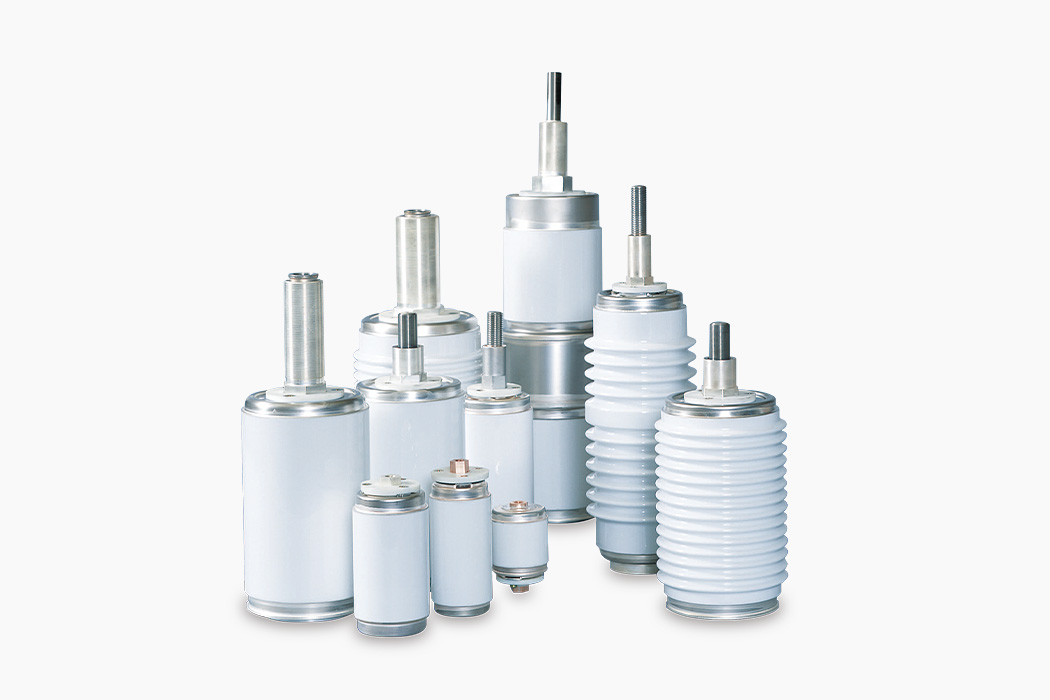
Mitsubishi Electric has been developing vacuum interrupters – a key component of medium-voltage VCBs – for over sixty years
Mitsubishi Electric has been developing these vacuum interrupters for over sixty years, gaining an excellent reputation for reliability. Until now, the high market share has been maintained by ensuring superior performance, but during market research for the new model it became clear that users are now keen to prioritize serviceability over the functionality of the device itself.
Workplaces cannot keep up with training engineers
Medium-voltage VCBs handle power supplies on the kilovolt (kV) level, which means failing to perform maintenance properly can cause accidents. Manufacturers specify appropriate maintenance procedures, which users generally follow. However, as Hiroshi Yamada explains: “We were already seeing a growing need for equipment that needs as little maintenance as possible, by as few people as possible.”
Yamada, the leader of the development project team, guessed that the reason behind this requirement could be the declining number of electrical engineers. Medium-voltage electrical equipment can only be serviced by engineers with sufficient technical expertise, but a generation of experienced engineers are reaching retirement, while users are not able to keep up with training new engineers – a situation only made more pressing by Japan’s aging population. “At one customer’s factory which should have twenty in-house electrical engineers, they suddenly found themselves with only fifteen,” says Yoshihiro Takebe from the sales team.
Even with fewer engineers, users cannot reduce the amount of maintenance work required to prevent accidents. Naturally, this has resulted in growing requirements to make the maintenance work itself less labor-intensive. This trend is backed by a move in the electrical industry to revise standards in response to the shortage of engineers.
National standards reflect international standards based on different assumptions
Medium-voltage VCBs are usually installed inside power distribution panels housing electrical equipment. To ensure safety, standards were established by the Japan Electrical Manufacturers’ Association (JEMA) – the country’s industry association for electrical equipment. One of these standards concerns the distribution panels where medium-voltage VCBs are installed, and manufacturers made VCBs to comply with this standard.
At around the time when Yamada’s team were talking to customers, a project was underway to upgrade this JEMA standard to Japanese Industrial Standard (JIS) status, making it an industry-wide national standard. One of the steps in this process was to incorporate standards set by the International Electrotechnical Commission (IEC), an international standardization organization. As well as helping circuit breaker manufacturers to expand into international markets by bringing it in line with international standards, this move was also intended to streamline maintenance.
“One of the differences between JEMA and IEC standards is a distinct approach to safety and the expected level of electrical engineers,” Yamada points out. “JEMA standards are based on the assumption that maintenance and inspections will be performed by qualified electricians, whereas the IEC standards allow for these tasks to be done by workers with no electrical knowledge.”
In Japan, where the JEMA standards apply, technical levels are guaranteed by qualifications, which means engineers can typically understand what is intended in maintenance work without everything being explicitly stated. On the other hand, in the global market where IEC standards apply, technical levels vary from country to country, so the quality of work can only be maintained by taking safety into consideration in the structure: making the product impossible to operate incorrectly, reducing the risk of electric shock, and reducing the impact on workers in case of incorrect operation. This was the reason behind the difference between the standards.
However, even in Japan, changing demographics and a shortage of engineers will inevitably mean that more work will need to be performed by workers varying degrees of training and experience. This is why a new JIS standard was being created, based on the IEC standard which ensures safety without relying on individual skills. This too reflects the state of the industry and the urgent need for less labor-intensive maintenance.
“We can’t just say it’s not available”
Driven by the meteoric rise of generative AI in the past few years, data centers are springing up all over Japan, which has led to rising demand for medium-voltage circuit breakers. With engineers in short supply, conformance to the new JIS standard was becoming increasingly necessary. However, the new standard – still a work in progress at the time – was expected to require significant design changes.
Of course, the new standard would not require all models to be brought up to the highest level of safety. Some parts were expected to remain similar to the JEMA standard. Complying with all items is not a mandatory requirement, so manufacturers do not necessarily need to invest a large amount of development resources.
Even so, the project team chose to go down the route of developing a medium-voltage VCB to comply with the new standard. This decision was motivated by a sense of responsibility, Mitsubishi Electric boasts the top market share in this sector.
“If a facility developer or switchgears manufacturer wants a product conforming to the new standard, we can’t just say it’s not available,” explains Takebe. In fact, some users keep on using a Mitsubishi Electric medium-voltage VCB for the whole product lifespan – around twenty years – and then want to update to a similar Mitsubishi Electric product. Without a complete product range, it may not be possible to meet the expectations of such users.
Based on the team leaders’ decision, the team began developing a next-generation medium-voltage VCB that would comply with the new JIS standard. Throughout the development process, they kept an eye on what was happening with the new standard as it approached publication.