

Insights

[VF-20E/25E series Medium-Voltage vacuum circuit breakers]Taking on the challenge of meeting a new standard
Published in April 2026

Part 3: Final testing overseas
In early 2025, two young members of the development project team flew to Busan, South Korea to test the new medium-voltage VCB.
Testing electrical equipment such as circuit breakers overseas is not all that unusual, as there are not many third-party facilities in Japan capable of tests.
The engineers responsible for observing the testing in South Korea were Yusuke Fujiki, in his fourth year at Mitsubishi Electric, and Ryohei Watarai, who had been with the company less than two years. Fujiki had worked on the main circuit design and Watarai designed the crucial vacuum interrupter, making the pair well suited to oversee the testing of the new circuit breaker, but working in another country was a new experience for both of them.
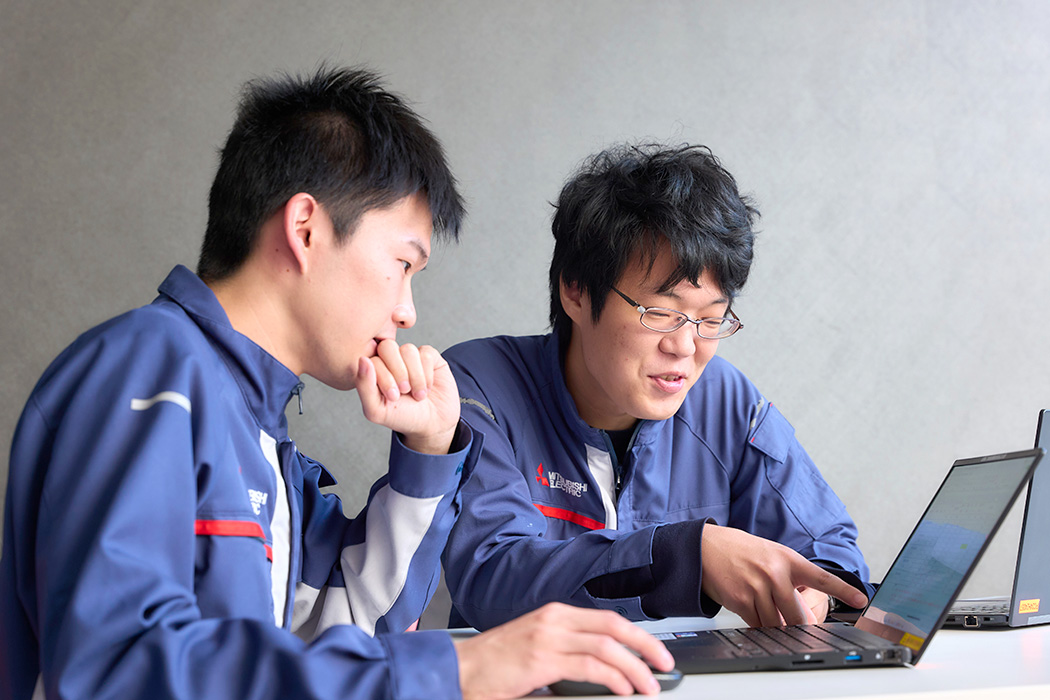
Watarai (L) and Fujiki (R) observed testing in South Korea. They found it challenging to work in a foreign environment, communicating remotely with the team in Japan
Close communication was required at the testing site for everything from setting test conditions to evaluating results. In addition to the language barrier with the Korean staff, the pair had to communicate remotely with engineers in Japan. “It felt like we were sat in the middle between the local staff and the team in Japan,” Watarai says.
A month-long testing schedule had been planned, but before they knew it, the month was almost up, and after facing some challenges with conditions at the site they were running out of test devices.
“Come back to Japan for now,” the team ordered the pair. Fujiki reluctantly gave up on the idea of completing the testing during this trip and accepted that they would have to continue later.
But, in Fujiki’s words: “If the target is for the circuit breaker to interrupt current with millisecond timing, this cannot be confirmed by reusing a single test device over and over.” As soon as they got back to Japan, the two engineers wasted no time in acquiring and shipping extra test devices in preparation so that Fujiki could return to South Korea, this time alone, to restart the testing.
“It must have been tough for the two of them, but I think it was a good experience,” says project leader Hiroshi Yamada. Having previously experienced testing in South Korea himself during a previous development project, he knew firsthand the difficulties of being “sitting in the middle”. He sent the young engineers, in their fourth and second years at the company, with a vision to help the growth of the next generation of developers.
With the end of testing in sight, Yamada, who had led the project to that point, was assigned to a new position. The new project leader was Tomohiro Nakata, who had been working on development of a different product until the previous year.
“It even appeared in my dreams”
Originally involved in developing DC circuit breakers for railways, Nakata took part in the medium-voltage VCB project alongside this work. Although he officially joined the development team in 2024, it was a change to go from an engineer position to being responsible for the whole project.
Taking over as project leader in the final stages of development, of course Nakata’s main mission was to get the product released on schedule. To achieve this, testing of all models would need to be completed by October 2025. Because the testing in South Korea had not been completed in a single visit, adaptations took longer than planned.
“We got to the point where the release would have to be delayed if anything went wrong in the next round of testing,” says Nakata.
As the tests neared completion and the product launch approached, there was a huge amount of pressure on Nakata. On one occasion, with just three days to go until a deadline to report to upper management, they still faced issues. “Work issues even appeared in my dreams,” says Nakata.
The others could tell that Nakata was worried, but this resulted in a stronger sense of unity among the project team. As they rallied around to support the team leader, it finally looked as if the product would be released on schedule.
The first Japanese manufacturer to offer a full product range
JECA Fair, Japan’s largest exhibition of electrical equipment, was held in Osaka in May 2025. Even though final testing was still in progress, the new VF-20E/25E series medium-voltage vacuum circuit breaker was unveiled in advance as a reference exhibit, making Mitsubishi Electric the first manufacturer to offer a lineup fully covering the new JIS standard. As the old standard had recently been withdrawn in March 2025, there was a great deal of interest from switchgear manufacturers, actually more attention than end users, at the exhibition.
Rather than queries about the product itself, Takebe says: “We were bombarded with questions about the new standard.”
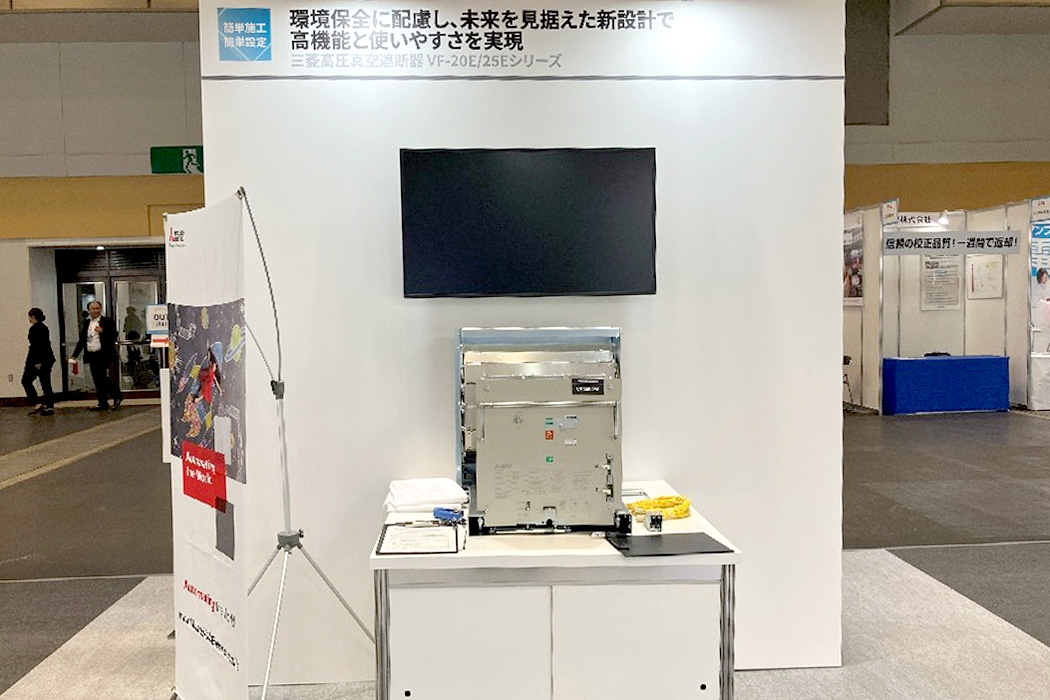
The new medium-voltage VCB was unveiled at the JECA Fair in May 2025
Other Japanese manufacturers are sure to develop product ranges covering the new standard eventually. However, both users and vendors often have difficulty interpreting a new standard immediately after it is published. What is required of manufacturers is to carefully analyze the standard and embody it in the form of a product to lead the industry in the right direction.
Although the project team faced several challenges, they succeeded in quickly developing a product lineup covering the new standard, demonstrating the future direction of the industry to equipment design vendors. This goes to show Mitsubishi Electric’s pride in being the top manufacturer of medium-voltage circuit breakers.
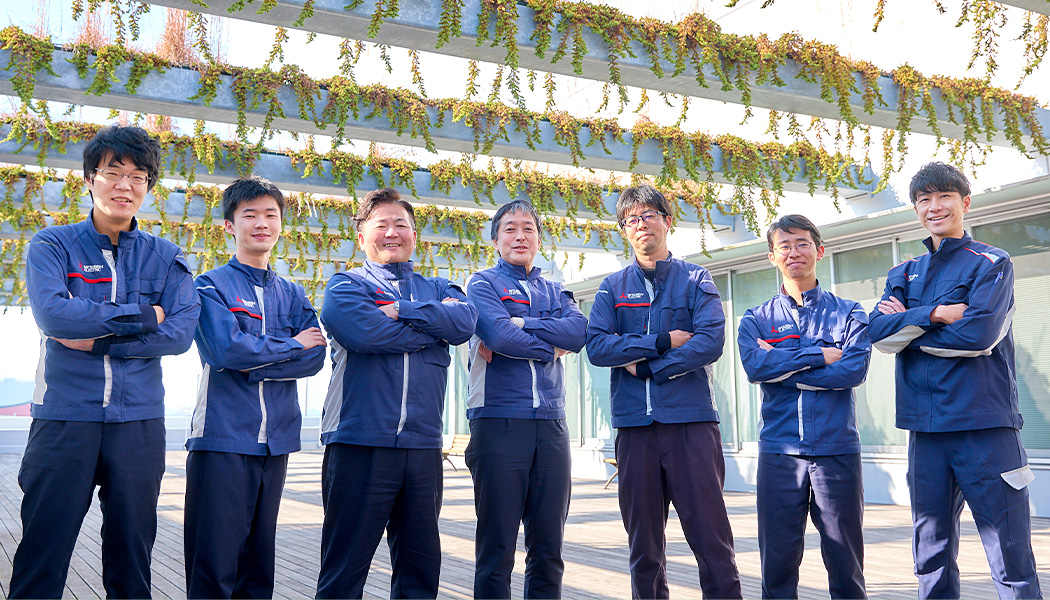
Interviews conducted December 2025