

Insights

[VF-20E/25E series Medium-Voltage vacuum circuit breakers]Taking on the challenge of meeting a new standard
Published in April 2026

Part 2: In pursuit of intrinsic safety
Bringing together Japanese and international standards, JIS C 62271-200:2021 is the new standard for power distribution switchgears installed with medium-voltage vacuum circuit breakers. It includes several regulations written with safety in mind, of which two requirements in particular were likely to have a major impact on the design.
The first requirement is the installation of metal shutters. A medium-voltage VCB is housed in a fixed frame, allowing it to be pulled out of the distribution panel for maintenance. However, even when the circuit breaker is removed, medium-voltage at the terminals of the fixed frame could cause an accident if accidentally touched. Conventional fixed frames used a resin shutter to cover the terminals, but the new standard requires a metal shutter for improved safety.
The second requirement is a mechanism allowing the VCB to be disconnected with the panel door closed. If the door is opened to disconnect the medium-voltage VCB from the main circuit inside the distribution panel, a mistake could expose workers to a high-temperature arc between the terminals. Such accidents can be prevented by enabling disconnection from outside without the need to open the door, and the new standard defines a mechanism for this.
Preventing arc without changing the size
The reason for changing the shutter from resin to metal is to prevent it from becoming electrically charged from the medium-voltage terminals, posing a risk of electric shock. With a metal shutter, it can be grounded to let the electric charge escape.
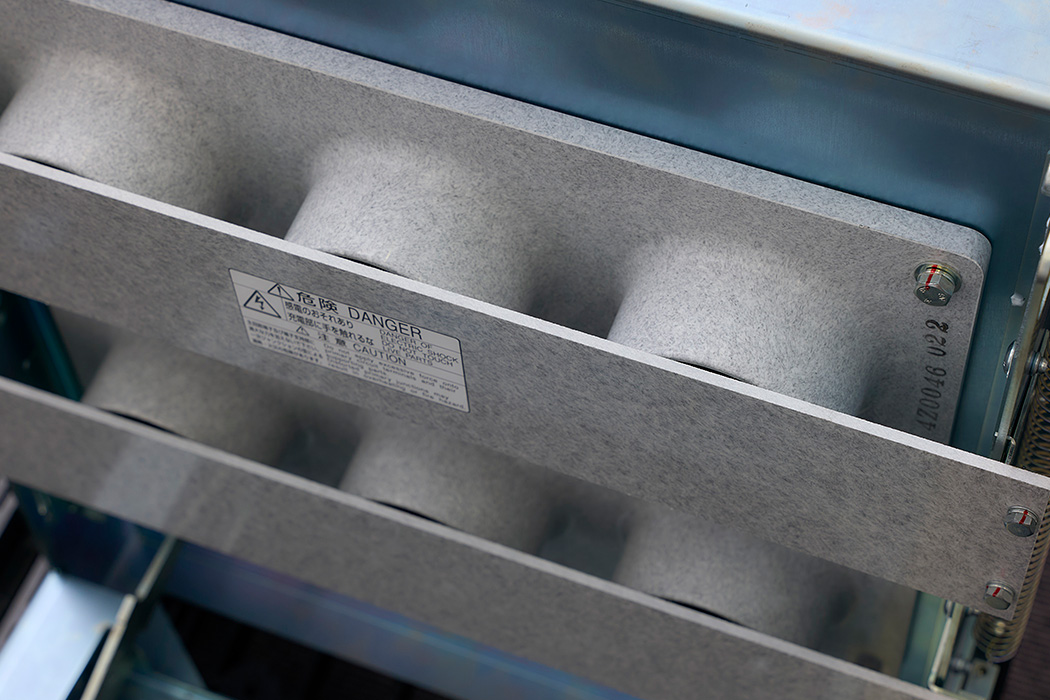
A conventional VCB with the resin shutter lowered. It is sealed to prevent fingers getting inside
However, it was not just a matter of simply changing the material. With a shutter made of metal, an arc could form between the terminal and shutter without sufficient insulation. To prevent this, the distance between them needed to be made too wide for an arc to form, but this would increase the size of the housing and make the product larger than existing models. This would force users of medium-voltage VCBs, like switchgears manufacturers, to respond by making design changes and other adjustments.
This update involved more than just increasing the distance. The resin shutter was designed to cover the terminals using a relatively simple mechanism to move it up and down. However, with a metal shutter, allowing sufficient insulation distance would create a gap big enough for a worker’s hand to fit between the shutter and the terminal, running the risk of a serious accident if touched. A further issue was that the shutter’s range of motion would no longer fit inside the fixed frame.
The manufacturer could, of course, avoid responsibility for such accidents by including a warning in the manual. But the intention of the new standard was to produce circuit breakers that could be operated safely even by inexperienced engineers. To ensure intrinsic safety, the new construction should make it impossible for anyone to put their hand inside, even if they tried to.
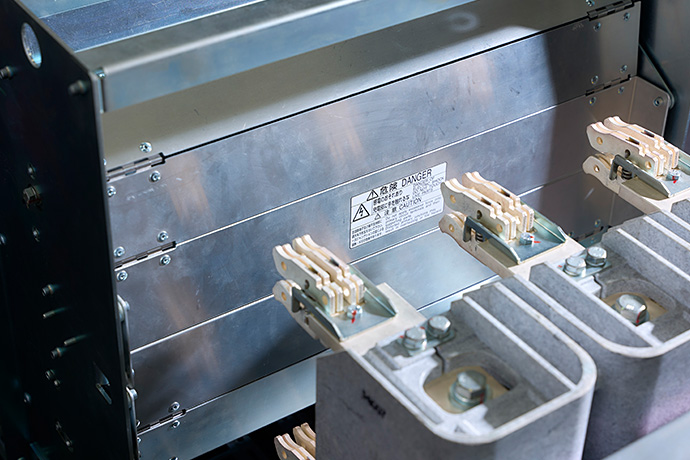
It would have been possible to use the same operating mechanism as the resin shutter by redesigning the resin bushings holding the terminals in place; but this could not solve the size issue. Faced with these constraints, the developers came up with a folding shutter design. By developing a unique motion mechanism and folding structure, they were able to maintain a safe distance between the shutter and terminals, while keeping the size the same as the existing product.
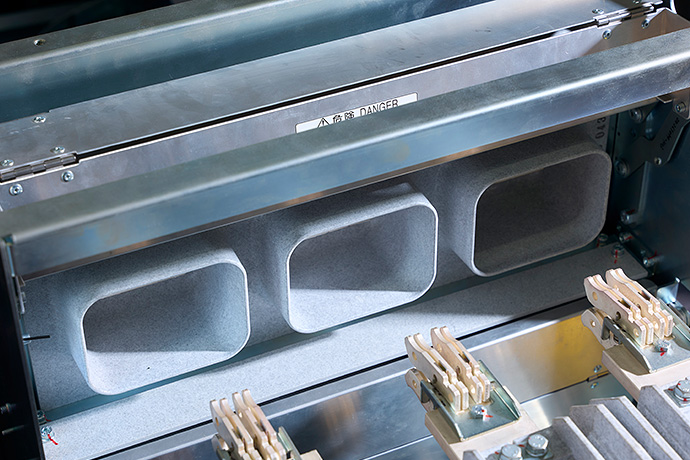
Metal shutters in the open (L) and closed (R) state. By adopting a folding design, the size is kept the same as the existing product, while maintaining a safe distance between the shutter and terminals
Metal shutters in the open (T) and closed (B) state. By adopting a folding design, the size is kept the same as the existing product, while maintaining a safe distance between the shutter and terminals
They even came up with a way to allow the shutters to move up and down individually. Although this was not a mandatory requirement of the standard, the team decided to spend extra time implementing this feature in view of serviceability, safety, and benefits for the switchgear manufacturer.
If the bolts keep loosening, get rid of the bolts
The new standard requires a mechanism allowing the circuit breaker to slide, enabling disconnection without opening the door of the distribution panel. The challenge was how to achieve this without affecting the size of the housing. A rail below the circuit breaker would allow it to be moved manually from outside the door, but this would significantly increase the height. As such, the team needed to devise a new disconnection mechanism, while keeping the height to a minimum.
Another challenge was optimizing the interlock system – the mechanism restricting operation to ensure safety. A circuit breaker is designed so that it will only operate if the correct procedure is followed, with several restrictions to prevent accidental operation. The new design would require an additional interlock to allow disconnection from outside the door. However, this led to complications, such as inconsistency with the existing safety interlock. “We ended up having to adjust the whole system, including other mechanisms,” recalls Ryosuke Matsuoka, who was in charge of the design.
Matsuoka went ahead with the design changes in consultation with other members of the design team. They adopted a toggle link for the sliding mechanism, allowing the circuit breaker to be operated in a small space. The interlock system was designed so that the lock is released by a tab on the back of the door, preventing the handle from being turned unless the door is closed.
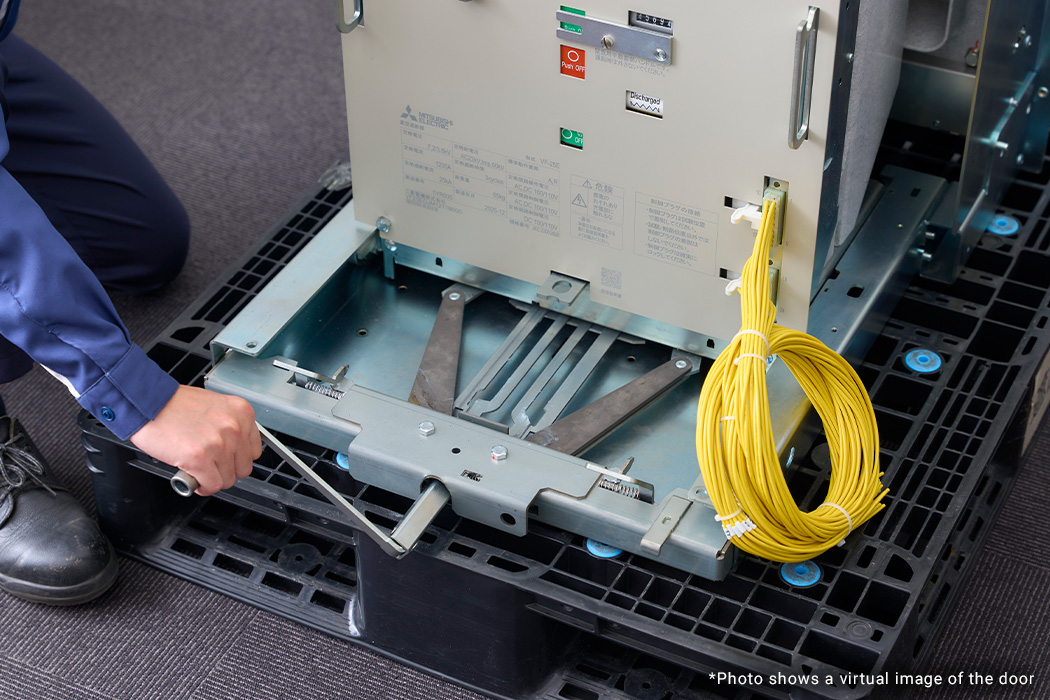
Mechanism to slide the circuit breaker using a handle on the outside, designed to be mechanically impossible to move without closing the door (Photo shows a virtual image of the door)
However, even once they had designed the mechanism, testing continued to uncover new challenges. One particularly tricky issue was that the bolts used in the interlock device tended to come loose during impact resistance testing. The circuit breaker is opened and closed by powerful springs, which subject the circuit breaker to significant impact during operation. In testing, the team found that these repeated impacts caused the fastening bolts to loosen.
“We initially underestimated the external force applied to the bolts,” explains Matsuoka. The design passed an opening and closing test of 10,000 cycles, as specified by the standard; but if there were no bolts, this problem could be avoided completely. Eliminating bolts would make assembly easier, too. Going back to the original goal of pursuing intrinsic safety, Matsuoka decided to aim for a boltless construction.
Back to the drawing board
Improvements were also made to the vacuum interrupter, a key component of the circuit breaker, and peripheral equipment. As well as employing oil-free bearings in the operating mechanism powering the vacuum interrupter, switching to long-life grease doubled the maintenance period from six years to twelve years. Each design team closely examined the updates from their own perspectives, contributing to easier maintenance.
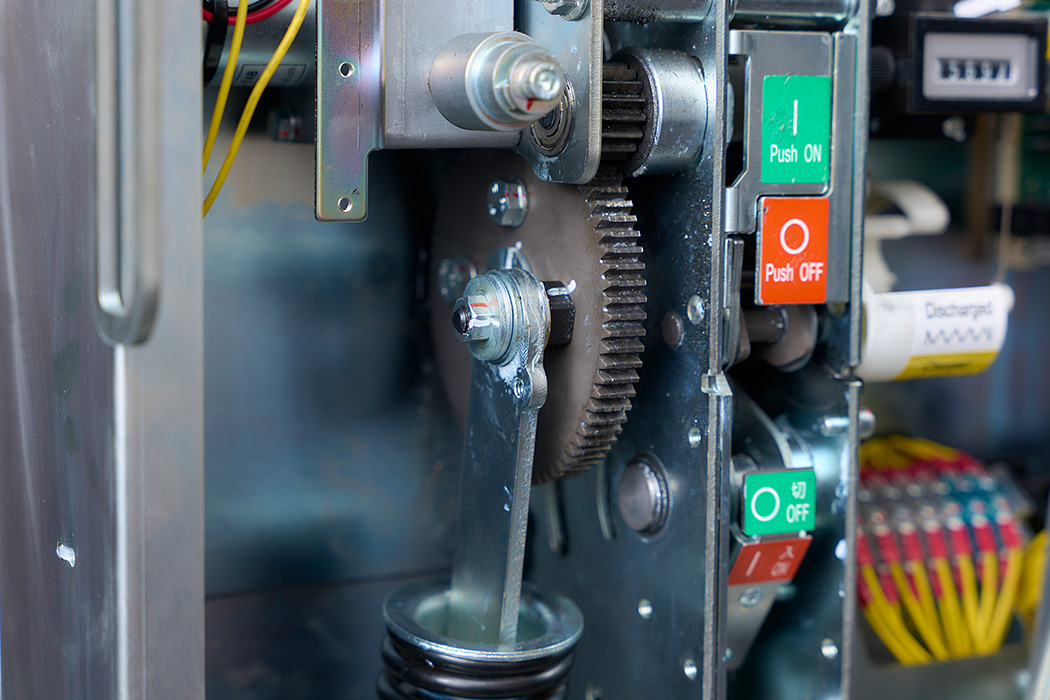
The lubrication cycle was extended to 12 years by adopting oil-free bearings in the operating mechanism
Still, the team faced a series of challenges, including the operating mechanism of the new circuit breaker. This system is initiated by a built-in solenoid, but the existing design could not generate enough suction force to operate the mechanism of the new circuit breaker. This meant a complete redesign, starting from the insulating rod configuration, making it possible to adopt a spring suitable for higher loads.
Just when they thought they had solved this, the team encountered an issue with the solenoid itself, which did not produce the required suction force for the new spring. One possible solution would be to compensate by boosting the current flowing through the solenoid or the number of coils, but this would increase the power consumption and size of the component.
The solenoid was redesigned to provide sufficient suction force, but another issue emerged. “This time, we found that the required precision was not practical for mass production, so we reluctantly went back to the drawing board,” recalls Akira Nishi, who worked on the design.
Compliance with the new standard was a major mission in the development of the next-generation medium-voltage VCB, but in fact, there were ripple effects on aspects not directly related to the new standard. Rather than compliance with the standard alone, the development team was also focused on making maintenance less labor-intensive – the real-world challenge in the background behind the standard.