

World roundup

Mitsubishi Electric Automation Korea
MECA competition: "Beyond automation, empowering people"
Published in December 2025

Part 1: Korea’s First MECA KOREA CUP 2025 — Behind the Scenes
With a total of ten teams taking part, the competition focused on the practical operation of real equipment rather than theoretical presentations. An official from Mitsubishi Electric Automation Korea (MEAK), who was responsible for managing the competition, explained: "The tasks assigned to students involved not only automating a production line, but also simulating potential failures and preparing countermeasures." This highlighted the fact that both practical skills and creativity were key evaluation criteria.
The competition was thoroughly prepared from the initial training stage. As well as the equipment owned by the school, teams with MFEC(*) certification were provided with online education, equipment rental, and a two-month software license by Mitsubishi Electric. Participants at the site were actively visualizing digital twin models on screens and monitoring real-time sensor data connected to physical equipment.
(*MFEC (Mitsubishi FA Engineer Certification) is a privately registered certification system independently established by Mitsubishi Electric Automation Korea Co., Ltd. to verify the technical capabilities of users of Mitsubishi Electric FA products. Refer to the website for more information.)
Winning teams in the competition would receive certificates presented by Korea’s Minister of Employment and Labor and the President of the Korea Committee for the WorldSkills Competition (aka the President of the Human Resources Development Service of Korea). Far beyond a typical skills competition, these awards are a formally recognized qualification that enhances the recipient’s portfolio when applying for a job.
MEAK has expressed its intention to ensure that this competition is not just a one-time event, and is expanding it into a year-round program, incorporating the MFEC certification system, regular training, and equipment support. In addition, the Korean grand champion team will join the Global MECA competition, which will be held in Japan in 2026.
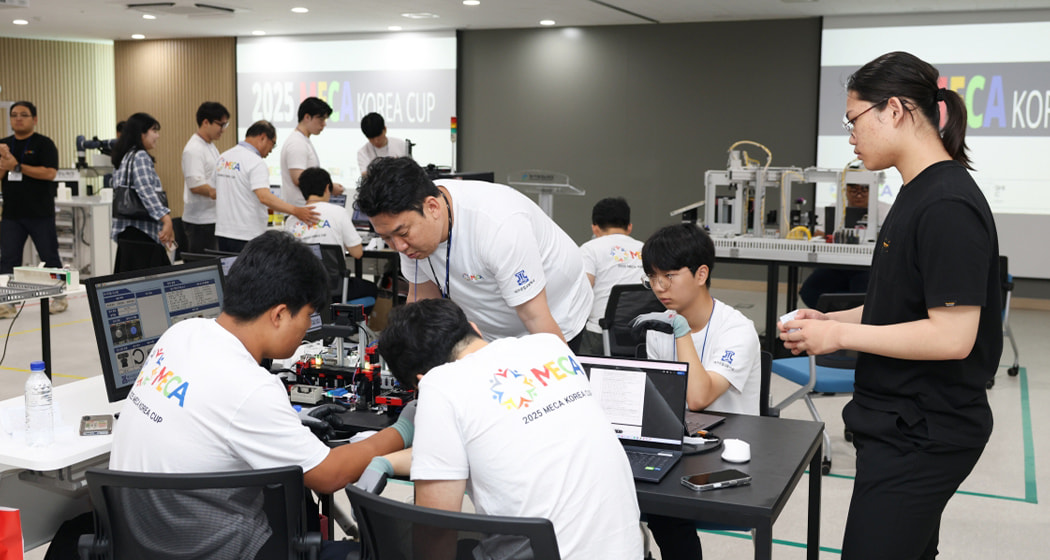
Participants formed teams to create demo designs for automated systems.
Numerous representatives from industry and educational institutions, including officials from the Human Resources Development Service of Korea, and the Smart Manufacturing Innovation Center of the Korea Electronics Technology Institute (KETI SMIC) and MEAKs own representatives, attended the competition onsite. A professor commented, "Through the competition, students gain valuable experience in collaboration, problem-solving, and presenting, making it highly educational." Students who participated in the competition said that they gained confidence in addition to acquiring technical skills. One participant said, "Previously, I only learned the theory of PLC and sensor control, but actually operating and configuring them made the concepts come alive at my fingertips." As he noted, the competition provided an opportunity to connect theory with practice.
"Why MECA?" the real-world demands practical experts
FA technology is advancing rapidly, but the key lies in practical engineers who can identify problems and solve them. Recognizing this need, Mitsubishi Electric officially launched MECA, a global educational support program, in the early 2000s.
The program not only moves beyond traditional lectures, but also focuses on developing the well-rounded capabilities that future engineers need through practical training and global skills competitions. MECA is designed as a hybrid structure that connects theory and practice, helping students build practical problem-solving skills. Mitsubishi Electric has operated this program around the world for more than 20 years because it believes that the future of the FA industry will be shaped by field-oriented experts rather than purely theoretical ones.
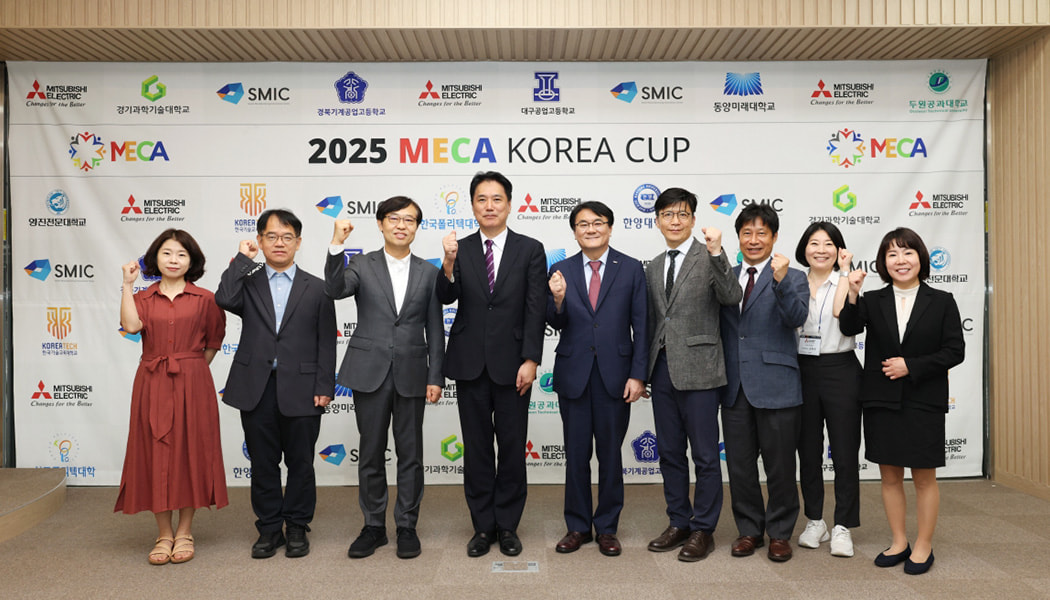
MEAK executives planned the first-ever MECA competition in Korea.
The educational structure of MECA thoroughly avoids theoretical learning only. The Italian program is a prime example. Students first learn the theory online, then undergo practical training to operate equipment and solve problems directly. Mitsubishi Electric supplied FA equipment to 30 universities in Türkiye and opened regional FA centers as training facilities. Students there engage in practical training with key equipment such as PLCs, servo motors, and HMIs, performing tasks that simulate real industrial projects.
By doing so, it organically connects both theory and practice, and through repeated practical training, students develop into engineers skilled in application rather than just understanding. This distinguishes MECA from traditional educational approaches and develops talent that is immediately ready to step into the field.
The core of MECA is undoubtedly its skills competition. The competition was first launched in China in 2007 and is held annually. So far, more than 600 educational institutions and 12,000 students have participated. This competition goes beyond a simple showcase of ideas – participants are required to design an automation system within a limited time using actual FA equipment and implement creative solutions.
The competition consists of two categories, System Application and Creative Design, each of which is evaluated based on technology readiness and creativity. Teams that qualify through the preliminary round advance to the finals, competing over two days and presenting their results. The MECA skills competition operates as a connection between education, recruitment, and technology trends.
Another key component of MECA is its certification system. More than just a simple certificate, it is a system that validates practical skills. In Korea, a private certification system called MFEC has been introduced, offering exams twice a year. It consists of three levels allowing not only students but also experts to assess and upgrade their skills. The exam prioritizes practical skills over written tests, requiring candidates to directly operate FA products under conditions identical to those of Mitsubishi Electric's actual equipment. MFEC certification is more than just a one-time exam, and instead serves as a system that encourages continuous skill development and fosters ongoing motivation to learn.

The MECA skills competition serves as a virtuous cycle connecting education, recruitment, and technology trends.
MECA is continuously evolving to reflect the industrial and educational environments of countries around the world. For example, Vietnam hosts an annual nationwide skills competition involving up to 120 teams who compete by presenting practical projects and academic papers. Brazil recently hosted its first MECA competition in São Paulo, while Taiwan is introducing the MECA curriculum mainly through higher technical institutions. Training centers in Thailand are integrating e-learning with practical field training to build a sustainable educational ecosystem. These activities serve as strategic investments to secure national manufacturing capabilities.
The reason MECA has been able to successfully establish itself in countries around the world is simple. As theory-based education reached its limitations, there emerged an urgent demand for a practical, customized system. Mitsubishi Electric has expanded MECA as a joint platform through collaboration with governments, universities, and corporations around the world, making it the standard for FA education.
The MECA skills competition has finally arrived in Korea. Despite being a manufacturing leader, Korea's system for developing practical talent in the FA field is still in its early stages. The introduction of MECA goes beyond a simple competition. Educational institutions enhance their curricula with a focus on practical training, while corporations recruit certified talent. Meanwhile, students are offered an integrated growth platform that combines theory, practical training, certification, and competition all in one.
Korea already possesses global technological competitiveness in PLC, robotics, and smart factory industries, making the synergy with the MECA system very promising. In this era of technology, what truly matters are the people who can change the world, not just the tools they use. Thus, the MECA’s fundamental mission is to nurture these leaders.
"Technology begins with a challenge" three voices, one direction
The 1st MECA KOREA CUP has officially begun, with three speakers taking turns delivering the opening and congratulatory speeches. The first to speak was Tsukasa Yamaguchi, the representative from MEAK, who offered practical advice to the participants.
He said, "You have likely encountered trial and error throughout your preparation and may have had conflicts with your teammates at times. However, all those experiences have become valuable assets shaping the person you are today."
Yamaguchi also emphasized, "MECA is not just a competition but a practical training platform for future engineers" and that, "The MECA competition provides students with opportunities to learn, embrace challenges, and progress toward their goals, getting them ready to lead the future of the industry."
In conclusion, he especially encouraged students to develop their own technical language and seize opportunities to grow through this competition.
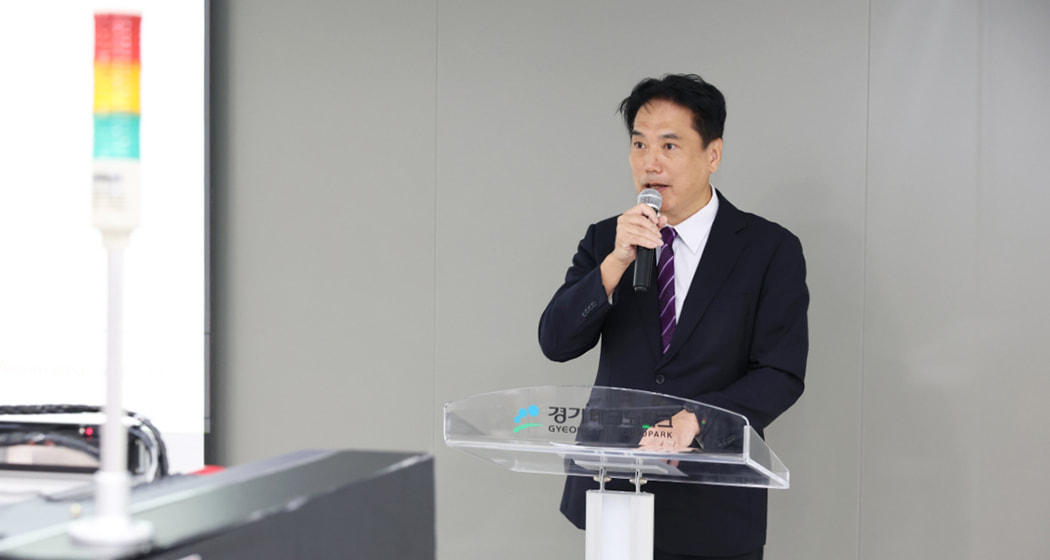
Tsukasa Yamaguchi, a representative from MEAK
Afterwards, Wooyoung Lee, Director of the Human Resources Development Service of Korea (HRDK), addressed the audience with a message about the value of technology.
Lee stated, "The future of Korea depends on young technical talents like you," and emphasized that the participants have embarked on their first journey toward success through this competition.
As a former professor majoring in mechanical engineering, he engaged with the students by specifically mentioning their school and stated, “Even in the era of AI, human creativity and problem-solving skills remain irreplaceable assets,” and emphasized that practical skills and a sense of overcoming challenges in the FA field will become significant in the future.
He added, "From the perspective of HRDK, which is responsible for selecting WorldSkills participants and supporting private skills competitions, MECA is a meaningful platform," and suggested that, in the future, winning contestants will be granted practical benefits, such as exemptions from the national technician qualification exam.

Wooyoung Lee, Director of the Human Resources Development Service of Korea
Lastly, Byunghoon Song, Center Director of KETI SMIC, concluded the congratulatory speech by emphasizing the importance of practical technical skills.
Song stated, "Manufacturing has entered an era of convergence between AI and automation, but the role of individuals who can truly understand systems and identify problems has become increasingly important."
He pointed out, "The software used by the participants, such as SCADA software GENESIS™ and 3D Simulator MELSOFT Gemini, is also used in real industrial processes," and emphasized that "MECA is an educational platform that connects theory and practice."
He concluded by expressing his expectation that MECA will continue to expand across various industries in Korea. The speeches showed a clear vision of the talent needed for the future of manufacturing – individuals with practical experience in technology, the courage to face failure, and a lifelong commitment to learning.

Byunghoon Song, Center Director of KETI SMIC
- Introduction: Highlights from the first-ever MECA KOREA CUP: "Awakening the power of theory"
- Part 2: Students’ Challenge — Designing and Building the Factory of the Future
- Part 3: Achievements and Outlook — The Awards Ceremony and the Future of MECA