IEEE Fellow
Michael J. Jones
Computer vision and object detection
IEEE Fellow
Computer vision and object detection
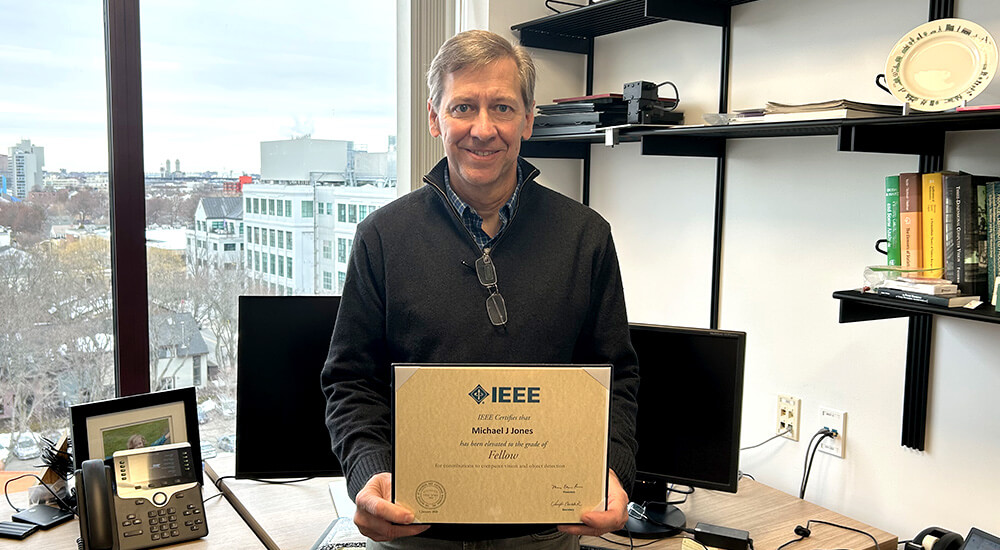
Dr. Michael J. Jones was elevated to IEEE Fellow, as recommended by the IEEE Computer Society, for contributions to the computer vision topics of object detection and video-based anomaly detection. Detecting different types of objects (such as faces or people) in an image is a fundamental problem in computer vision and is the starting point for many image processing applications. His research demonstrated a new way of detecting objects that is both accurate and very fast. Mike has also made important contributions to the problem of detecting unusual activity from video of a scene, which has important applications in surveillance and security.
Mike's early work with colleague Dr. Paul Viola led to the development of the first real-time face detector that ran on a standard CPU. The Viola-Jones face detector demonstrated the power of the Adaboost algorithm for machine learning applications to the computer vision community.
Adaboost is used to automatically find the most accurate set of image features for detecting a particular class of objects, such as faces. This work also introduced the idea of the integral image representation which makes the computation of certain simple image features extremely efficient. Finally, his work showed the power of a cascade of increasingly more complex classifiers which greatly speeds up object detection. Together these ideas created a new paradigm for fast and accurate object detection in images.
Mike's more recent work on video-based anomaly detection introduces new methods for efficiently modeling a dynamic scene from video that shows normal activity. Unusual activity in the scene can then be detected by noticing differences from the normal model. This technology frees humans from the tedious job of monitoring surveillance video for safety and security purposes.
Mike's elevation to IEEE Fellow "helps to shine a spotlight on the world-class research being done at MERL," he states. "It shows the key role that an industrial research laboratory like MERL can play in advancing technology for the world.“
Speaking about what's next, he says, "In the future I hope to continue finding new solutions to difficult research problems and to mentor students to help them find success doing research in computer vision and machine learning."
I joined MERL because it allows researchers to freely pursue their research interests and to publish their research as a part of the greater research community.
The research environment at MERL gives researchers a lot of freedom to pursue their passions and at the same time provides a way to apply their new ideas to actual products and businesses.
My advice to researchers is to follow your passions for finding interesting new research questions. Also, when you see most researchers going one direction, go another way.
For me, research is about trying to add new ideas to the body of human knowledge. Doing good research is a way to leave a positive mark on society.


Distinguished Research Scientist,
Mitsubishi Electric Research Laboratories
Michael J. Jones
In 1997, Michael earned his Ph.D. from the Massachusetts Institute of Technology. His areas of expertise include computer vision, machine learning, and data mining. His research interests focus on the detection and analysis of individuals in images and video—specifically the development of advanced face and pedestrian detection and recognition technologies—as well as novel methods for detecting anomalous behavior within complex scenes. He is widely renowned as a co-developer of the Viola-Jones face detection method and has received prestigious international honors, including the ICCV Marr Prize and the CVPR Longuet-Higgins Prize.