IEEE Fellow
Toru Takahashi,Ph.D.
Antennas
IEEE Fellow
Antennas
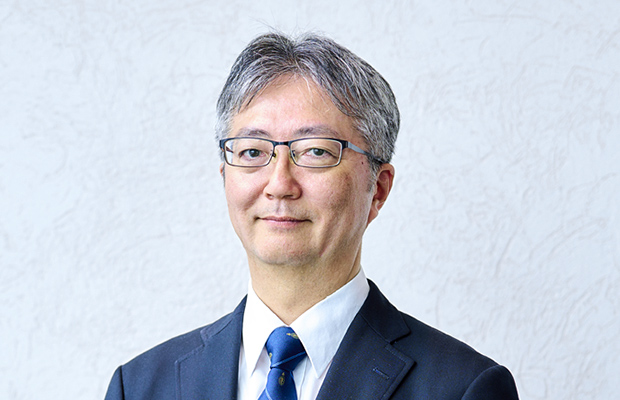
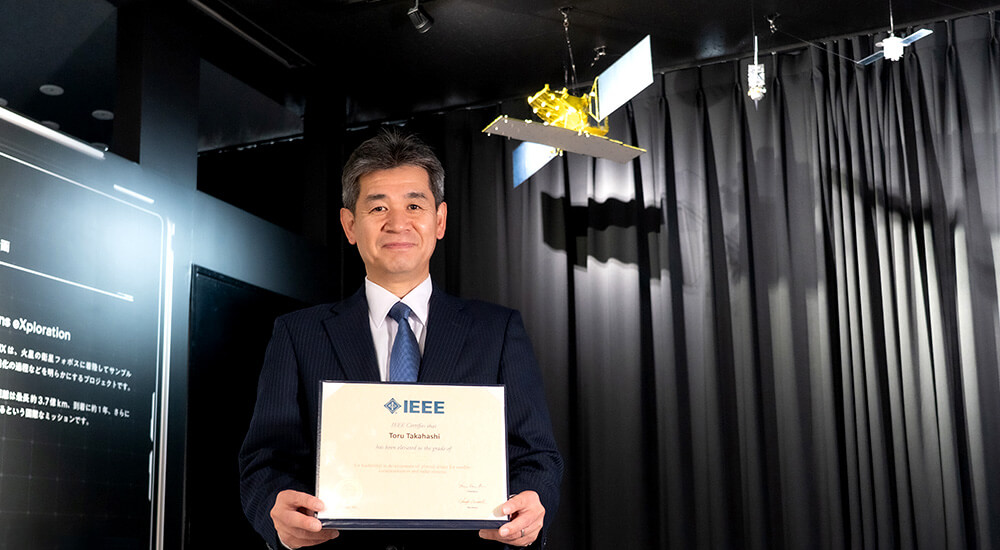
Dr. Toru Takahashi has led the development of two innovative technologies to advance and improve the quality of phased-array antennas for satellite communications and radar systems: unique calibration technologies; and dual-polarization technologies. In recognition of the originality of these breakthroughs and their contribution to society through Mitsubishi Electric's products, he was awarded the title of IEEE Fellow in 2026.
Takahashi's calibration methods enable a phased array to operate as a single antenna by precisely synchronizing all array elements. By reducing calibration time, improving accuracy, and theoretically analyzing error sources, these methods have greatly advanced phased-array performance.
Likewise, for dual-polarization, he discovered that offsetting the feed point of the antenna element from the central axis leads to a reduction in cross-polarization. He also succeeded in theoretically deriving the optimal offset condition. This innovative approach, called "feed point perturbation," is a simple but highly effective design method.
The calibration technology developed by Takahashi has contributed to the development of phased arrays at Mitsubishi Electric, improving the quality of their beam-forming in particular. Similarly, his dual-polarized technology has been applied to the Advanced Land Observing Satellite-2 (ALOS-2) and the follow-on satellite ALOS-4, contributing to the full polarimetry observation of the onboard synthetic aperture radars. These technologies are expanding satellite communication capacity and enabling more versatile radar observations, thereby contributing to a safer, more secure society.
For Takahashi, his achievements and his elevation to IEEE Fellow were part of a collective effort. "'IEEE Fellow' is not only my personal honor, but also an honor for all the colleagues that I have worked with," he says. "The technologies I developed were created through working with a lot of engineers in Kamakura Works and the Electronics and Communication Systems Center. And they could not be put into practical use without the tremendous efforts of those engineers. Hence, I think this achievement should be attributed to them, and I'd like to express sincere appreciation to them."
Looking to the future, he explains, "I'd like to continuously extend my expertise in radio-wave systems, including antennas, radio wave propagation, radar, wireless communications, etc., by incorporating a variety of technologies in other areas, and develop as many leading researchers as possible by mentoring young researchers as a Chief Expert."
When I was a graduate student in Waseda University, I was interested in electromagnetic field theory and wanted to engage in R&D related to it. Then I learned that Mitsubishi Electric was renowned for antenna technology deeply related with electromagnetic field theory and that the company is one of the top players in the area. That is why I joined Mitsubishi Electric.
Mitsubishi Electric has not only a lot of leading researchers but also technical strength in various fields. Working with top researchers in the company has definitely contributed to enhancing my R&D skills.
Additionally, I'd like to emphasize that Mitsubishi Electric also has a lot of skilled engineers in its business divisions. Having discussions with those engineers has improved the quality of my R&D results.
I was very lucky to progress R&D, based on those technical assets.
Always keep in mind to be creative and set higher goals. And keep learning.
If you do so, you will be able to achieve good results in the near future.
For me, "Research" is the first step in creating a new common sense.


"Research" is the first step in creating a new common sense.
Chief Expert,
Future Society Creation Lab,
Information Technology R&D Center
Toru Takahashi
Dr. Takahashi joined Mitsubishi Electric Corporation (in Japan) in 1994. His main area of research and development is antennas, especially phased arrays for radar and wireless communication systems. He was involved in the development of satellite phased arrays and reflector antennas in Mitsubishi Electric's Kamakura Works (2004-2007) and R&D of high-frequency circuits and semiconductor packaging technologies in Mitsubishi Electric's Information Technology R&D Center (2018-2021). Recently, he has been interested in R&D of radio wave systems such as radar, wireless data links, and satellite positioning systems. Currently, he is President of IEICE Communication Society and Chair of the IEEE AP-S Tokyo Chapter.