


Initiatives toward a Circular Economy
The Mitsubishi Electric Group is actively engaged in the circular economy, undertaking initiatives such as recycling plastics and reducing water usage to mitigate environmental impacts.
Effective Utilization of Plastic Waste
Based on Japan’s Resource Circulation Strategy for Plastics, the Mitsubishi Electric Group is prioritizing the effective utilization*1 of plastic waste*2 and has established a medium-term target of achieving 100% effective utilization of plastic waste by the fiscal year ending March 31, 2036.
As part of these efforts, the Group manages the amount of plastic waste, ensures proper sorting, and continually reviews waste-processing contractors. For our overseas sites, we have set targets for the effective utilization of plastic waste starting in the fiscal year ending March 31, 2027. Going forward, we plan to promote waste reduction and effective utilization activities in accordance with local regulations and the status of waste management infrastructure, including the processing capacity and location of recycling facilities. We also intend to make further efforts to reduce waste generation by sharing effective improvement practices among sites, enhancing the visibility of plastic waste, and advancing initiatives aimed at increasing material and chemical recycling rates.
- Note: Waste refers to items that are no longer needed at a site. This includes items that have been disposed of directly, entrusted to a third party for disposal, or sold/transferred to others.
- 1 Reuse, material recycling, chemical recycling, thermal recovery
- 2 Plastic waste includes valuable materials.
| Environmental Data | Effective utilization of plastic waste |
|---|
Generating High-Purity Plastics from End-of-Life Home Appliances
The Mitsubishi Electric Group employs proprietary technology to convert end-of-life home appliances into high-purity plastics. Insights obtained during this recycling process are fed back into product design, driving continuous improvements in product recyclability rates.
Mitsubishi Electric Group’s Proprietary Technology for Producing High-Purity Plastic from Home Appliances
|
Closed-Loop Recycling of Plastic
The Mitsubishi Electric Group is advancing closed-loop recycling in which high-purity recycled plastics produced within the Group are reused in Mitsubishi Electric home appliances.
For example, we have developed a technology that produces regenerated PC/ABS* with consistent quality, high durability, and flame retardancy by utilizing PC/ABS recycled from end-of-life appliances. This regenerated material is used in wireless communication terminals for sensor applications, such as gas meter reading systems. This has enabled reductions of approximately 70% in the volume of new plastic used in these components and 57% in CO2 emissions compared to manufacturing PC/ABS from new raw materials. In addition, we are working to expand the use of recycled plastics to other applications, such as plastic boxes for wire EDM machines and home appliances.
- A plastic which is a blend of polycarbonate (PC) and acrylonitrile butadiene styrene (ABS)
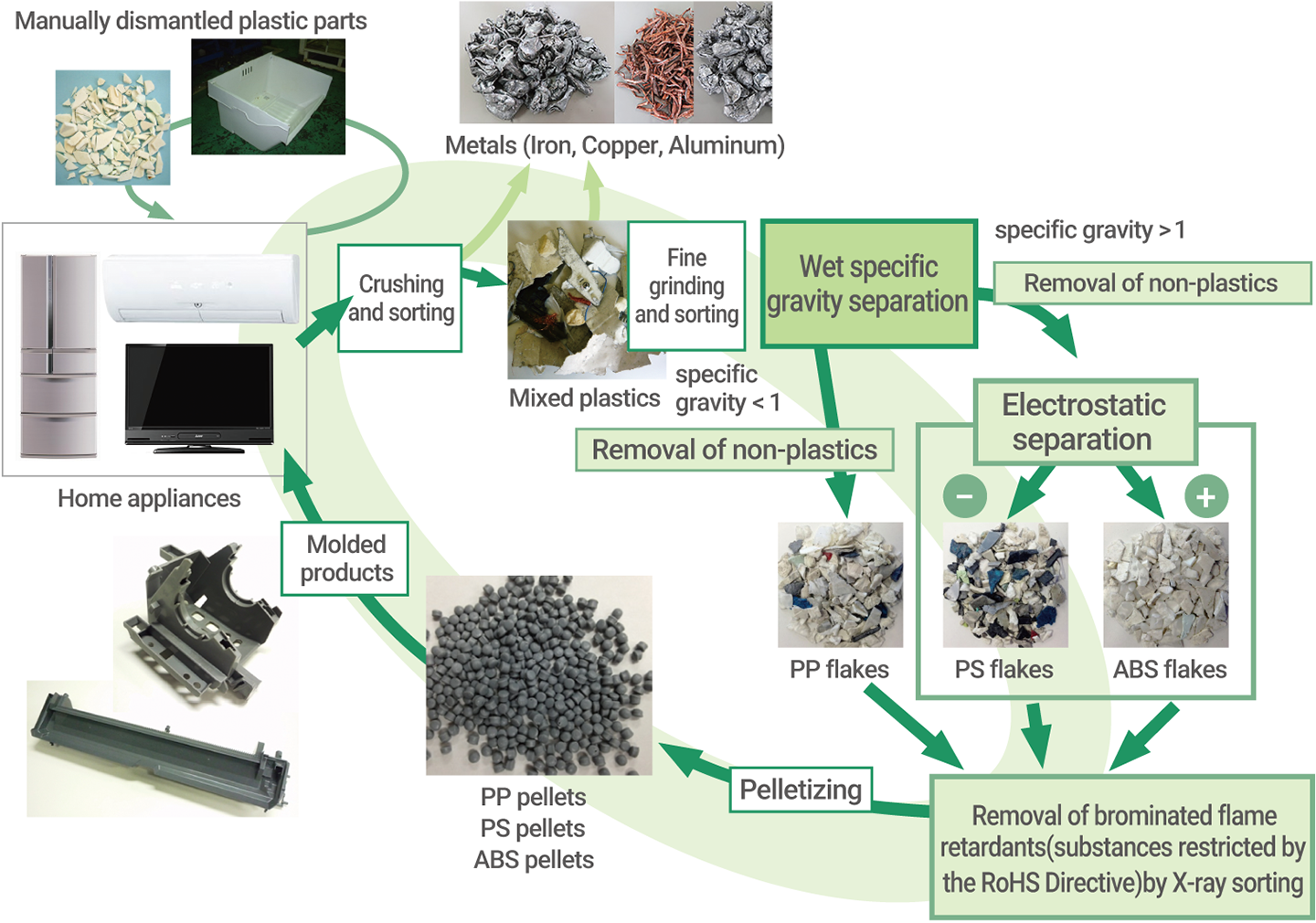
Flow chart of Mitsubishi Electric Group closed-loop plastic recycling
Creating a Service in the Recycling Business
Based on the advanced sorting technologies and know-how cultivated through its home appliance recycling business, Mitsubishi Electric promotes to offer its "Smart Plastic Separation DX Solution CIRCUENGINE" to enable utilization of its advanced plastic sorting technology based on electrostatic separation for use in customers’ plastic recycling operations.
The CIRCUENGINE solution uses sensors to collect data on factors that affect electrostatic separation, such as material composition and input volume of crushed mixed plastic pieces, as well as sorting results. AI performs an integrated analysis of the collected data.
By applying digital and smart technologies to electrostatic separation, the CIRCUENGINE solution enables consistent separation of a wide variety of mixed plastics and contributes to the production of high-quality recycled plastic materials. Mitsubishi Electric will expand resource circulation toward a circular economy by bringing the solution to a wide range of sectors beyond home appliances.
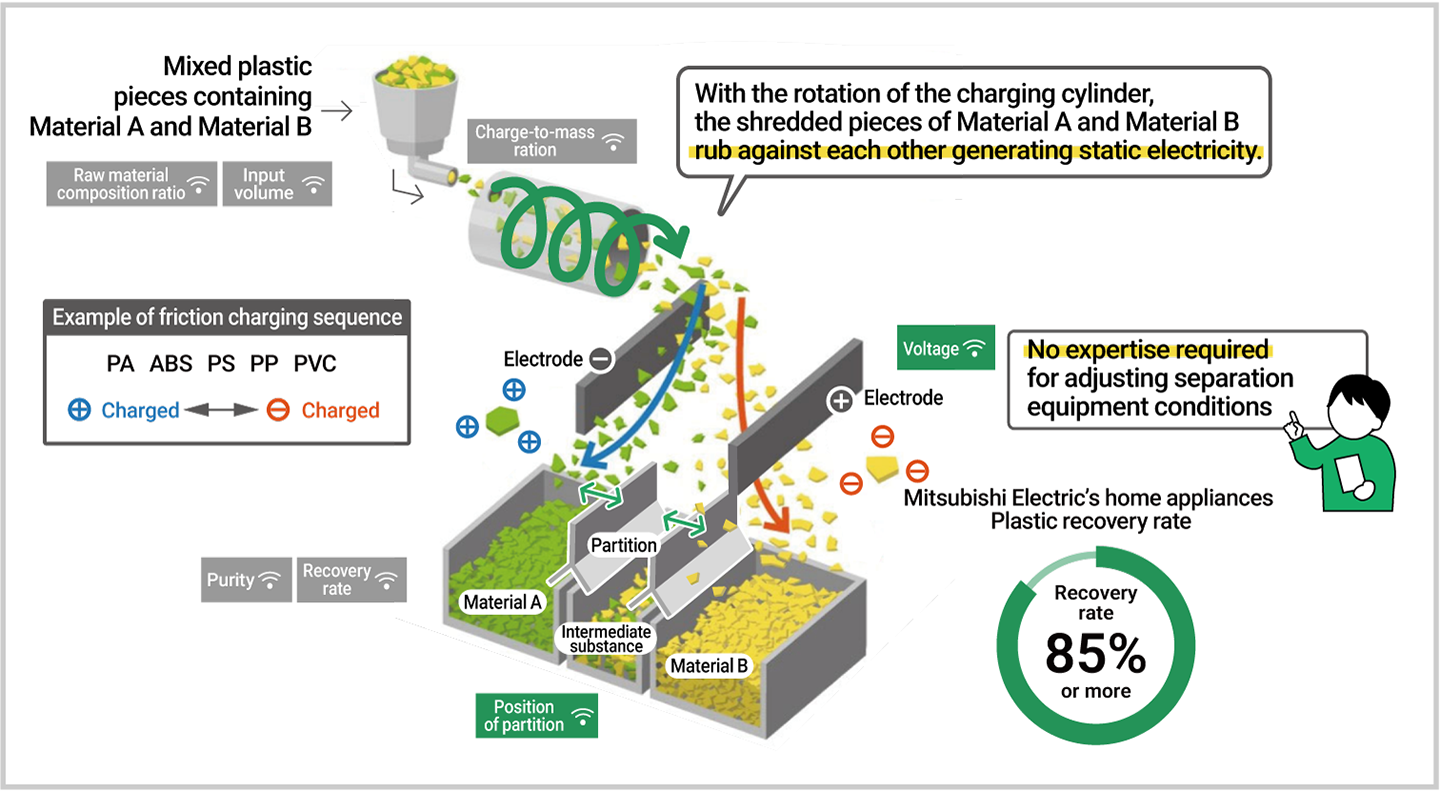
Smart Plastic Separation DX Solution CIRCUENGINE
3Rs for Packaging Materials
The Mitsubishi Electric Group is advancing the 3Rs—Reduce, Reuse, Recycle—of the packaging materials required for product transportation, with the goal of minimizing overall packaging use.
<3Rs for Packaging Materials>
- Reduce : simplify packaging designs to use fewer materials
- Reuse : broaden the application of returnable containers and packaging
- Recycle : reclaim and reprocess used packaging materials
| Environmental Data | Packaging material usage |
|---|
Reducing Water Usage
Managing Water Risk
Globally, escalating water shortages, pollution, and climate-change-driven extreme weather are severely impacting raw-material sourcing and product manufacturing, underscoring the critical importance of corporate water-risk management.
The Mitsubishi Electric Group has evaluated water stress and quality at approximately 160 manufacturing sites—including associated companies—using Aqueduct*1 and Water Risk Filter.*2 We also conducted an assessment of species-extinction risk with the IBAT*3 (STARt). By combining these results with each site’s operational profile (e.g., business scope, production-related water use), we have quantified the water risk at every production location. We will consider setting water-related targets for high-risk sites, taking into account the circumstances of their watershed. We are also working to reduce our environmental impact by taking measures to minimize local environmental impacts, including complying with regional wastewater standards.
- 1 Water risk assessment tool developed by the World Resources Institute (WRI), used to assess “baseline water stress” and “coastal eutrophication potential.”
- 2 Water risk analysis tool developed and operated by the World Wide Fund for Nature (WWF), used to assess “baseline water depletion,” “blue-water scarcity,” and “surface water quality index.”
- 3 Integrated Biodiversity Assessment Tool: The assessment is based on the threat abatement (t) component of the Species Threat Abatement and Restoration Metric (STAR).
Response to High-Risk Sites
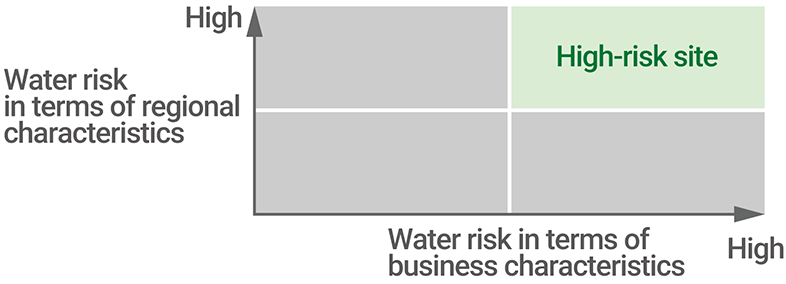
Conceptual diagram of water risk analysis
The Mitsubishi Electric Group has identified five production sites*1 as high-risk sites based on Aqueduct water-risk evaluations and each site’s operational profile, and actively manages their water risk. Under our Environmental Plan 2025, we have set a target to reduce water consumption per unit of sales at these high-risk sites by at least 6% in fiscal 2026*2 versus fiscal 2020.*2 To achieve this, we are monitoring water-saving performance in water-using equipment, tracking rates of water reuse, installing and utilizing low-flow faucets, and taking other water-saving measures.
We will continue to co-exist in harmony with local communities by implementing effective water risk measures in consideration of regional characteristics and circumstances at each production site, with a focus on high-risk sites.
| Environmental Data | Water consumption per unit of sales at high-risk sites |
|---|
- 1 The following manufacturing companies are located in Thailand:
- Mitsubishi Electric Consumer Products (Thailand) Co., Ltd.
- Siam Compressor Industry Co., Ltd.
- Mitsubishi Electric Automation (Thailand) Co., Ltd.
- Mitsubishi Elevator Asia Co., Ltd.
- Mitsubishi Electric Thai Auto-Parts Co., Ltd. - 2 Refers to the fiscal year ended March 31 of that year
Status of Water Usage, Intake, Discharge, and Reuse
The Mitsubishi Electric Group treats water used in production processes and reuses it in those same processes, and repurposes purified wastewater for toilet flushing, cooling towers, etc. The Group also reduces groundwater consumption by harvesting rainwater.
At its production sites, water is taken to be used mainly for cooling, cleaning, and adjusting the concentration of water-based paints, and as a solvent, an additive to materials and a heat medium. Each site regulates wastewater discharge according to its voluntary effluent-quality standards to ensure compliance with local statutory limits. When applicable, these standards also integrate local discharge criteria aligned with the receiving water body’s characteristics.
| Environmental Data | Water usage |
|---|