


TNFD-Based Disclosure
General Requirements
| Item | Content |
|---|---|
| Application of materiality | The Mitsubishi Electric Group has set forth the clear course of action it will take through the year 2050 in its Environmental Sustainability Vision 2050. The Group is working hard to contribute to realizing a sustainable global environment based on an environmental policy that outlines how the Group will contribute to the environment. This report identifies material issues for natural capital, and discloses and reports relevant dependencies, impacts, risks, and opportunities in accordance with the double materiality approach, which assesses materiality in terms of impact and finance. |
| Scope of disclosures | This document covers the Mitsubishi Electric Group’s business operations in Japan and abroad and holistically describes how each segment is related to nature. In addition, those locations that are determined to be material as a result of evaluation and analysis are subjected to an in-depth analysis of nature-related issues. Going forward, we will consider analyzing how our value chains are related to nature. |
| Location of nature-related issues | For the Mitsubishi Electric Group’s production sites in Japan and abroad, this document describes the results of evaluation on whether each of them should be classified as a sensitive location, based on nature-related metrics for the region, by using the TNFD’s evaluation and analysis methods. In addition, those locations that are determined to be material are subjected to an in-depth study of nature-related issues. The Mitsubishi Electric Group also recognizes that its value chains for materials procurement and other purposes have material dependencies and impacts on nature. Initiatives for sustainable procurement are already underway, and going forward, we will consider analyzing how our value chains are related to nature. |
| Integration with other sustainability-related information disclosures | We disclose information on natural capital related to the Mitsubishi Electric Group in line with the TNFD’s recommendations. In addition to environmental information disclosures in accordance with the disclosure framework, we are expanding integrated ESG information disclosures in view of meeting internationally harmonized disclosure standards, typically those set by the International Sustainability Standards Board (ISSB). Going forward, we will consider integrating these with climate-related disclosures based on the TCFD’s recommendations. |
| The time horizons considered* | Short-term: Two- to three-year period starting from the current fiscal year (period of the environmental plan and the medium-term management plan) Medium-term: Period through the fiscal year ended March 31, 2021. |
| Engagement with indigenous peoples, local communities, and affected stakeholders | We are aware that in any part of the upstream and downstream value chains, the Mitsubishi Electric Group’s business model would be infeasible without nature-derived resources. In addition, recognizing the importance of the human rights of its stakeholders, the Group has built a system for human rights due diligence that encompasses the supply chains. The Group also engages with suppliers through initiatives such as evaluating and improving the suppliers’ activities in line with the Mitsubishi Electric Group Supply Chain Code of Conduct and the Green Accreditation Guideline. As part of these efforts, in the procurement of materials related to natural capital, the Group takes care to protect the human rights of Indigenous Peoples and people in local communities who could be affected, by reducing associated risks. |
- As of December 2025
Nature-related dependencies and impacts (Evaluate)
Evaluation process
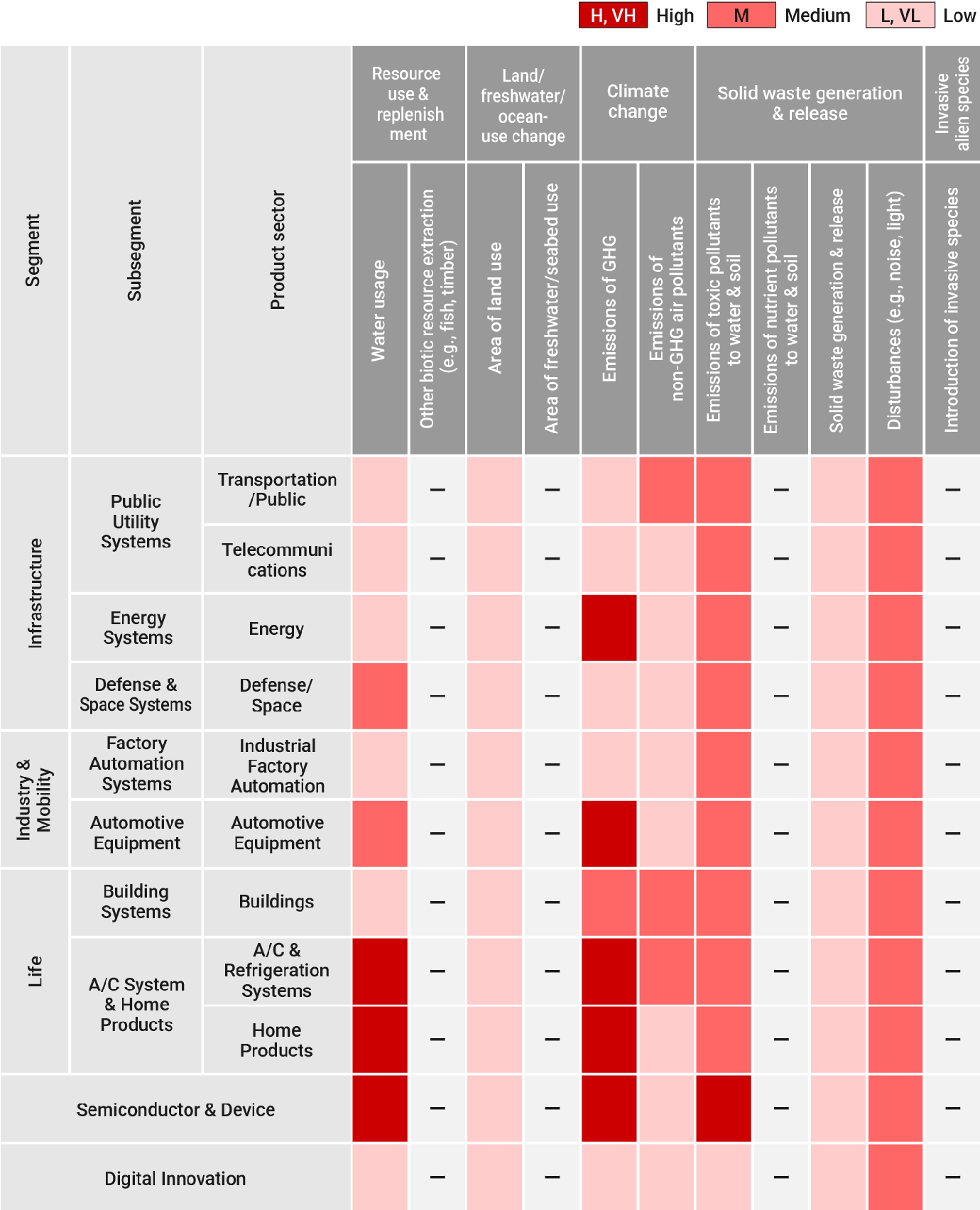
The TNFD-recommended ENCORE tool was used to evaluate the dependencies/impacts that the Mitsubishi Electric Group’s business has on nature. In practice, we categorized the Mitsubishi Electric Group’s business segments into the Class-level economic activities defined by the International Standard Industrial Classification (ISIC), evaluated them with ENCORE’s five-level rating system (VL, L, M, H, VH), adjusted the results based on the situation specific to the Group, and compiled the results into a heat map.
Heat map (dependencies)
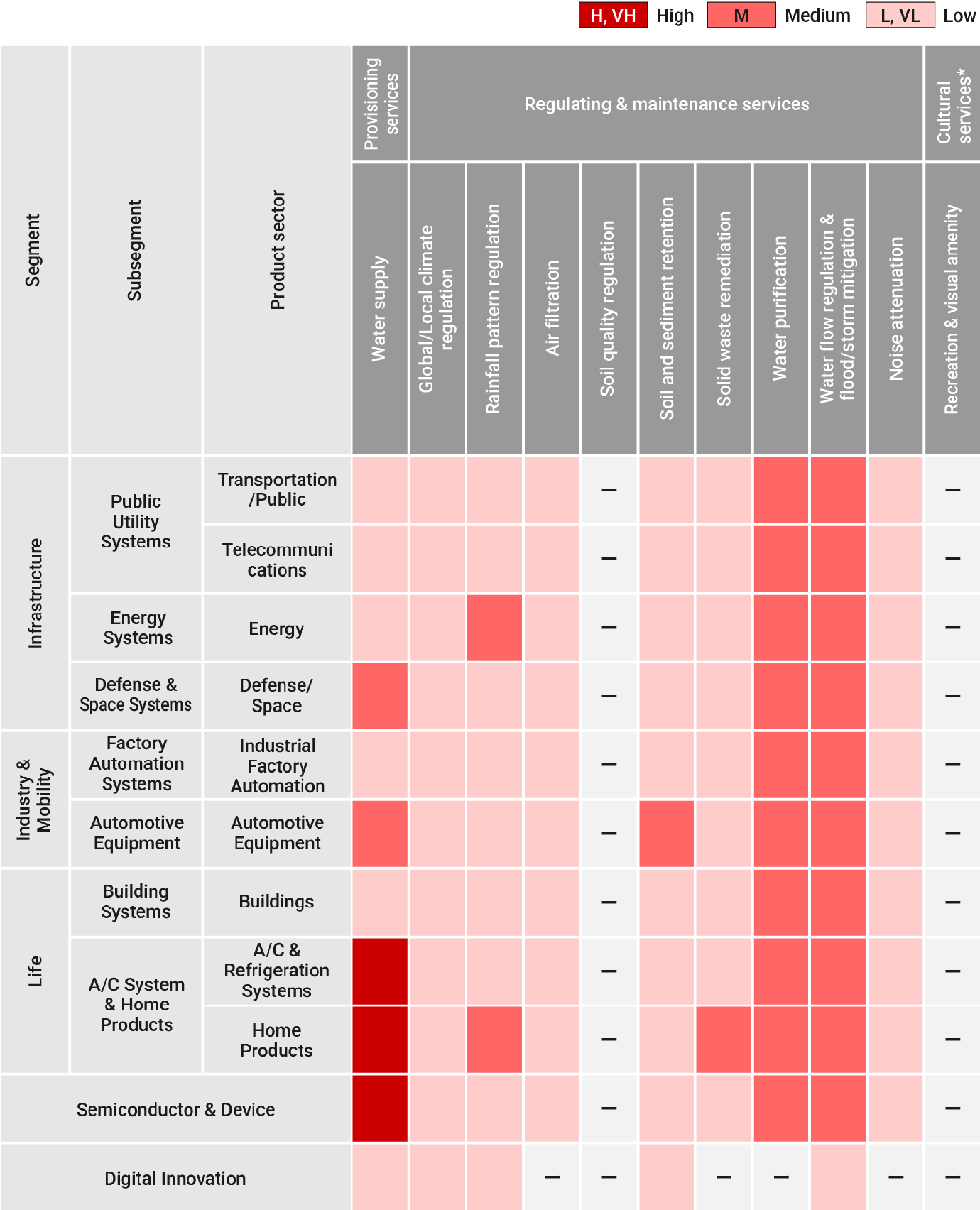
- Services such as recreation and tourism opportunities that humans can receive through contact with nature.
Heat map (impacts)
Results of identification of material dependencies and impacts
Dependencies on nature
- Water resources are used in the manufacturing of all products. Water intake is particularly high for the A/C system & home products and the semiconductor & device segments, suggesting their potential dependency on water resources (water supply).
Impacts on nature
- The A/C system & home products and the semiconductor & device segments can have a significant impact on water usage due to their high water intake.
- The manufacturing of all products can have an impact on greenhouse gas emissions. This impact can be particularly high in the energy systems, automotive equipment, A/C system & home products, and semiconductor & device segments.
- The semiconductor & device segment can have a significant impact on the emissions of toxic pollutants.
Interconnections between dependencies and impacts
- In the Mitsubishi Electric Group's manufacturing processes, we recognize that water intake activities can have impacts on the state of nature and that deterioration of the status of local nature will highly likely make ecosystem services, including water supply, unavailable.
Priority nature-related locations (Locate)
Evaluation overview
Priority location identification process
Priority locations were identified from among the 166 consolidated production sites (as of 2023) of the Mitsubishi Electric Group, based on the location information.
Evaluation items used for the locations of operations were the dependency-related items of ecosystem integrity (general dependency) and water stress (water supply) and the impact-related items of biodiversity importance (general impact), water stress (water usage), and water pollution (emissions of toxic pollutants to water and soil). Evaluation targets varied by business segments and were limited to those related to dependencies and impacts that had been determined to be material in the Evaluate phase. Next, priority locations were identified based on the evaluation results for the locations of operations. With respect to water usage, we followed the methodology of Science-Based Targets (SBTs) for Nature and considered the level of our own pressure on nature (water intake).
The results were evaluated for each evaluation metric with the five-level rating system (VH, H, M, L, VL), while taking into account the situation specific to the Group. The locations rated “H” or “VH” were determined to have the likelihood of creating material environmental risks and thus identified as priority locations.
Evaluation tools and metrics used
| Item | Evaluation tool | Evaluation metrics | Relations with the Evaluate phase |
|---|---|---|---|
| Biodiversity Integrity | WWF Biodiversity Risk Filter v2.0 | Ecosystem condition: It indicates whether the natural environment is intact and connected with scores calculated separately for terrestrial, freshwater, and marine areas. | Dependency |
| Biodiversity importance | IBAT | START (Species Threat Abatement and Restoration for Threat Abatement): The score is a sum of the proportions of habitats of different species, weighted according to the IUCN Red List of Threatened Species. | Impact |
| Water availability | (1) WRI Aqueduct 4.0 (2), (3) WWF Water Risk Filter v2.0 |
Evaluation is based on the maximum value among the scores of the following three metrics, which are included in the tools used in the SBTs for Nature. (1) Baseline Water Stress: The ratio of total water intake to available renewable surface and groundwater supplies. (2) Water Depletion: The ratio of total water consumption to available renewable surface and groundwater supplies. (3) Blue Water Scarcity: The ratio of blue water* footprint to total blue water availability. |
Dependency/Impact |
| Water Pollution | WWF Water Risk Filter v2.0 | Surface Water Quality Index BOD (with corrections made for certain locations based on measured data): The score is calculated based on the Biological Oxygen Demand (BOD) of surface water. | Impact |
- Fresh surface and groundwater, in other words, the water in freshwater lakes, rivers, and aquifers.
Identified priority locations
The results indicate that water supply may become unavailable at a plurality of the locations where the Mitsubishi Electric Group operates and that these sites will likely have impacts on water resources and greenhouse gas emissions. Another finding from the results is that the Group may have impacts on the emissions of toxic pollutants in Japan and China. Although these evaluation results suggest the need for attention in some of the locations where the Mitsubishi Electric Group operates, the Group implements measures and initiatives to address environmental risks to reduce or avoid impacts on nature.
Based on the current evaluation, which covered the Mitsubishi Electric Group’s production sites, we intend to gradually extend the scope of evaluation to the overall value chain, including non-production sites, and analyze the results in detail through local investigations and other activities.
Nature-related risks and opportunities over short, medium, and long term (Assess)
Evaluation overview
During the Assess phase, while considering the findings in the Evaluate and Locate phases, we listed nature-related risks and opportunities along with the qualitative assessment of their materiality, and summarized activities that can contribute to reducing material risks or creating material opportunities. Risks and opportunities were categorized and sorted in accordance with the TNFD’s framework (v1.0), while the same time horizons as used for the TCFD disclosures apply.
Risk pathways
The physical risks we have identified are those related to material dependencies as such risks arise from the degradation of ecosystem services on which the Mitsubishi Electric Group’s business segments depend. The transition risks we have identified are those related to material impacts as such risks arise from social changes intended to avoid or reduce the impacts of the Mitsubishi Electric Group’s business segments on nature.
Opportunity pathways
We have identified opportunities related to material dependencies and impacts arising from the avoidance, reduction, or management of risks relative to the degradation of nature and ecosystem services on which the Mitsubishi Electric Group and society depend. The opportunities we have identified as being created through the strategic transformation of products, services, etc., addressing nature-related issues are those irrespective of material dependencies and impacts as such opportunities arise from activities such as restricting the loss of nature and implementing nature-based solutions.
Nature-related risks and opportunities
The Group’s nature-related risks and opportunities resulting from its business activities were identified and summarized for every dependency/impact rated as “H” or “VH” in the Evaluate phase. We also summarized risks and opportunities arising from initiatives related to business activities that are irrelevant to dependencies/impacts but influence or contribute to nature and/or biodiversity.
This list has been created with reference to the TNFD nature-related risk and opportunity registers (December 2024 version*) published by the TNFD.
Resilience to nature-related risks and opportunities based on scenario analysis (Assess)
Evaluation overview and scenario analysis results
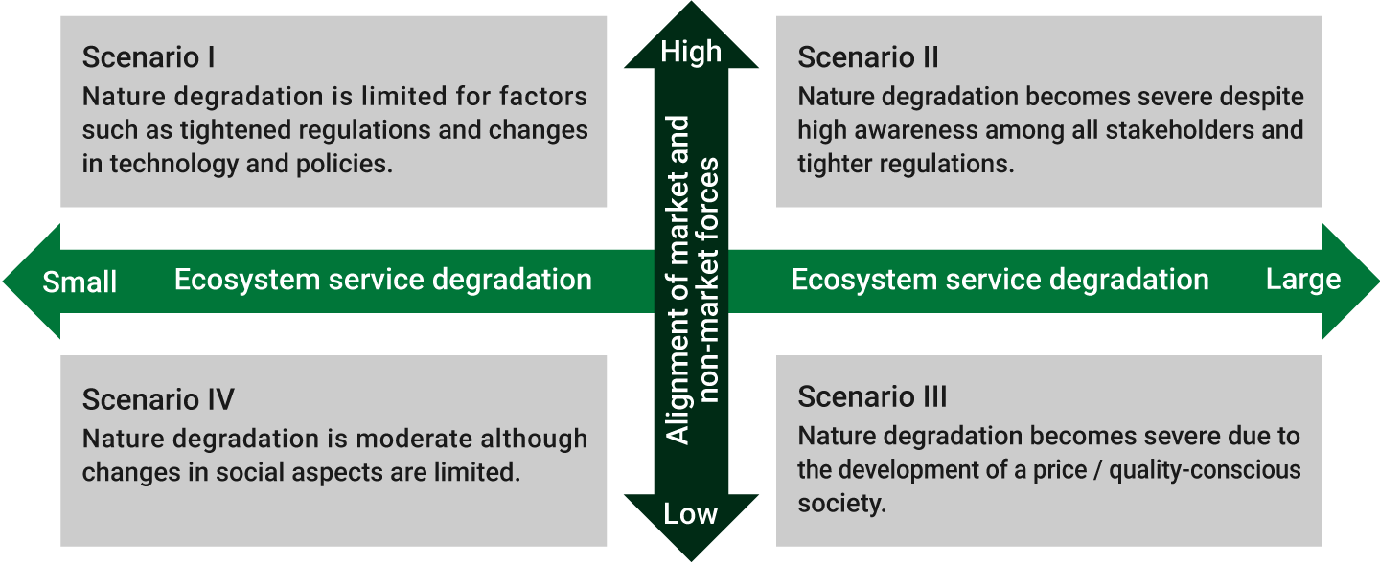
The TNFD’s framework recommends a scenario analysis approach that uses four quadrants for which two critical uncertainties—ecosystem services degradation and the alignment of market and non-market forces—serve as the two axes. Our materiality assessment is based on this approach.
In this scenario category, the horizontal axis represents ecosystem service degradation—the further to the right, the more severe the situation, and the further to the left, the more moderate/restored the situation. The vertical axis represents alignment of market and non-market forces—the higher the position, the stricter the regulations and the higher the awareness among consumers and investors, and the lower the position, the weaker the regulations and the lower the interest among consumers and investors. Each scenario was defined with a PEST analysis, which is commonly used for analyzing the external environment for a company or business, with the E (Environment) factor added to the parameters to be considered.
The figure shows the details of each scenario.
Four-quadrant scenario (Created by the Company with reference to the TNFD’s guidance*)
For each scenario, materiality of nature-related risks and opportunities was assessed based on their likelihood and the magnitude of the effects of the risks. For risk assessment, risks were categorized into two types: (1) risks originating from the locations of operations and (2) risks resulting from global social trends. Likelihood and the magnitude of effects were determined for each of them. For opportunity assessment, opportunities were categorized into two types: (1) opportunities created through risk avoidance, reduction, or management and (2) opportunities created through the strategic transformation of products, services, etc., that addressing nature-related issues. Based on the likelihood and the magnitude of effects determined as a result of these assessments, material risks and opportunities were identified through the comprehensive assessment of materiality.
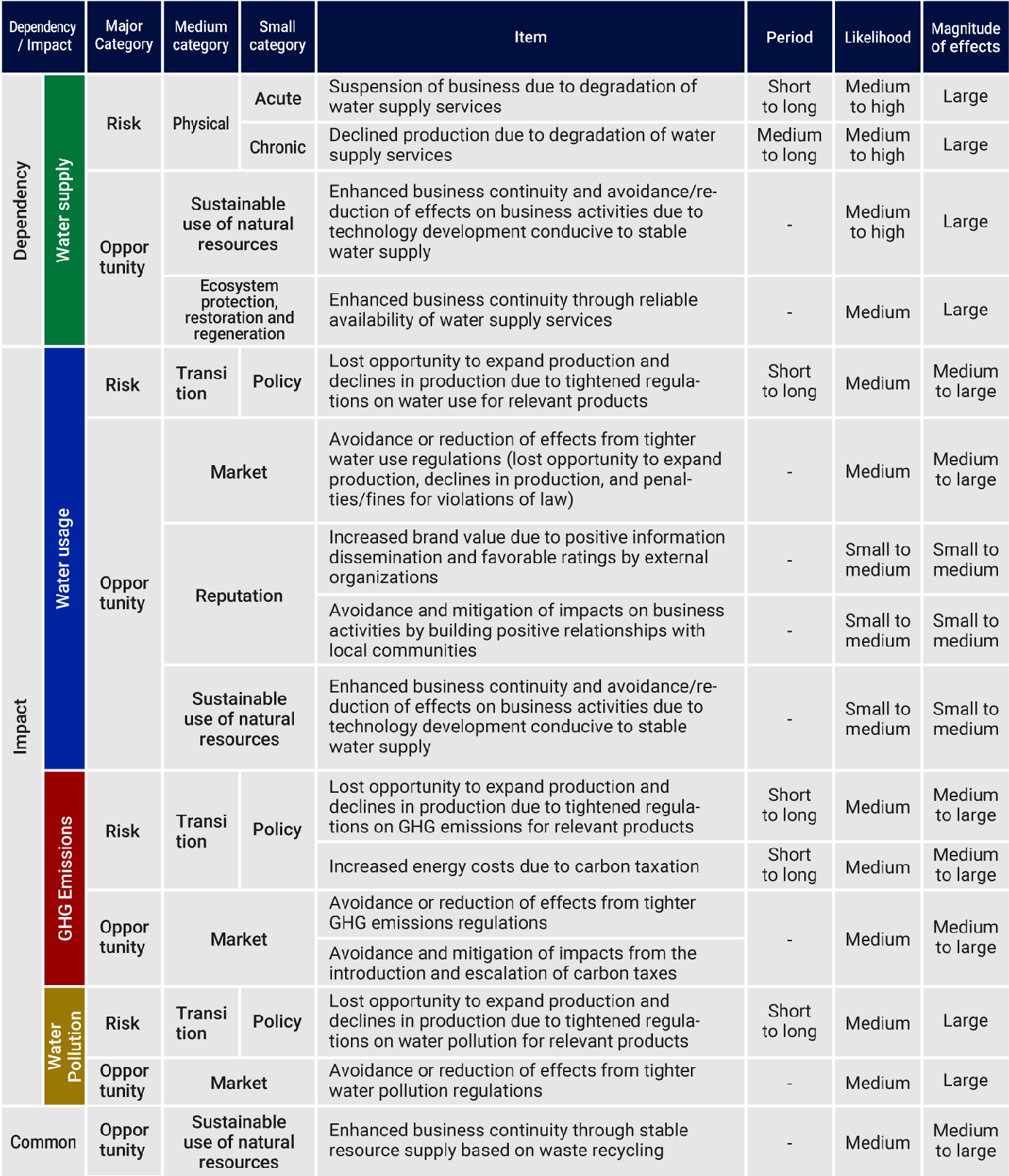
The results show that although the Mitsubishi Electric Group’s businesses are exposed to various nature-related risks, environmental management initiatives, such as biodiversity preservation activities around the Group’s sites, as well as the development of businesses for solving nature-related issues, help the Group acquire opportunities in nature-positive areas. The table shows material risks and opportunities that were identified by factoring in dependencies/impacts and the scenario analysis. The potential risks and opportunities indicated by the scenario analysis results are used as inputs for considering the Mitsubishi Electric Group’s materiality, its next environmental plan and other programs. To address the identified material risks and opportunities, the Mitsubishi Electric Group implements a diverse range of measures at the dependency/impact level.
Please refer to the pages of each measure for details.
Nature-related risks and opportunities
Nature-related measures (Prepare)
Response to dependencies, impacts, risks, and opportunities
The Mitsubishi Electric Group aims to contribute to the sustainable development of society by recognizing/managing negative impacts and risks that can arise from its business activities through evaluation and analysis based on the LEAP approach and existing sustainability management methods and avoiding/reducing these impacts and risks while creating opportunities that can bring positive impacts.
Please refer to the pages of each measure for details.
Metrics and Targets
The table below shows the Mitsubishi Electric Group’s metrics aligned with the TNFD core global disclosure metrics.
| Metric | Driver of nature change | Indicator | Metric and description |
|---|---|---|---|
| TCFD | Climate change | GHG emissions | Greenhouse gas emissions throughout the entire value chain |
| C1.0 | Land/freshwater/ocean-use change | Total spatial footprint | Measurement of the area before and after land-use change |
| C1.1 | Extent of land/freshwater/ocean-use change | Area of the Mitsubishi Electric Group’s Nationally Certified Sustainably Managed Natural Sites | |
| C2.0 | Pollution/pollution removal | Pollutants released to soil split by type | Adherence to the Soil Contamination Countermeasures Act of Japan or equivalent laws |
| C2.1 | Wastewater discharged | Discharges split by destination and treatment conditions | |
| C2.2 | Waste generation and disposal | Amounts of hazardous and non-hazardous waste generated, recycled, and sent to direct landfill | |
| C2.3 | Plastic pollution | Total weight of product packaging materials used (sum of the weights of disposables and returnables) | |
| C2.4 | Non-GHG air pollutants | Emissions of VOC, NOx, and SOx | |
| C3.0 | Resource use/replenishment | Water withdrawal and consumption from areas of water scarcity | Identification of water risks and management of water withdrawal/discharge and intensity split by high-risk sites |
| C3.1 | Quantity of high-risk natural commodities sourced from land/ocean/freshwater | Not applicable | |
| C4.0 | Measures against invasive alien species | Identification and removal/control of invasive alien plants affecting the vegetation at business sites | |
| C5.0 | State of nature | Ecosystem condition | Analysis following the LEAP approach |
| Species extinction risk | |||
| C7.0 | Risk | Value of assets, liabilities, revenue, and expenses that are assessed as vulnerable to nature-related transition risks (total and proportion of total). | Under calculation |
| C7.1 | Value of assets, liabilities, revenue and expenses that are assessed as vulnerable to nature-related physical risks (total and proportion of total). | ||
| C7.2 | Description and value of significant fines/penalties received/litigation action in the year due to negative nature-related impacts. | Not applicable | |
| C7.3 | Opportunity | Amount of capital expenditure, financing, or investment deployed toward nature-related opportunities, by type of opportunity, with reference to a government or regulator green investment taxonomy or third-party industry or NGO taxonomy, where relevant. | Under calculation |
| C7.4 | Increase and proportion of revenue from products and services producing demonstrable positive impacts on nature with a description of impacts. |