


Environmental Sustainability Vision 2050
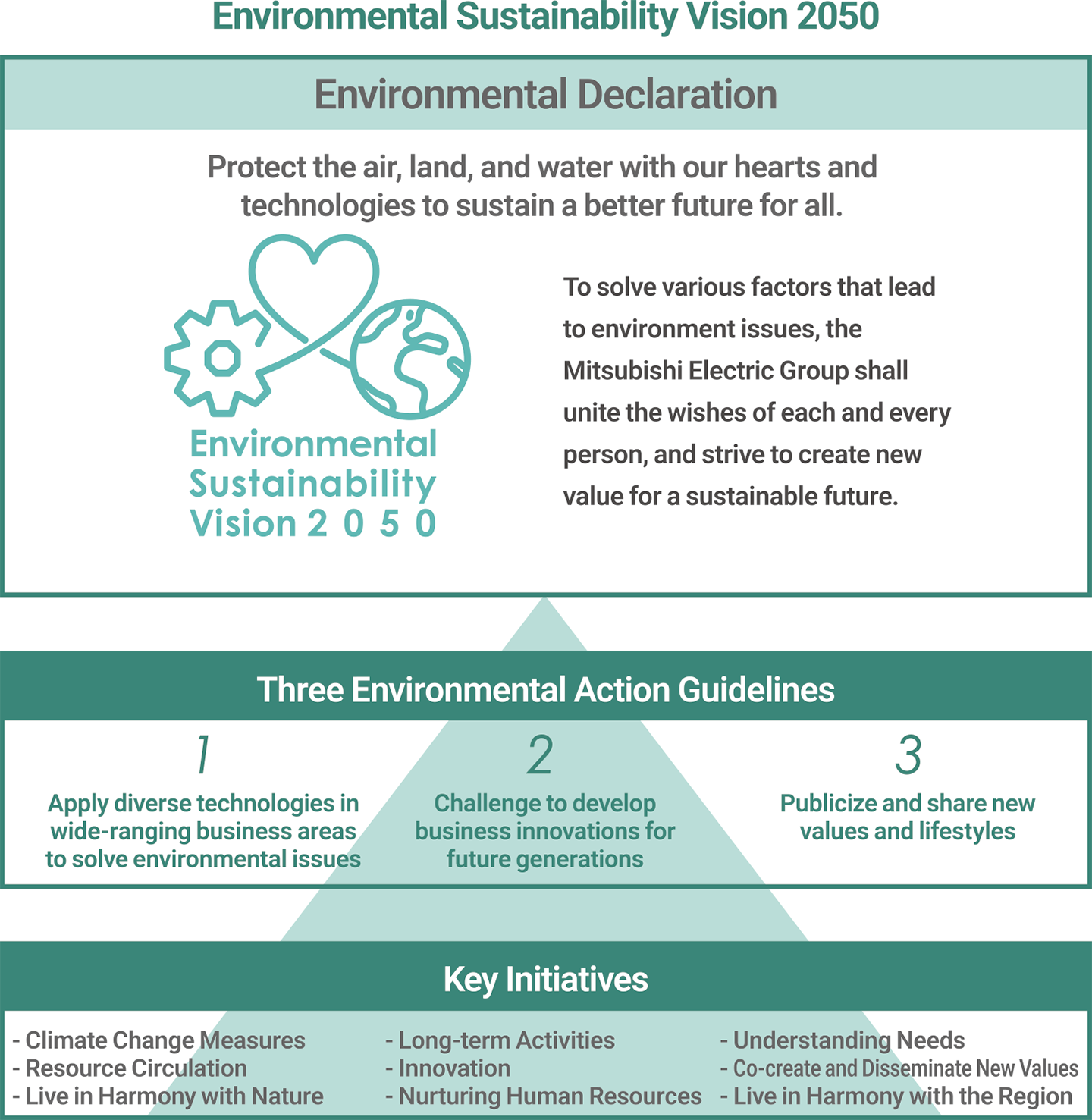
The Mitsubishi Electric Group has announced that in response to the worsening of global environmental challenges, the Company has revised its Environmental Sustainability Vision 2050, first introduced in 2019. Going forward, the Mitsubishi Electric Group will steadily implement various environmental initiatives to achieve its new targets and contribute to a more sustainable global environment, one of its materiality.
Environmental Plan
Every few years, the Mitsubishi Electric Group formulates a new Environmental Plan comprising medium-term targets and initiatives aimed at supporting the realization of its Environmental Sustainability Vision 2050. The Environmental Plan 2030 (April 2026–March 2031) follows the Environmental Plan 2025 (April 2024–March 2026). One of its new targets is achieving carbon neutrality*1 at Group factories and offices by the fiscal year ending March 31, 2031. This goal is part of the pursuit of carbon neutrality, one of three focus areas established in the Environmental Vision 2050. The plan also establishes targets for improving resource circulation to contribute to a circular economy and for protecting biodiversity at business sites to support a nature-positive*2 world.
- 1 Including carbon offsets
- 2 Besides reducing environmental damage, also enhancing biodiversity, improving ecosystem health, and supporting the sustainable use of natural resources
Environmental Plan 2030 (FY2027–FY2031)
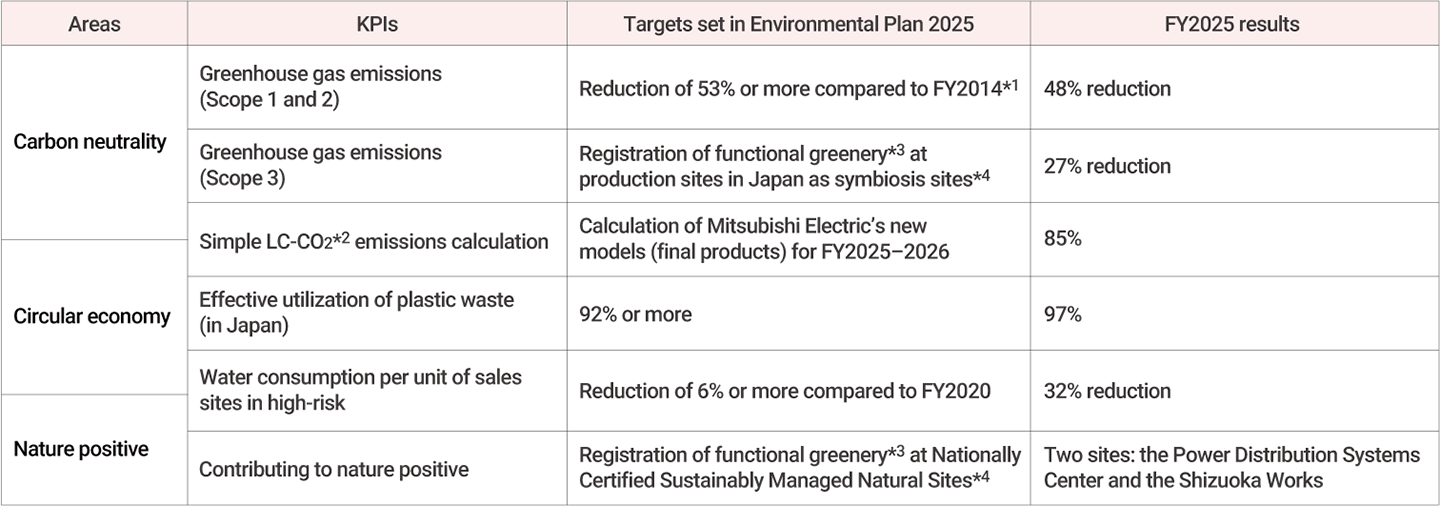
Under the Environmental Plan 2030, the Group is actively engaged in a range of initiatives aimed at achieving its stated targets. Key performance indicators and targets are presented in the table below.
Note: Refers to the fiscal year ending March 31 of that year.
- 1 Direct emissions from the use of own fuel
- 2 Indirect emissions from the use of electricity and heat purchased from outside the Company
- 3 Indirect emissions from the entire value chain, excluding Scope 1 and 2
- 4 Total weight of reused products and recycled plastic used in Mitsubishi Electric Group products
- 5 Only manufacturing-related waste generated at factories is included. (General waste is excluded.) The percentage of generated waste that is reused through material recycling, chemical recycling, and thermal recovery.
- 6 It applies only when local regulations and conditions regarding plastic waste, as well as local recycling capacity, are met.
- 7 Nationally Certified Sustainably Managed Natural Sites (the Ministry of the Environment)
- 8 OECM: Other Effective area-based Conservation Measures
- 9 Satoyama Woodland Preservation Project, Mitsubishi Electric Outdoor Classrooms
Environmental Plan 2025 (FY2025–FY2026)
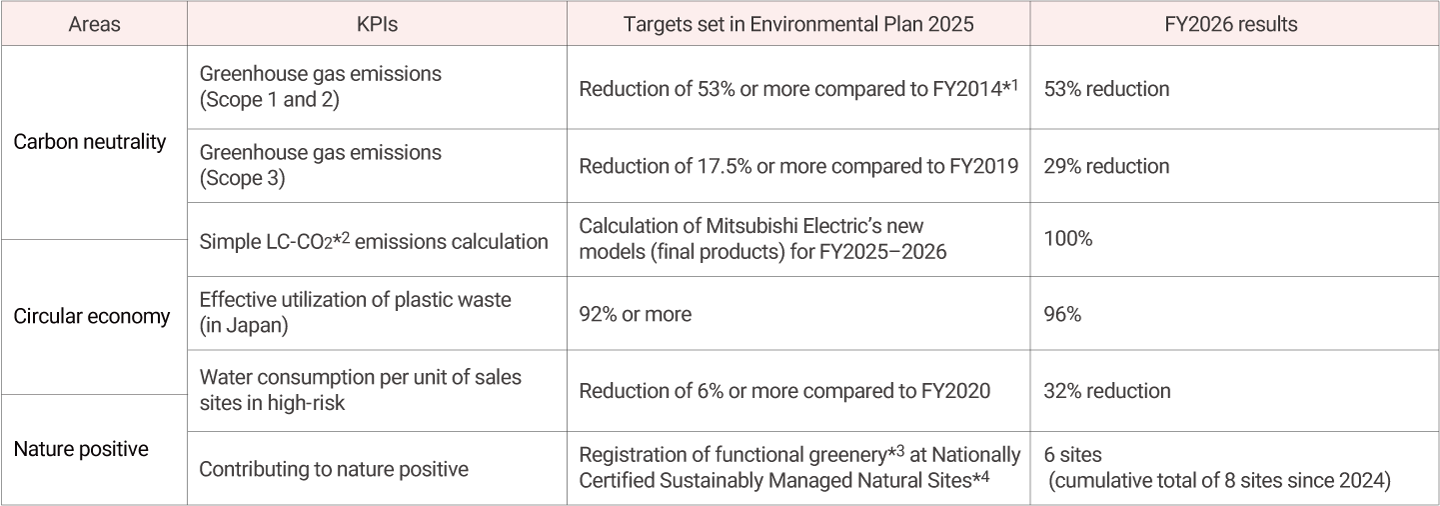
Under the Environmental Plan 2025, the Group is actively engaged in a range of initiatives aimed at meeting its stated targets. Key performance indicators, targets, and fiscal 2026 results are presented in the table below.
Note: Refers to the fiscal year ended March 31 of that year.
- 1 Calculation including carbon offset
- 2 Life Cycle CO₂: All CO₂ emissions throughout the entire life cycle of products and services
- 3 Functional greenery at Mitsubishi Electric (in Japanese)
- 4 Nationally Certified Sustainably Managed Natural Sites (the Ministry of the Environment)