


Human Assets and Culture Transformation
Mitsubishi Electric’s Approach to Culture Transformation
In response to a series of improper quality control practices that have come to light since June 2021, the Mitsubishi Electric Group has been promoting reforms in the three areas of quality assurance, organizational culture, and governance, as part of its measures to prevent recurrence. With regard to organizational culture reforms, we launched the Company-Wide Transformation Project in October 2021 as an organization under the direct control of the president, and have been working on communication reforms and other measures across the Group.
From 2025, under our philosophy of "building a strong culture that serves as a source of competitiveness, based on the good corporate culture we have cultivated," we established the Corporate Culture Transformation Division as a permanent organization. Based on the Mitsubishi Electric Group's Our Philosophy, this office works to foster a sound and high-quality organizational climate centered on “integrity,” and a strong organizational culture centered on “challenge” and “co-creation.” Through these initiatives, we aim to realize a culture in which each and every employee continues to proactively drive the transformation into an Innovative Company.
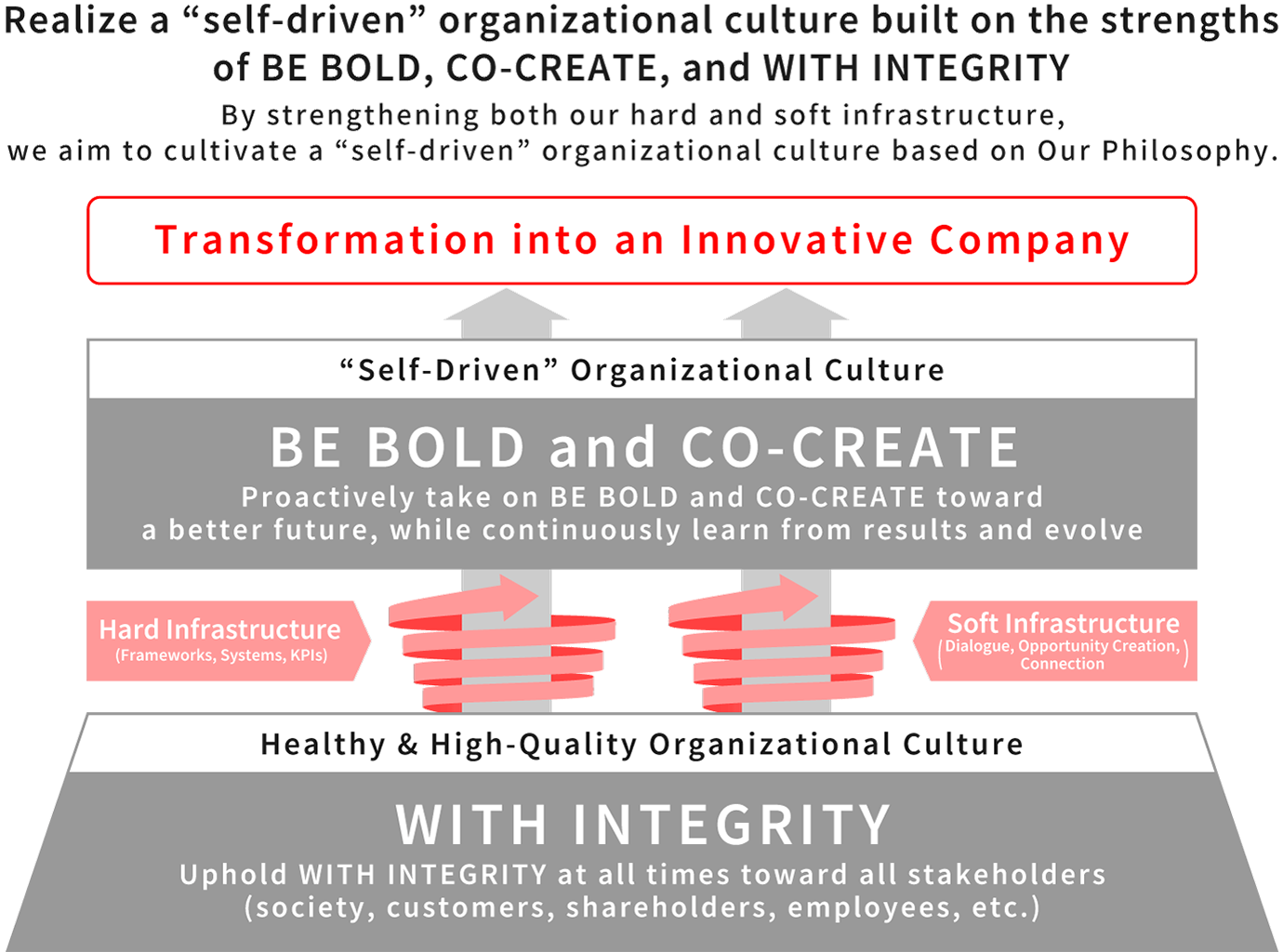
Initiatives to Foster an Organizational Culture with Challenge and Co-creation as Strengths
At Mitsubishi Electric, employee engagement has been set as a key KPI to measure the degree to which organizational culture has taken root, and is monitored on an ongoing basis.
As a result of ongoing efforts to transform our culture, our employee engagement score in fiscal 2026 improved from the previous survey, with a favorable response rate of 62%. We remain committed to further improving the scores by continuously implementing the following measures: increasing opportunities for dialogue between management and employees; developing measures to prompt communication between supervisors and their team members in the workplace (e.g., one-on-one meetings); strengthening measures to support the formation and development of employees' career paths; and carrying out robust implementation measures with a resolve to reform the culture, such as revision of the personnel system.
| KPI | FY2022 (Result) |
FY2023 (Result) |
FY2024 (Result) |
FY2025 (Result) |
FY2026 (Result) |
FY2031 (Target) |
|---|---|---|---|---|---|---|
| Employee engagement score (percentage of employees who are proud and motivated to work for the Company)* |
54% | 54% | 55% | 60% | 62% | 70% |
- Average percentage of positive responses to the five questions in the employee engagement survey, conducted annually: “Pride in working for the Company,” “Willingness to contribute,” “Desire to change jobs,” “Encouraging others to join the Company,” and “Sense of achievement through work”
Promoting "Challenge" and "Co-creation" through the Personnel Evaluation System
We introduced a personnel evaluation system in fiscal 2025 to evaluate "challenge" and "co-creation," with the aim of realizing an organizational culture in which employees can proactively embody these qualities. Taking "change, connect, and support" as the behavioral evaluation axes, the system facilitates dialogue between supervisors and their team members regarding “challenge” and “co-creation” for the current fiscal year.
Supporting “Challenge” and “Co-Creation” through One-on-One Meetings
We are also promoting one-on-one meetings as a way for supervisors to encourage and support "challenge" and "co-creation" among their team members. As of fiscal 2026, more than 4,000 managers have undergone one-on-one meeting training. Going forward, we will continue our efforts to further foster and establish our organizational culture.
Initiatives to Foster an Organizational Climate of Integrity
The Mitsubishi Electric Group conducts an annual Employee Engagement Survey to monitor its organizational climate.
In addition to employee engagement, the survey includes questions to measure the degree to which organizational climate and organizational culture have taken root, enabling us to drive data-based culture transformation.
Workplace-Led Improvement Activities
At Mitsubishi Electric, the results of employee engagement surveys are shared at the workplace level, and managers and employees work together on improvement activities for their respective workplaces. Guided by the concept of "improving our own workplace by ourselves," each workplace independently identifies and addresses its improvement themes based on the strengths and weaknesses of its own organization as revealed by the data.
By engaging in improvement activities with "ourselves" as the subject, employees develop a sense of ownership, creating a state of ongoing improvements and helping to foster an organizational climate of integrity.
Creating Workplaces with High Psychological Safety
The Mitsubishi Electric Group considers the realization of workplaces with high psychological safety, where the individuality of each employee is respected and can be fully expressed, to be a key element of an integrity-based organizational climate.
The ideal for human relationships that the Mitsubishi Electric Group is aiming for is a state in which “anyone is welcome to speak out at any time to anyone about organizational policy regardless of differences in skills and opinions and without being worried about damaging relationships or failure.” We promote initiatives to enhance psychological safety, aiming to build strong and positive relationships where employees feel free to speak their minds—even when it involves healthy conflict.
To increase psychological safety at Mitsubishi Electric, we have established the Psychological Safety Guidelines, which we have made available to all employees. The content of the Guidelines includes “Tips for Increasing Psychological Safety (For Team Leaders and Team Members)” and “Case Studies,” which can be put to practical use in individual organizations. We have also added a question on psychological safety to the employee engagement survey we conduct each year and introduced a monitoring mechanism. By implementing PDCA cycles, we will create an inclusive environment with a high level of psychological safety where everyone can enjoy positive, strong human relationships.
Create a Work Environment Where All Employees Can Work Actively with a Sense of Security
Work-Style Reforms and Detailed Management of Working Hours
Mitsubishi Electric made “Work-Style Reforms” an important management policy in fiscal 2017, seeking to build a workplace environment in which everyone can maintain physical and mental health and thrive with a good work-life balance. Ever since, we have pursued a variety of measures to contribute to the improvement of operational efficiency and productivity, as well as to reduce total working hours. Building on these efforts, we no longer position Work-Style Reforms as special initiatives, but regard them as a foundational pillar of our business management. We are accelerating a broad range of activities—including the proactive use of digital transformation (DX) and generative AI, top-led streamlining of operations, and the development of self-driven initiatives that enable each organization to solve issues independently.
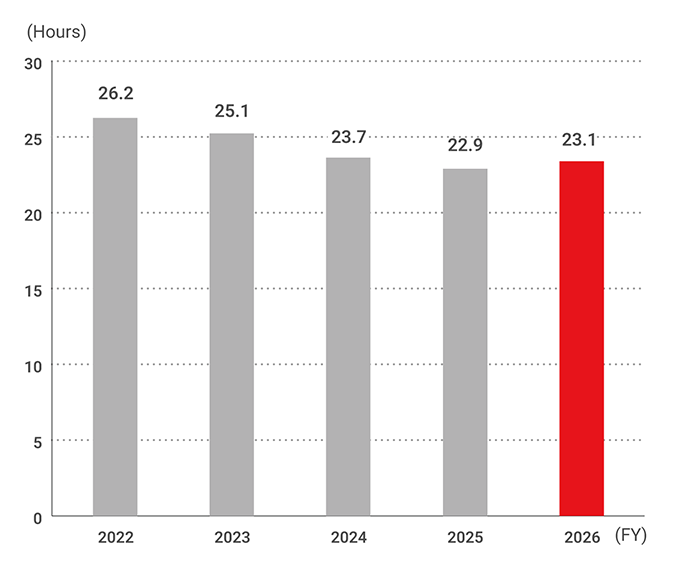
Changes in monthly overtime hours per employee (including managers)
While further reducing long working hours with the efforts outlined above, we are also implementing detailed management of working hours using objective data such as entry and exit times and PC logon and logoff times. This helps us to secure and retain varied and versatile human capital (strengthen recruitment competitiveness and retention), increase well-being, promote health and productivity management, and encourage autonomous career development. It also helps ensure that each individual employee continues to experience a positive work-life balance at a high level. We believe that these efforts have yielded results to some extent. Specifically, in fiscal 2026, we reduced monthly overtime hours per employee to 23.1 hours.
Support for Flexible Working Styles
Development and implementation of childcare and family-care programs
Mitsubishi Electric is making every effort to fully establish a work-life balance support system that more than satisfies the legal requirements, and to develop workplace conditions that allow employees to comfortably do their jobs and raise children or care for elderly family members. Our childcare leave system is available until March following the child’s first birthday (extendable until the end of March following the child’s second birthday in special circumstances). The reduced working hours program for childcare is available until the end of March of the child’s final year in elementary school (or, for employees raising children with disabilities or children requiring medical care, until the end of March following the child's 18th birthday). Our nursing care leave program is available for up to two years for each eligible family member. Our reduced working hours program for nursing care is available for as long as necessary, with no upper time limit. In addition, we have a childbirth support leave system for employees who wish to undergo fertility treatment to support the development of the next generation. There is also a program to provide the spouse with special paid leave (self-support leave) to use in certain circumstances such as to participate in a child’s school event, a remote work program (work from home), as well as a re-employment system for employees who have temporarily left the company to provide childcare and family care. Recognizing the high latent demand for balancing work and caregiving responsibilities, we launched new initiatives in fiscal 2024, including hosting seminars to support employees managing both family care and work and establishing consultation services for family care.
To raise employee awareness of these initiatives, we actively disseminate relevant information through a portal site, which features a range of information on work-life balance, such as a list of support systems for employees raising children, and interviews with working parents. We make this information available to employees, managers, and new hires, aiming to create an environment that is conducive to using these support systems. Along with enhancing our programs, we will work to foster a workplace culture in which employees can enrich their personal lives while advancing their careers.
Work-Childcare Balance Handbook for Supervisors and Their Team Members
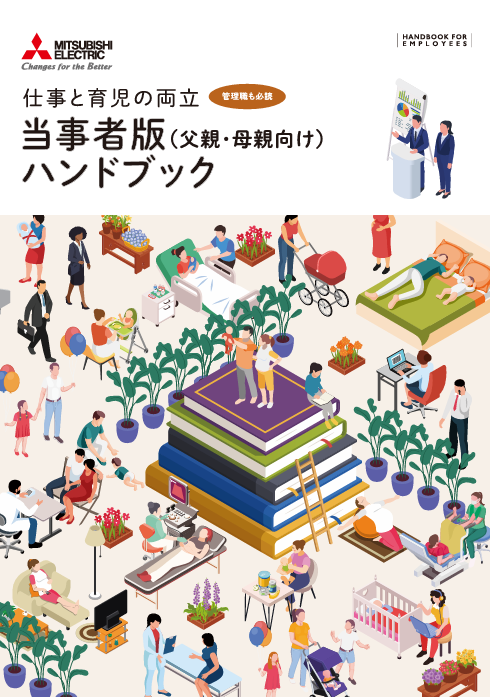
Work-Childcare Balance Handbook for Supervisors and Their Team Members
To help employees on childcare leave smoothly return to work and continue to perform at their best while raising children, we distribute a handbook to both employees and their supervisors, and have formalized a rule requiring regular supervisor interviews both before and after the employee’s return.
In fiscal 2027, recognizing that support for balancing work with childcare is essential to maximizing organizational performance and achieving sustainable growth, we have revised the handbook. The aim was to reduce employees’ concerns regarding the work-childcare balance and to foster a culture in which each employee can remain aware of their role and contribution to value creation, even under constraints of time and working arrangements, while prioritizing both life events and career development equally.
Work-Family Care Balance Support: Seminars and Consultation Services
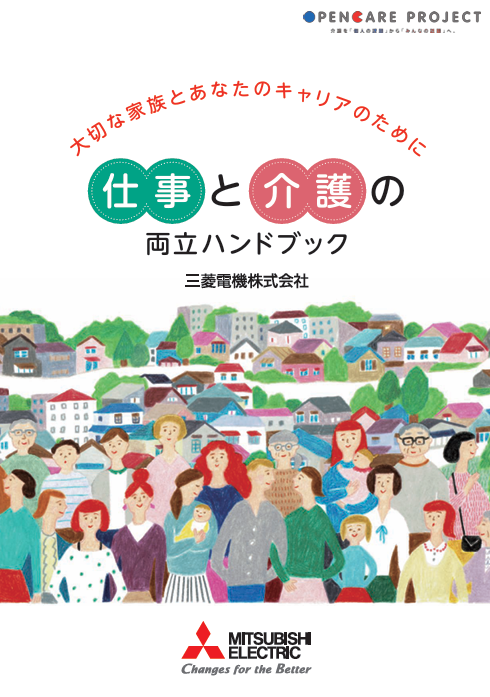
Work-Family Care Balance Support: Seminars and Consultation Services
In view of the declining working-age population due to the falling birthrate and aging society, nursing care is an issue that can impact anyone regardless of gender or age. We therefore regard support for balancing work and nursing care as one of our key management priorities, on a par with childcare support. We also believe that proactive measures to prevent employees from leaving the workforce due to nursing care responsibilities should be implemented before they are even faced with such a situation. To enable employees with caregiving responsibilities to balance work and nursing care with peace of mind, we implement a variety of support initiatives under the concept of the Ministry of Economy, Trade and Industry’s "Open Care Project: Turning Caregiving from a Personal Issue into a Shared Conversation." The aim is to share basic knowledge and information about caregiving with employees, including younger employees in their 20s and 30s, to help them prepare for caregiving needs regardless of their generation or role. In addition to setting up an external consultation desk for employees to consult with care managers on various nursing care concerns, such as initial care and long-term care insurance services, we also held a caregiving support seminar in fiscal 2026 featuring an external lecturer, in which approximately 750 employees participated. In fiscal 2027, we have also revised our Work-Family Care Balance Guidebook to ensure that information on balancing work and nursing care reaches even more employees. This handbook explains family care in four phases: preparation phase, initial action phase, balancing phase, and end-of-life care phase, and is designed to be widely used as an aid for employees both before and after they face family care responsibilities.
Status of development of main childcare and nursing care systems
| The remote work program | Implemented for all employees with the aim of greater flexibility in working styles. |
|---|---|
| The Company-led nursery school matching service | A match-making service between employees looking for a nursery school and Company-led nursery schools with openings to accept children. |
| Babysitting coupons | Partial subsidization of babysitter costs of in-home childcare or transportation to/from childcare facilities up to third grade of elementary school (or up to sixth grade of elementary school for children requiring nursing care due to a disability, etc.) based on the Corporate-Led Babysitter User Support Program. |
The remote location work program |
A program that allows employees to live outside the commuting area of their offices and engage mainly in remote working. |
| Increased the number of days of leave to prepare for impending childbirth by employee’s spouse | Period of leave that can be taken for infertility treatment extended from 12 months to 30 months. |
| Extension of the career support leave system for accompanying a spouse on an overseas transfer | Period of career support leave that can be taken to accompany a spouse on an overseas transfer extended from three to five years. |
Introduction of new paid leave to support work and family care responsibilities, etc. |
We are implementing measures that go beyond legal requirements—paid leave to support work and family care responsibilities for employees raising children below elementary school age, along with initiatives to create a work environment that helps prevent employees from leaving their jobs to care for family members. |
| Support for employees raising children with disabilities or medical needs | Upon request, employees raising children with disabilities or children requiring medical care may be granted reduced overtime hours and exemption from night shifts. In addition, the reduced working hours program for childcare will be available through the end of March following the child’s 18th birthday. |
| Removal of the maximum eligibility period for reduced working hours for nursing care | Maximum eligibility period has been removed since fiscal 2027, enabling employees who work while caring for a family member to work with peace of mind. The system can now be used for the required period without any time limit. |
Special Paid Leave (Self-Support Leave)
The self-support leave is a system that allows employees who do not use up their annual paid vacation time by the end of the fiscal year to accumulate up to 20 days of unused vacation time and carry them over to the next fiscal year and onward.
Those who receive company approval to participate in their children’s school programs, recuperate from an illness, engage in family care, take part in a volunteer activity, pursue career development, etc., may acquire self-support leave.
Remote Location Work Program
Mitsubishi Electric has introduced the remote location work program, which allows employees to live outside the commuting area of their offices and engage mainly in remote working, to realize flexible a work style regardless of employees’ place of work. The program enables personnel to achieve a work style that suits their own lifestyle by eliminating situations of employees living separately from their family members and by letting them engage in childcare or nursing care.
System for Continuing Careers According to Individual Employees’ Circumstances
Mitsubishi Electric has introduced a range of systems that enable employees with childcare or nursing care responsibilities to continue their careers, reflecting evolving home environments and changing perspectives on work, as well as the increasingly varied career needs of employees. One of the systems the Company offers is a Career Support Leave System that enables employees to take administrative leave for self-improvement, volunteer activities, or to accompany their spouse who has been transferred to an overseas site. The program also features a system that excludes employees from transfers that require relocation for up to three years if they have difficulty relocating due to childcare, nursing care, treating illnesses, or other circumstances.
Stable and fulfilling private life
At Mitsubishi Electric, we are enhancing our benefits programs to strengthen the foundation for expanding the value of our people, the driving force behind our sustainable growth. We believe that enhancing employee benefits will lead to a stable and fulfilling foundation for everyday life, an important area of focus for increasing the well-being of employees.
We have introduced a housing support system including dormitories, company housing, a rent subsidy system, and an owner-occupied housing lease system. We have also established a Group employee shareholding union to support asset building. In fiscal 2027, we plan to introduce a financial literacy improvement program to help all employees to think more proactively about their own life and financial plans and make better choices. Furthermore, we have introduced and developed a variety of systems to create an environment in which employees can continue working with peace of mind, including support for cultural and sports club activities through the Employee Friendship Association; provision of a recreation facility exclusively for Group employees; cafeteria plans; and a group insurance system.
Cafeteria Plan
We introduced a cafeteria plan in fiscal 2005 with the aim of respecting the varied values and lifestyles of each individual employee and supporting them to develop autonomously their life and work careers.
In fiscal 2027, we increased the points allocation to the points equivalent to 100,000 yen and expanded the menu of available options to better accommodate individual needs.
To support employees in balancing childcare or nursing care with work, support is given to the value of double the regular number of points for menu items related to subsidies for childcare and nursing care service usage fees.
Housing Support System
From fiscal 2027, the system was fundamentally redesigned from one based on standardized model cases to a simpler and easier-to-understand system that does not depend on marital status or cohabitation with a spouse. Specifically, the maximum rent subsidy for single employees and employees on unaccompanied assignments was raised to the level previously applicable only to married persons. The eligibility period for rent subsidies was also changed to a uniform period starting from the year an employee first entered the workforce, regardless of marital status.