Insights

[MELSEC MX Controller]Rising to the challenge of integration
Published in January 2026

Part 3: Brimming with innovation — making standard components stand out
“Perhaps we have been too single-minded?” Sugiyama wondered.
Realizing that they had been focusing solely on performance, he decided to broaden the perspective. The team knew they had to add unique features to gain an advantage over competitors, given the risk of commoditization associated with using a general-purpose microprocessor. Sugiyama and the project team had put a lot of effort into implementing the new features, but they realized that pursuing this too far could actually have the opposite effect.
Deliberately taking a step back to strengthen future maintenance
When general-purpose microprocessors are used, developers typically rely on open-source software libraries. Combining libraries makes it easy to implement various processes, but these libraries are still off-the-shelf code. Sugiyama’s team had aimed to differentiate their product from those of its competitors by enhancing these libraries in novel ways.
This resulted in significant differences from the original libraries, which could have major implications for future maintenance. For example, if an original library were updated to improve its own functionality or address vulnerabilities, it could become difficult to quickly implement those changes in the modified version, which would be disadvantageous to users. To avoid this issue, the team would have to revert to the original version, abandoning some of the development assets they had already created.
Sugiyama made up his mind. In October 2021, he decided that general-purpose libraries should be used without modification as far as possible, even if this involved rewrites. At this point, when the product release should have been in sight, having to re-do several months’ worth of work was a major blow, and it also meant they needed to find ways to replace the features that they had created through their own modifications. Despite this, Sugiyama believed it was essential in view of future product maintenance.
The team never gave up
Adopting a general-purpose microprocessor was turning out to be the double-edged sword, just as they had feared. Even at this late stage, the issue of how to set their product apart from the competition was still bothering the team, who believed they needed to add something extra to avoid it becoming “just another controller.” Impatience was growing, but they never gave up.
Sugiyama started to explore ways to fully leverage CC-Link IE TSN. Time Sensitive Networking (TSN) provides real-time capabilities to industrial Ethernet, and support for CC-Link IE TSN was included in the requirements for the new controller from the start as a function essential for multi-axis control. The initial goal – synchronous control of multiple axes – could be achieved with CC-Link IE TSN, but with the trend towards multi-axis control of hundreds of axes it could potentially provide new functions to further differentiate Mitsubishi Electric’s product. The team explored the possibilities and came up with the idea of mixing multiple communication cycles.
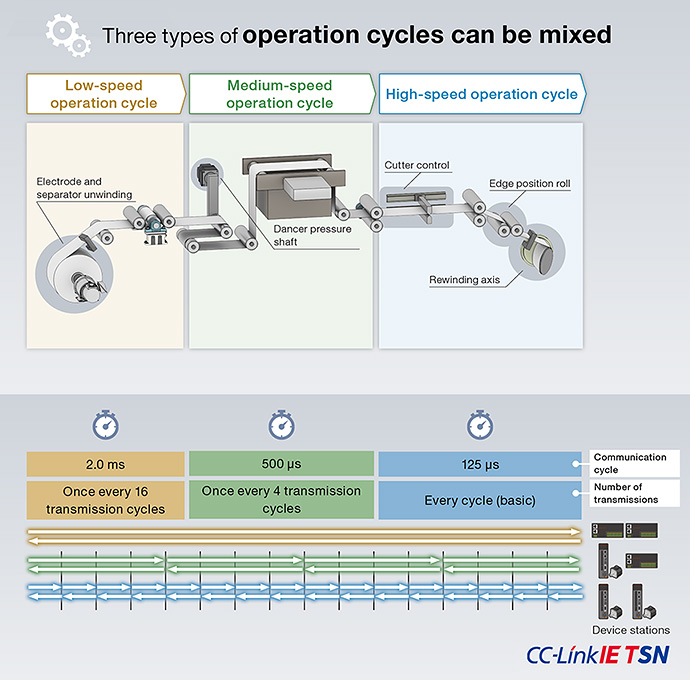
By assigning axes requiring high-precision control to the high-speed cycle group, they will not be affected by large numbers of axes in the low-speed cycle group
Controlling more axes would require an increase in the processing load, so with a single cycle some control tasks might not be performed fast enough. However, slowing down the control cycle would reduce overall system performance, so even if the system provided multi-axis control, it would not provide high performance.
To ensure that multi-axis control does not affect equipment requiring high-precision control, one way would be to divide up the network according to the cycle required, but this is typically impractical as it makes the network more complicated. However, CC-Link IE TSN provides a function to allow multiple cycles to coexist on the same network. Using this function, it could be possible to group tasks with low-speed cycles and high-speed cycles on the same network, achieving both multi-axis control and high performance at once.
No system had been implemented this way before. However, it would certainly be a way to set the product apart from the competition.
“We knew it was possible from the specifications – we just couldn’t find any examples of it being implemented,” says Kusakabe, who was responsible for development of motion control. “Implementing this function would take a huge amount of work, including software construction and changing algorithms.”
The decision to implement this function was made in early 2022. Adding a major new function almost three years after determining the hardware configuration was an unusual decision, to say the least, but the team chose not to give up, even if it meant extending the development time.
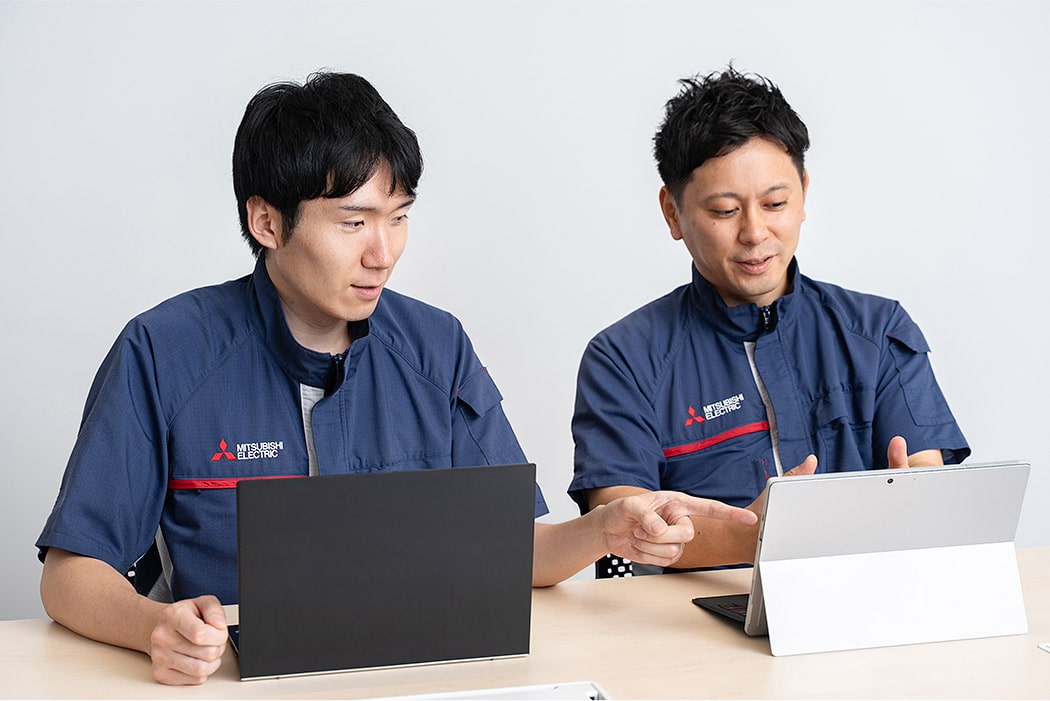
Major new features were added late in the development process, including the ability to use a mix of multiple communication cycles
Re-doing development work to obtain certification
Another feature added late in the development process was the implementation of security measures. The Nagoya Works, where the project team was based, obtained process certification for the international cybersecurity standard IEC 62443-4-1 in mid-2021. This certification confirmed that the development process ensured cybersecurity.

Certificate of compliance: IEC 62443-4-1 (International Cybersecurity Standard)
However, at the time of certification, development of the new controller was already well underway. Because the certificate was issued at a later date, it would not provide proof that the development process of the new controller conformed to the standard. If users were to install the new controller for the purpose of controlling multiple devices and lines, it would need to link to higher-level systems, such as information systems used by management departments. In such cases, the system would not be enclosed within the factory, making security measures vital.
Although the team had been working on the development of security functions from the start, but without certification, it would be difficult to convince users. Additionally, overseas sales offices were also requesting compliance with international standards.
“We’ll just have to start over,” the project team realized. They ended up deciding to re-do the development work that was not covered by the certification. This involved not only rewriting source code but also work at the design documentation level, which inevitably made the development schedule even tighter. Despite this, the team decided to go even further and obtain product-level certification IEC 62443-4-2 as well. At the time, there were no other IEC 62443-4-2 certified FA controllers in Japan. To strengthen the product differentiation, they were determined to be the first.
Users are starting to switch to the new product
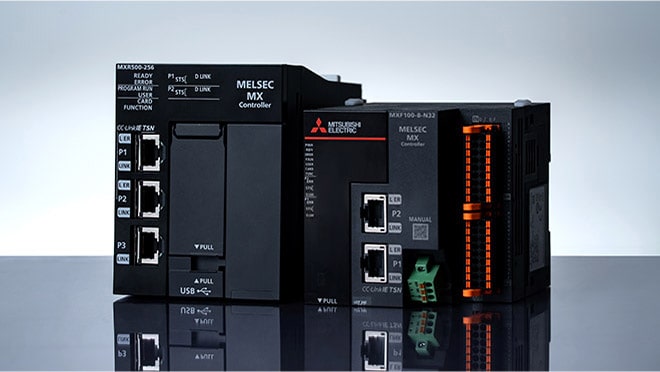
The new series was named the MELSEC MX Controller. The letters MX in the name carry the meaning of “manufacturing transformation,” reflecting the concept of digital transformation (DX). The high-end model was named MX-R, and the mid/low range model MX-F. Development work was reaching the final stages but delays due to the team’s insistence on getting everything just right meant that the target release date in fiscal year 2024 was looking difficult.
Meanwhile, sales representatives like Watanabe and Okabe, who had returned to the Nagoya Works from the overseas subsidiaries where they had been working, kept urging the development team to hurry. Calls to supply the new controller were mounting every day, from sales departments both in Japan and other countries. In China in particular, new markets were emerging. For example, there were production facilities not only for lithium-ion batteries but also for hygiene products, tire molding machines and more. Additionally, competitors were beginning to develop their own new products aimed at these markets. Watanabe and Okabe understood the development team’s commitment, but they wanted to get the product to market quickly.
To release the product as quickly as possible, the project team decided to provide samples to certain users. They could have the samples ready by the end of March 2024, on the condition that these would only be pre-release samples, not the finished product. This was a risk not only to the users, but also to Mitsubishi Electric in supplying the products. To mitigate this risk, the development and sales teams worked together to provide a robust support system in case of any problems.
Taking the risk of providing pre-release samples proved to be a successful move. “Users initially introduce new products on test machines,” explains Watanabe. “They welcomed the early release of samples as it gave them more time for testing.” As a result, users have started to switch over from competitors’ controllers.
What’s more, as Okabe notes: “MX-F is more cost-effective than iQ-F for motion control, so it appeals to users who prioritize cost.”
Starting from the decision to adopt a general-purpose microprocessor, the development process of the MX next-generation controller was unconventional from start to finish. More than 100 engineers were involved at Mitsubishi Electric alone, making the scale of the project – including the amount of code written – among the largest ever undertaken. Despite the challenges, the difficult path was overcome and eventually paid off, as the MX Controller was launched successfully.
“I learnt the best way of sharing information across departments, like how to write specifications to provide to other departments,” remarks Kusakabe.
“I have formed new connections with engineers that I didn’t know before by working on tough challenges together,” reflects Soki.
By integrating sequence control, motion control and more, the MX Controller has not only resulted in a product with integrated hardware and performance, but has also brought together the people involved in each aspect, expanding future possibilities for the Nagoya Works.
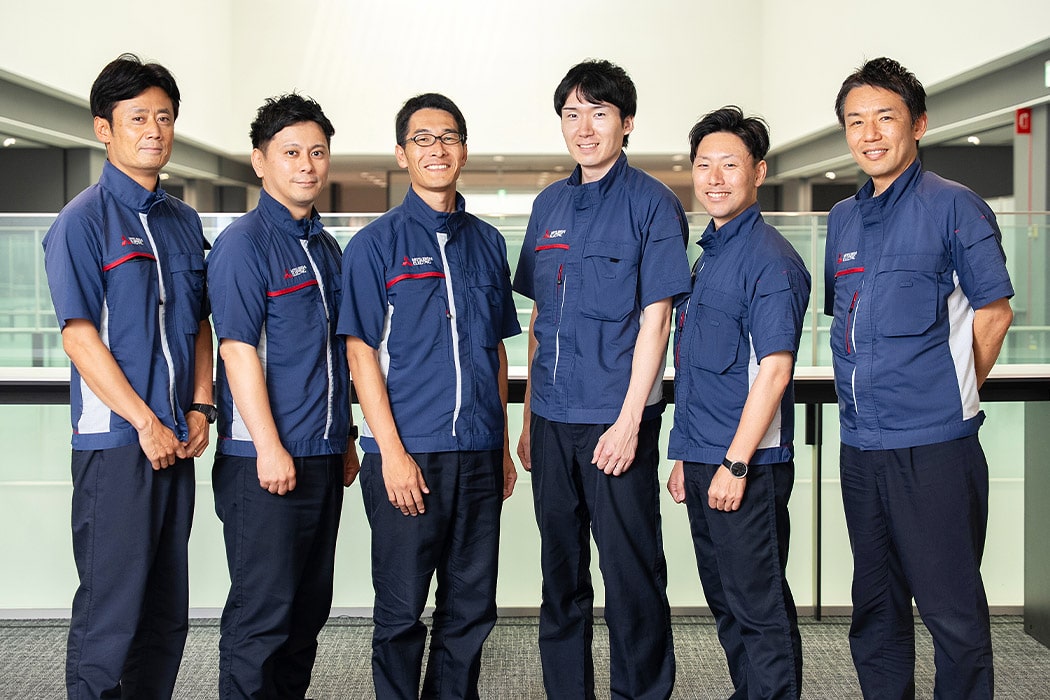
Development project member. From left to right: Shintaro Watanabe, Daiki Harada, Yoshihiro Sugiyama, Shingo Kusakabe, Hiroki Soki, Akira Okabe
Products and Solutions