


News
Note that the releases are accurate at the time of publication but may be subject to change without notice. This page shows only the most recent items. For the full archive of press releases please click "Search by category or year."
Mitsubishi Electric and Finland’s VTT Establish Core Technology for Direct Ocean Capture
 PDF Version (PDF:746.5 KB)
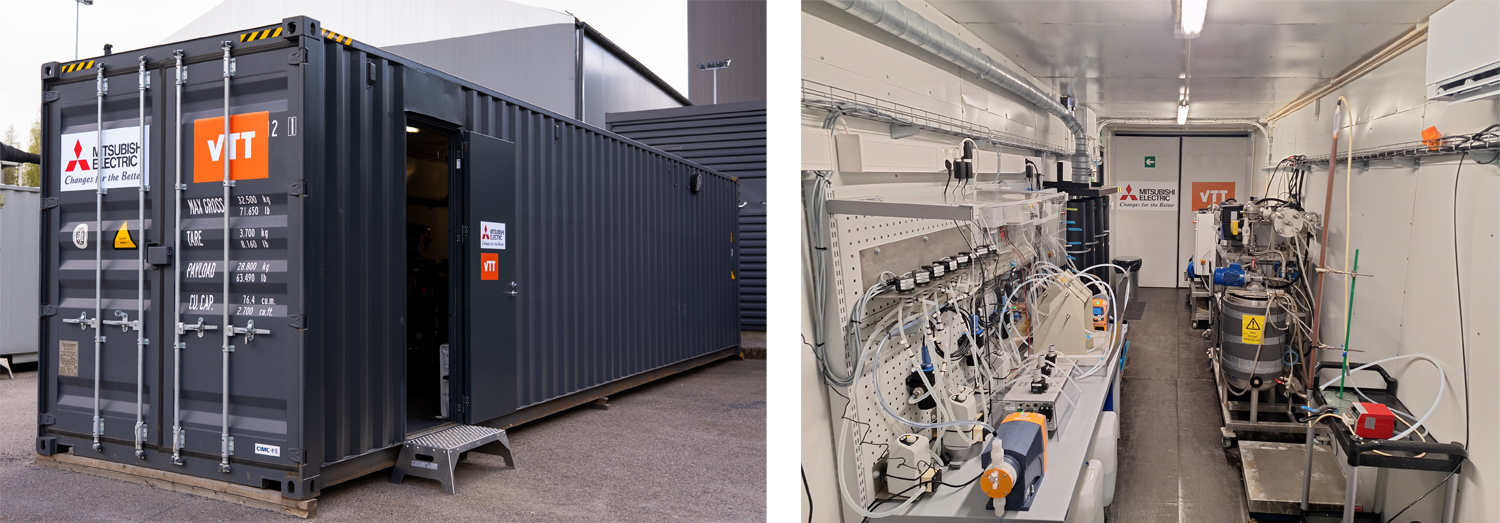
Lab-scale pilot facility for DOC
TOKYO, June 9, 2026 – Mitsubishi Electric Corporation (TOKYO: 6503) today announced that it has completed the core development of a direct ocean capture (DOC) system that removes CO2 via seawater, working in collaboration with VTT Technical Research Centre of Finland Ltd., headquartered in Espoo, Finland and headed by CEO Kalle Härkki. Supported by verified system performance and accumulated experimental data, Mitsubishi Electric and VTT are accelerating their efforts toward early deployment and are actively seeking partners to advance the technology’s demonstration and commercialization.
Mitsubishi Electric places sustainability at the cornerstone of its management. The company is advancing comprehensive initiatives that extend beyond the boundaries of its existing business domains and organizational structures. These initiatives are aimed at creating synergistic value streams that drive growth while contributing to society and environmental stewardship (“Trade-On” activities). Within this framework, Mitsubishi Electric is pursuing the establishment of DOC as a key technology to support carbon neutrality and nature-positive1 outcomes.
DOC is one of the marine carbon dioxide removal (CDR) technologies that leverages the mechanism by which the ocean absorbs CO2 due to differences in concentration between the atmosphere and ocean. By capturing dissolved inorganic carbon2 from seawater and lowering CO2 concentrations in seawater, DOC promotes the uptake of CO2 from the atmosphere into the ocean, thereby ultimately removing CO2 from the atmosphere. Since CO2 concentrations in seawater are approximately 140 times higher than those in the atmosphere (per unit volume),3 DOC is expected as a highly efficient and scalable approach for carbon removal and recovery.
Mitsubishi Electric and VTT have adopted an acidification-based approach (acid-DOC) for the electrochemical DOC process. In this method, hydrogen ions are introduced into intake seawater to temporarily increase4 its acidity, allowing dissolved CO2 in gaseous form for capture. Unlike basification approaches (base-DOC), which recover carbon as solid mineral carbonates, acid-DOC enables not only carbon dioxide capture and storage (CCS) but also supports carbon dioxide capture and utilization (CCU) applications, including synthetic fuels and industrial feedstocks.
In parallel, Mitsubishi Electric and VTT are developing technologies to extract and recover valuable resources5 from seawater during the process of CO2 recovery. By advancing the development of a value chain for the recovered resources, they aim to create additional value streams and strengthen the overall business profitability.
To accelerate deployment, the focus has been to develop system configurations that can be seamlessly integrated with existing large-scale seawater infrastructure, such as seawater desalination facilities and power plants. This integration strategy reduces capital expenditure while enabling scalable and efficient implementation.
Going forward, Mitsubishi Electric and VTT will validate technology in the field through a coastal demonstration system and expand the collaboration with new partner organizations to accelerate commercialization of the developed technologies.
DSc (Tech) Antti Arasto, Vice President of VTT and Project Leader of this collaboration, said, “This is exactly the type of long-term, high-impact challenge that can translate research into real-world breakthroughs. Through strong commitment and focused development efforts, we have achieved significant technological progress in a short time. Our collaboration with Mitsubishi Electric has now advanced DOC to a stage where further technology validation can be pursued, supporting future scale-up and field implementation activities.”
Seiji Oguro, Executive Officer, Vice President, Sustainability Innovation Group, Mitsubishi Electric, said, “This achievement represents a significant milestone toward the real-world deployment of a promising new solution. This success was made possible by our shared commitment with VTT to rapidly commercialize innovative technologies that can contribute to solving the climate crisis, and by the decisive pace that drove our collaboration. Moving forward, we will further strengthen our strategic partnership and welcome new collaboration partners to accelerate our commercialization initiatives. In doing so, we are committed to realizing ‘Trade-On (mutual benefit)’ business to address societal challenges and drive sustainable business growth.”
- 1
Contributions by not only reducing environmental damage, but also enhancing biodiversity, improving ecosystem health, and supporting the sustainable use of natural resources.
- 2
Dissolved inorganic carbon (DIC) is the total amount of inorganic carbon species, such as dissolved CO2, carbonic acid, bicarbonate ions, and carbonate ions, dissolved in water.
- 3
According to Mitsubishi Electric’s research.
- 4
After CO2 capture, the water is neutralized and treated to ensure it has a low environmental impact before being returned to the ocean.
- 5
Substances that have economic value and can be traded or circulated as resources.
Inquiry
-
Customer Inquiries
GIST Project Team
Sustainability Business Development Division
Sustainability Innovation Group
Mitsubishi Electric Corporation